
Key Takeaways
- VTOL unmanned helicopters enable point-to-point logistics in contested terrain without runways, reducing supply chain vulnerability.
- MIL-STD-810H compliance and IP68 ruggedization ensure survivability in extreme temperatures, sand, and shock.
- Advanced SWaP-C optimization allows payloads up to 150 kg with 8+ hours endurance, suitable for medevac, ammo resupply, and sensor delivery.
- Seamless integration with tactical C2 networks enables autonomous waypoint navigation and real-time cargo status tracking.
- System integrators should prioritize open architecture standards for interoperability with existing military logistic frameworks.
Defining VTOL Unmanned Helicopters in Military Logistics
Vertical Takeoff and Landing (VTOL) unmanned helicopters represent a paradigm shift in military logistics. Unlike traditional fixed-wing unmanned aerial vehicles that require cleared airstrips or catapult launches, VTOL platforms can operate from confined spaces—ship decks, jungle clearings, or urban rooftops. Their ability to hover, loiter, and precisely deliver cargo makes them ideal for last-mile resupply in denied or austere environments.
In the context of military logistics, VTOL unmanned helicopters fill the critical gap between high-altitude strategic airlift and ground convoy operations. They reduce the risk to human lives by automating dangerous supply routes and provide on-demand payload delivery with turnaround times measured in minutes, not hours.

Operational Advantages Over Traditional Cargo Drones
While fixed-wing drones offer superior endurance, they lack the operational flexibility required for tactical logistics. VTOL unmanned helicopters provide distinct advantages:
- No Launch/Recovery Infrastructure: Operations from unprepared surfaces, ship helipads, or even moving vehicles.
- Precision Payload Delivery: Hover and winch capability enables external sling loads or controlled air-drops.
- Reduced Acoustic Signature: Electric VTOL configurations offer near-silent approach for covert resupply.
- Multi-Role Versatility: Same airframe configured for cargo, ISR, or electronic warfare via modular payload bays.
Critical Technical Specifications for Military Deployment
SWaP-C Optimization
Size, Weight, Power, and Cost (SWaP-C) constraints drive every component choice in VTOL unmanned helicopters. Modern designs use composite airframes to reduce weight, high-energy-density lithium‑polymer batteries for extended flight, and miniaturized flight controllers with redundant IMUs. Typical SWaP-C targets for military logistics platforms: empty weight under 50 kg, payload fraction >30%, and unit cost below $250k for field-deployable units.
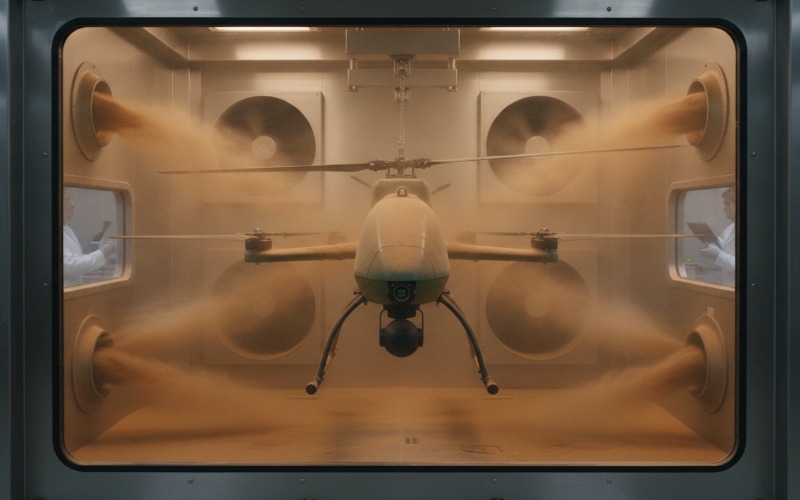
MIL-STD-810H Compliance and Ruggedization
Operational reliability in extreme environments is non-negotiable. VTOL unmanned helicopters must pass MIL-STD-810H testing for low/high temperature storage and operation, humidity, sand and dust, vibration, and shock. IP68 rating ensures water and dust ingress protection, allowing operations in monsoon conditions or after immersion. Electronic components should be conformally coated and connectors rated to MIL‑DTL‑38999 for corrosion resistance.
Payload and Range Capabilities
Current-generation platforms like the Kaman K‑MAX unmanned version can lift 2,700 kg externally, but tactical logistics focuses on smaller systems. Typical payload ranges:
| Platform Class | Max Payload (kg) | Endurance (hrs) | Range (km) | Typical Cargo |
|---|---|---|---|---|
| Micro VTOL | 5–15 | 1–2 | 20–50 | Medical supplies, batteries |
| Tactical VTOL | 30–70 | 4–6 | 100–250 | Ammunition, water, radios |
| Midsize VTOL | 100–150 | 8–12 | 300–500 | MREs, spare parts, micro-drones |
| Heavy Lift VTOL | 300+ | 6–8 | 200–400 | Palletized supplies, light vehicles |
Integration with Tactical C2 Systems
For VTOL unmanned helicopters to function effectively within military logistics, they must interface with existing Command and Control (C2) networks. The open architecture standards (e.g., STANAG 4586 for UAV control, OMS/UCI for data exchange) allow interoperability with systems like the Joint Battle Command-Platform (JBC‑P). Ground control stations can be ruggedized tablets running tactical mission planning software, enabling operators to assign waypoints, monitor cargo status, and re-task missions in real time.
Payload integration also requires standardized electrical and mechanical interfaces. The tactical vest mounted controller concept is being explored for dismounted operators to call for supply via portable terminal. Encryption (NSA Suite B, AES‑256) ensures secure datalinks in contested electromagnetic environments.
Comparative Analysis of Leading VTOL Unmanned Helicopter Platforms
The table below compares three platforms representative of the tactical logistics segment. All figures are based on manufacturer data and DARPA demonstration results.
| Parameter | Platform A (Coaxial Rotor) | Platform B (Tilt-Rotor) | Platform C (Hexacopter) |
|---|---|---|---|
| Max Takeoff Weight | 180 kg | 250 kg | 120 kg |
| Payload (internal) | 60 kg | 100 kg | 35 kg |
| Endurance (no payload) | 10 hr | 8 hr | 6 hr |
| Max Speed | 160 km/h | 200 km/h | 120 km/h |
| MIL-STD-810H | Yes (all methods) | Yes (partial) | Yes (limited) |
| IP Rating | IP68 | IP67 | IP56 |
| Autonomy Level | Level 4 (human on loop) | Level 3 (human in loop) | Level 2 (human direct) |
| Unit Cost (est.) | $450k | $620k | $280k |
Deployment Scenarios and Mission Profiles
VTOL unmanned helicopters have proven their value in numerous military exercises and real-world operations:
- Casevac / Medevac: Rapid evacuation of casualties from remote hot zones using a stretcher pod or sling. The quiet electric mode reduces detection risk.
- Resupply of Forward Operating Bases: Scheduled or on-demand delivery of ammunition, batteries, water, and food, replacing vulnerable convoy routes.
- Tactical ISR Extension: Carrying a multi-sensor gimbal for persistent surveillance during logistics missions, providing real-time battlefield awareness.
- Electronic Warefare: Modular payload swaps allow communication relay, signals intelligence, or jamming missions without changing airframe.
Challenges and Mitigation Strategies
Despite their promise, VTOL unmanned helicopters face hurdles:
- Energy Density: Batteries limit endurance. Mitigation: hybrid electric configuration with JP‑8 fueled engine for extended range.
- Airspace Integration: Conflict with manned aviation. Mitigation: detect-and-avoid systems compliant with NATO STANAG 4702.
- Cybersecurity: Vulnerable datalinks. Mitigation: anti‑jamming spread spectrum, NSA Type 1 encryption.
- Maintenance Burden: Complex rotor systems. Mitigation: modular design for line‑replaceable units, predictive health monitoring.
Future Directions: Autonomous Logistics and Swarm Operations
The next decade will see VTOL unmanned helicopters operating in autonomous swarms, coordinated by AI mission planners. DARPA’s OFFensive Swarm-Enabled Tactics (OFFSET) program has demonstrated 250‑drone swarms for urban resupply. Key enablers: mesh networking, decentralized collision avoidance, and adaptive payload management. For system integrators, the challenge is to build open, secure interfaces that allow rapid technology insertion as algorithms mature.
Frequently Asked Questions
What is the primary advantage of a VTOL unmanned helicopter in military logistics?
VTOL capability eliminates the need for runways, enabling resupply directly to frontline troops in rugged terrain, ship decks, or urban areas. This reduces response time from hours to minutes.
How does a VTOL unmanned helicopter differ from a multirotor drone?
VTOL unmanned helicopters typically use a single main rotor with tail rotor or coaxial counter-rotating rotors, providing higher aerodynamic efficiency and payload capacity than multirotors. They can operate in more demanding weather conditions and offer longer endurance.
What MIL-STD certifications are required for military procurement?
The baseline is MIL-STD-810H for environmental durability and MIL-STD-461G for electromagnetic compatibility. Additionally, platforms may require MIL-STD-1553 or MIL-STD-1760 for integration with aircraft and weapon systems.
Can a VTOL unmanned helicopter operate in GPS-denied environments?
Yes. Advanced inertial navigation systems (INS) fused with visual odometry, terrain‑referenced navigation, and L‑band satellite signals enable precision flight without GPS. Some platforms also use ultrawideband (UWB) local positioning for indoor or tunnel operations.
What is the typical acquisition cost for a tactical VTOL unmanned helicopter system?
For a complete system (airframe, ground control station, two payload modules, training), costs range from $1.5M to $3.5M depending on autonomy level and ruggedization. Operational cost per flight hour is estimated at $500–$1,200 including maintenance.
Conclusion
VTOL unmanned helicopters are no longer experimental—they are operational force multipliers in modern military logistics. For system integrators, the path forward lies in embracing open standards, robust SWaP-C optimization, and stringent MIL-STD compliance. By integrating these platforms with ruggedized ground control tablets and tactical vest operator systems, defense forces can achieve unprecedented agility in delivering mission-critical supplies to the point of need. The future of battlefield logistics is vertical, autonomous, and resilient.