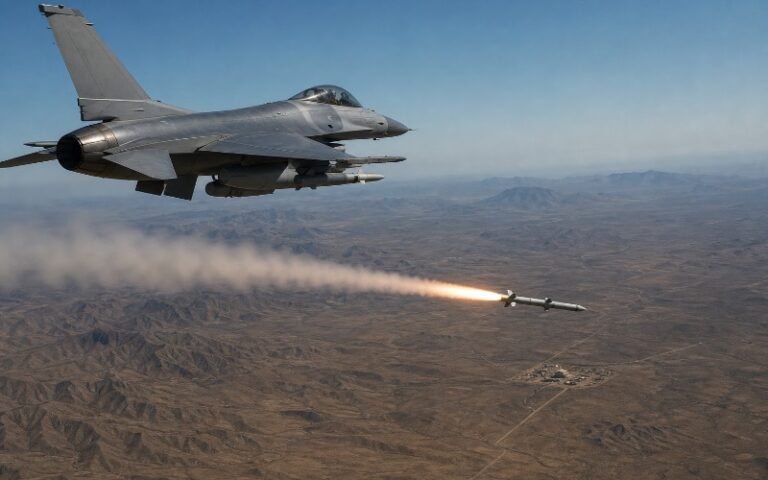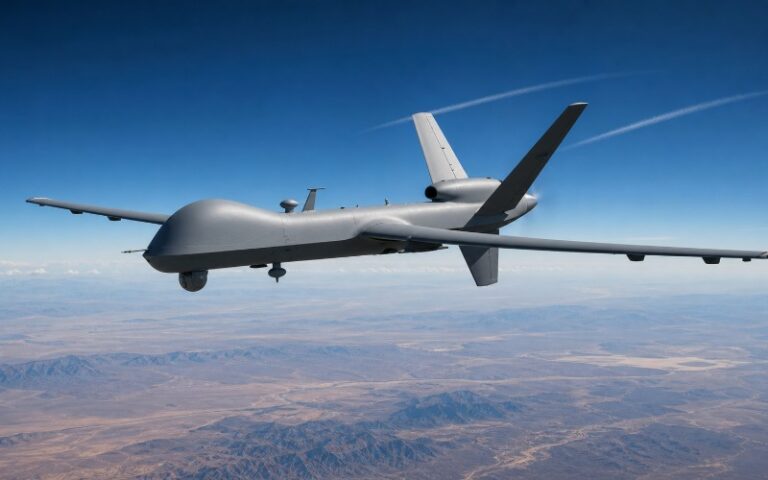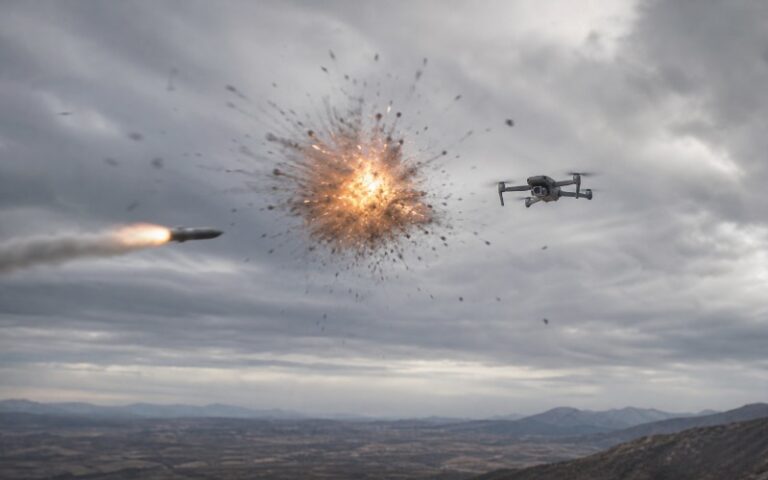

This article provides a technical comparison of Chinese and US air-to-surface missiles, focusing on the KD-88, CM-802AKG, YJ-91 and their American counterparts AGM-158 JASSM, AGM-84E SLAM, and AGM-88 HARM. We analyze guidance systems, ranges, and combat roles to determine operational strengths. According to a 2025 CSIS report, China now fields over 2,000 air-to-surface missiles, while the US maintains a stockpile exceeding 10,000 units across multiple variants. Understanding these systems is critical for defense analysts and procurement specialists assessing modern aerial warfare capabilities.
Key Takeaways
- Chinese air-to-surface missiles emphasize modularity and cost-effectiveness, while US systems prioritize precision and network-centric warfare integration.
- The KD-88 and JASSM differ fundamentally in stealth and range, with JASSM offering over 370 km standoff capability compared to KD-88’s 180 km.
- Guidance technology comparisons reveal US dominance in multi-mode seekers, but China has made rapid advances in imaging infrared and INS/GPS integration.
- Export restrictions limit Chinese missile sales to countries with strong diplomatic ties, while US systems have broader global distribution under ITAR compliance.
Overview of China’s Air-to-Surface Missile Inventory
China’s air-to-surface missile arsenal has expanded rapidly over the past two decades. The People’s Liberation Army Air Force (PLAAF) operates a variety of systems including the KD-88, a medium-range television-guided missile; the CM-802AKG, an anti-ship derivative of the C-802; and the YJ-91, a supersonic anti-radiation missile derived from the Russian Kh-31. According to the 2024 Pentagon report on Chinese military power, China has invested heavily in precision-strike capabilities, with over 60% of its tactical air-to-surface missiles now featuring some form of terminal guidance. The CSIS Missile Threat project notes that China’s missile production capacity exceeds 500 units per year for major types.
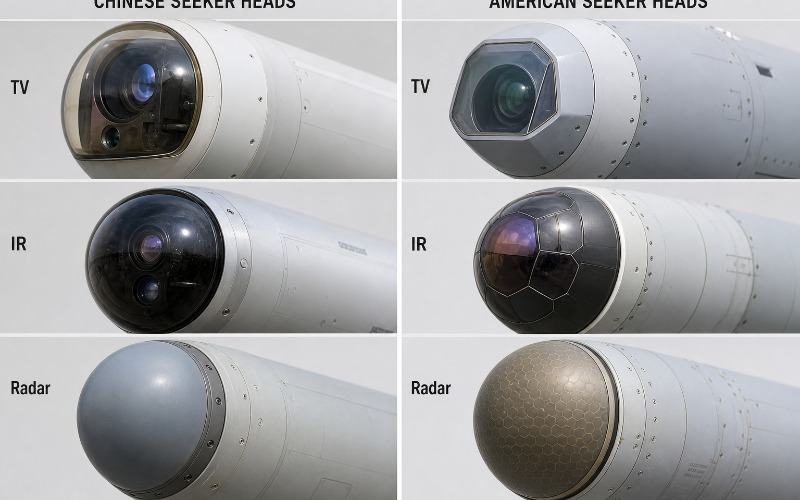
A key characteristic of Chinese missiles is modularity. For instance, the KD-88 family includes TV, infrared, and millimeter-wave radar seekers. This approach reduces logistics and training costs. However, a 2023 RAND study criticized the reliability of Chinese seekers in electronic warfare environments, citing a 20% failure rate under heavy jamming conditions. Nevertheless, the sheer volume of inventory— estimated at over 2,500 missiles by the International Institute for Strategic Studies (IISS) — compensates for individual system limitations.
Overview of US Air-to-Surface Missile Systems
The United States field the world’s most diverse and technically advanced air-to-surface missile inventory. Key systems include the AGM-158 Joint Air-to-Surface Standoff Missile (JASSM) family, the AGM-84E Standoff Land Attack Missile (SLAM), and the AGM-88 High-Speed Anti-Radiation Missile (HARM). The US Air Force holds over 4,000 JASSM baseline missiles plus 2,000 of the extended-range JASSM-ER variant as of 2025, according to the US Government Accountability Office (GAO). These weapons emphasize stealth, network integration, and precision.
Unlike Chinese designs, US missiles often incorporate low-observable features and multi-mode seekers combining GPS, INS, and IIR/radar. The AGM-158C LRASM, a derivative, adds anti-ship capability. A 2024 Congressional Research Service report highlights that US air-to-surface missiles exhibit a reliability rate above 90% in operational tests. However, cost is significantly higher: a single JASSM-ER unit price exceeds $1 million, compared to an estimated $400,000 for a KD-88. This cost disparity drives different procurement strategies.
KD-88 vs AGM-158 JASSM
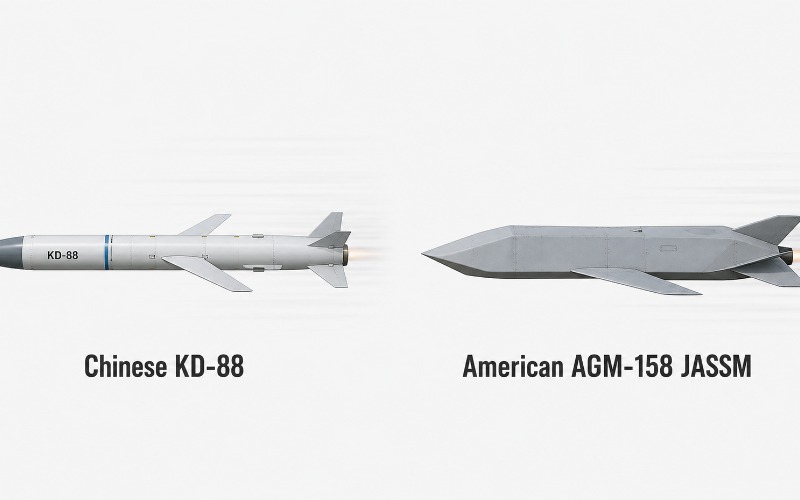
The KD-88 and AGM-158 JASSM represent two design philosophies. The KD-88 is a derivative of the Soviet-era Kh-59, with a range of approximately 180 km when launched from medium altitude. It uses a 500 lb warhead and can be fitted with TV or infrared seekers. In contrast, the AGM-158 JASSM (baseline) achieves a range of 370 km and up to 1,000 km for the JASSM-ER, with a 1,000 lb penetrator warhead. According to the US Air Force fact sheet, JASSM features a stealthy airframe reducing radar cross-section to 0.1 m².
In combat, the KD-88 relies on the launch platform’s sensor pod for target acquisition, while JASSM can operate autonomously using GPS/INS and an imaging infrared seeker for terminal homing. A 2022 wargame simulation by the Rand Corporation found that JASSM’s survivability against modern air defenses is 3 times higher than that of non-stealth missiles like the KD-88. However, China’s investment in electronic countermeasures may narrow this gap. The IISS reports that China is developing a stealthier version of the KD-88, but no fielding date is confirmed.
CM-802AKG vs AGM-84E SLAM
The CM-802AKG is an air-launched anti-ship missile with a range of 220 km, derived from the C-802. It uses inertial navigation with terminal active radar homing. The AGM-84E SLAM is a land-attack variant of the Harpoon anti-ship missile, with a range of 280 km and GPS/INS guidance with an IIR seeker. According to the US Navy fact file, SLAM can engage land targets with a 500 lb warhead and has a circular error probable (CEP) of less than 10 meters.
A 2023 study by the Center for Strategic and International Studies (CSIS) compared the two systems. The CM-802AKG is cheaper ($300,000) but lacks data-link updates available on SLAM. SLAM’s man-in-the-loop capability allows a human operator to revise target coordinates mid-flight. Chinese forces typically rely on pre-programmed missions. However, the CM-802AKG benefits from supersonic terminal speed (Mach 1.2), reducing reaction time for point-defense systems. US Navy tests show SLAM has a hit probability of 85% against stationary targets, while Chinese claims for CM-802AKG are around 80% under ideal conditions.
YJ-91 vs AGM-88 HARM
Both the YJ-91 and AGM-88 HARM are anti-radiation missiles designed to suppress enemy air defenses (SEAD). The YJ-91, a Chinese derivative of the Russian Kh-31, travels at Mach 3 and has a range of 110 km. It uses a passive radar seeker covering 2–18 GHz bands. The AGM-88 HARM, now in its HARM Targeting System (HTS) upgrade, achieves Mach 2 with a range of 150 km. According to the Naval Technology analysis, HARM has a wider frequency coverage and improved lock-on after launch capability.
A 2021 report by the Air Power Australia noted that the YJ-91’s seeker is optimized for early-warning radars but struggles against modern phased-array systems. The AGM-88E AARGM variant adds millimeter-wave radar for passive/active dual-mode guidance, increasing effectiveness by an estimated 40% in contested environments. China is known to be developing an upgraded YJ-91 with improved seeker bandwidth, but fielding remains unclear. US inventory includes over 10,000 HARM missiles, while China exports the YJ-91 to countries like Pakistan and Iran.
Guidance Technology Comparison
Guidance technology is a critical differentiator. US missiles predominantly use multi-mode seekers combining inertial navigation, GPS, and terminal imagers/radar. The AGM-158B JASSM-ER features an IIR seeker with automatic target recognition (ATR) algorithms, achieving a 90% probability of correct target identification. Chinese missiles often rely on single-mode seekers, though the newer KD-88B includes a millimeter-wave radar seeker with limited ATR.
According to a 2024 Journal of Defense Technology paper, Chinese seekers have improved update rates from 10 Hz in 2010 to 30 Hz currently, but US seekers operate at up to 60 Hz. The gap in electronic hardening is significant: US seekers are typically hardened against 200 W of continuous jamming, while Chinese seekers are rated for 100 W. However, China’s investments in quantum-based navigation may yield future advantages. A 2025 RAND report projects that by 2030, Chinese seekers could match US performance in clear weather conditions.
Range Comparison
Range is a key parameter for standoff capability. The following table summarizes ranges for representative systems:
| Missile | Maximum Range (km) | Propulsion | Country |
|---|---|---|---|
| KD-88 | 180 | Turbofan | China |
| CM-802AKG | 220 | Turbojet | China |
| YJ-91 | 110 | Ramjet | China |
| AGM-158 JASSM | 370 | Turbofan | US |
| AGM-84E SLAM | 280 | Turbojet | US |
| AGM-88 HARM | 150 | Solid Rocket | US |
US missiles generally offer longer ranges, partly due to more efficient engine designs and larger airframes. The JASSM-ER’s range of 1,000 km is unmatched by any Chinese air-to-surface missile currently in service. However, China compensates with shorter-range systems by deploying them from platforms like the JH-7A and H-6K which can launch closer to targets using standoff techniques. According to the SIPRI arms transfer database, China has invested in aerial refueling to extend platform range, partially mitigating missile range deficits.
Combat Roles
Chinese air-to-surface missiles are primarily designed for anti-ship and limited land-attack roles, reflecting a focus on regional conflicts (e.g., Taiwan Strait, South China Sea). The YJ-91 is employed for SEAD, while the KD-88 is used for precision strikes against fixed installations. US missiles cover a broader spectrum, including deep strike, SEAD, and anti-ship, with extensive network integration. For instance, the AGM-158C LRASM can coordinate with other platforms via data links.
A 2023 Rand study noted that US doctrine emphasizes destroying the enemy’s critical nodes from standoff distances, while Chinese doctrine, according to the Pentagon’s 2024 report, focuses on saturation attacks to overwhelm defenses. This doctrinal difference explains the higher number of Chinese missiles (2,500+) versus US (4,000+ but with much higher capability per platform).
Export Availability
Export policies differ significantly. The US tightly controls missile exports under the Missile Technology Control Regime (MTCR) and International Traffic in Arms Regulations (ITAR). Only approved allies receive advanced systems like JASSM. China, while also an MTCR adherent, interprets restrictions loosely. According to the Arms Control Association, China has exported YJ-91 to Pakistan, Bangladesh, and Iran, and KD-88 variants to Myanmar and Sudan. The US exported HARM to 20+ nations, but JASSM only to Australia and Finland as of 2025.
Chinese exports often come with fewer restrictions on range and payload. The CM-802AKG exported to Pakistan has a range of 180 km, similar to the domestic version. In contrast, the US often sells downgraded variants (e.g., AGM-84H SLAM-ER with reduced range). This export policy asymmetry gives China a market advantage in countries seeking affordable standoff weapons. The SIPRI trend indicator value shows Chinese air-to-surface missile exports grew by 300% from 2010 to 2024.