
For B2B system integrators operating in defense and security domains, the choice of unmanned helicopter type directly impacts mission success. Reconnaissance missions demand persistent surveillance, low acoustic signature, all-weather capability, and integration flexibility. This technical comparison evaluates small quadcopters, coaxial rotorcraft, and conventional single-rotor unmanned helicopters across critical parameters such as endurance, payload capacity, ruggedization, and SWaP-C optimization.
Each configuration brings distinct advantages and tradeoffs. We analyze real-world constraints like MIL-STD-810H compliance, IP68 ingress protection, operating temperature ranges, and compatibility with modular mission packages. The goal is to equip system integrators with data-driven criteria for selecting the optimal platform.
Key Takeaways
- Quadcopters excel in low-SWaP-C urban reconnaissance and rapid deployment, but have limited endurance (20–40 minutes) and payload capacity (under 2 kg).
- Coaxial rotor helicopters provide a balanced combination of endurance (60–90 minutes), moderate payload (3–6 kg), and improved gust resistance without complex tail rotor.
- Conventional single-rotor UAVs offer the highest endurance (120+ minutes) and payload (up to 15 kg), enabling advanced sensors and extended range, at the cost of larger logistical footprint.
- Ruggedization standards must include MIL-STD-810H for temperature, vibration, and shock, plus IP68 for immersion up to 1.5 meters for maritime operations.
- SWaP-C tradeoffs are mission-dependent: covert operations favor small quadcopters, while persistent overwatch demands conventional rotorcraft.
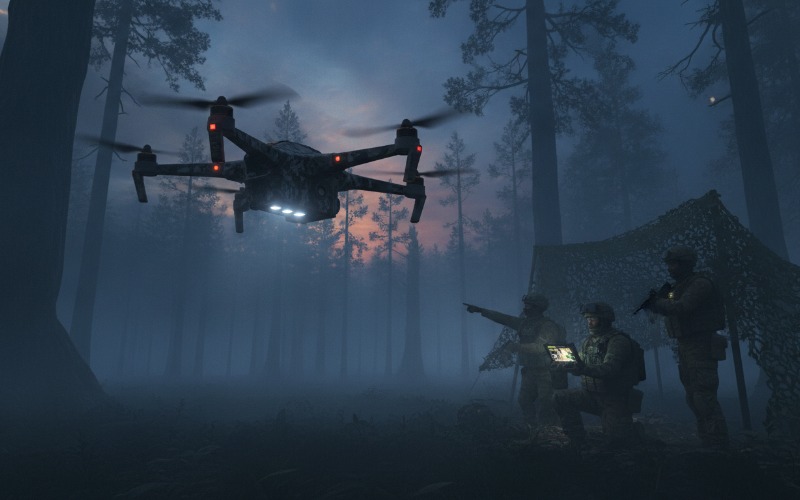
1. Quadcopter Reconnaissance Unmanned Helicopters
Quadcopters dominate short-range, covert reconnaissance due to their compact form factor and stability. Typical configurations include four motors with fixed-pitch propellers, providing vertical takeoff and landing (VTOL) and precise hovering. For reconnaissance, they are often equipped with stabilized EO/IR cameras and onboard recording.
Advantages include very low acoustic signature (noise levels <50 dB at 30 m), small logistics footprint (fits in soldier’s rucksack), and ease of hand launch. Disadvantages are acute: battery-limited flight times rarely exceed 40 minutes under load, and payload capacity is constrained to 0.5–2 kg. Additionally, quadcopters are more susceptible to wind gusts due to their smaller inertia and fixed-pitch rotors.
For B2B integrators, quadcopters require careful selection of MIL-STD-810H compliance (especially altitude and temperature), and IP68 sealing if operating in rain or dust. Typical applications: building reconnaissance, perimeter patrol, and immediate battle damage assessment.
2. Coaxial Rotor Unmanned Helicopters
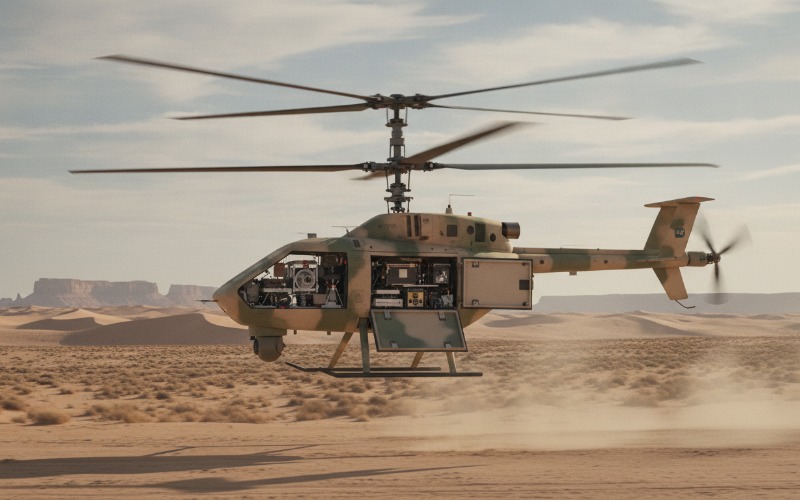
Coaxial rotor designs employ two counter-rotating rotors mounted on the same axis, eliminating the need for a tail rotor. This configuration offers several advantages for reconnaissance: reduced noise (lower tip speed due to overlapping discs), higher thrust efficiency, and superior gust rejection due to the dual-rotor torque cancellation.
Endurance typically ranges 60–90 minutes with payloads of 3–6 kg. The mechanical complexity is higher than quadcopters but lower than conventional helicopters. Coaxial UAVs can carry gimbaled multispectral sensors, laser designators, or small synthetic aperture radar (SAR). Many platforms achieve MIL-STD-810H compliance for shock, vibration, and temperature extremes. IP68 ratings are common for naval variants.
System integrators value coaxial rotorcraft for their stability in gusty winds (up to 25 kts ops limit) and ability to operate from small ship decks. The SWaP-C tradeoff is moderate: they require a larger ground control station and generator-based charging compared to quadcopters.
3. Conventional Single-Rotor Unmanned Helicopters
Conventional unmanned helicopters with a main rotor and tail rotor represent the historical benchmark for heavy-lift reconnaissance. They offer the highest endurance (typically 120+ minutes) and payload capacity (5–15 kg), enabling integration of advanced imaging LIDAR, high-resolution EO/IR turrets, and communication relay payloads. They also support hybrid power systems for even longer endurance.
Tradeoffs: Larger size and weight (often >30 kg MTOW) necessitate vehicle-based transport or dedicated storage. Acoustic signature is higher due to tail rotor noise and larger blade area. They require more maintenance and trained operators. However, for persistent wide-area surveillance or signals intelligence collection, the conventional rotorcraft remains unmatched.
All major defense OEMs offer conventional UAVs with MIL-STD-810H compliance across all environmental extremes, and many are qualified for shipboard operations. SWaP-C here is prioritized for maximum capability per sortie.
4. Technical Comparison Table
| Parameter | Quadcopter | Coaxial Rotor | Conventional Single-Rotor |
|---|---|---|---|
| Endurance (typical) | 20–40 min | 60–90 min | 120–180 min |
| Payload capacity | 0.5–2 kg | 3–6 kg | 5–15 kg |
| MTOW | <5 kg | 8–20 kg | 25–70 kg |
| Acoustic signature (30m) | <50 dBA | 55–65 dBA | 65–80 dBA |
| Gust tolerance (max wind) | 15–20 kts | 20–25 kts | 20–30 kts |
| Logistics footprint | Backpack | Large pack or small case | Vehicle transport |
| MIL-STD-810H available | Limited (consumer models) | Often | Almost always |
| IP68 rating available | Few models | Several | Select naval variants |
5. Ruggedization and Environmental Compliance
All reconnaissance unmanned helicopters must survive harsh operational environments. MIL-STD-810H defines test methods for temperature (Method 501/502), humidity (Method 507), shock (Method 516), vibration (Method 514), altitude (Method 500), and salt fog (Method 509). IP68, defined by IEC 60529, ensures protection against dust ingress and continuous water submersion up to 1.5 meters deep for 30 minutes.
For B2B integrators, verifying specific test reports is critical. A quadcopter with a consumer-grade shell may fail in high-vibration environments, whereas a coaxial rotorcraft designed to military standards will have redundant seals and conformal coatings. Payload integration also demands EMI/EMC compliance per MIL-STD-461.
6. SWaP-C Optimization Strategies
SWaP-C (Size, Weight, Power, and Cost) drives procurement decisions. For quadcopters, the constraint is battery energy density: advancements in silicon-anode lithium-ion cells can extend endurance by 20–30%, but remain expensive. Coaxial rotorcraft benefit from higher payload fraction, allowing larger batteries without exceeding regulatory limits (e.g., FAA Part 107 weight threshold under 55 lbs). Conventional helicopters often use hybrid diesel-electric or hydrogen fuel cell systems for extended endurance.
Cost considerations: quadcopter mission kits (UAV + sensor + GCS) start at $20k, coaxial at $50k–$150k, and conventional at $150k–$500k. Lifecycle costs including maintenance and training can double initial outlay. Integrators must balance procurement against mission availability targets.
7. Integration with C4ISR Architectures
All three types support open mission systems (OMS) and can be integrated into tactical edge networks. Quadcopters often use Wi-Fi or 915 MHz data links with limited range (5–15 km), while coaxial and conventional platforms employ Ku-band or L-band satellite links for beyond-line-of-sight operations. Video feeds are typically H.264/H.265 compressed at 1080p or 4K resolution. Tracking targets requires onboard gyro-stabilization and gimbal control, which is more robust on larger platforms.
For C2 interoperability, the UAV must support STANAG 4586 or similar standards. Quadcopters rarely meet this; coaxial and conventional platforms can be certified. Integrators planning for full battlefield integration should prioritize STANAG 4586 Level 2 or 3 compliance.
8. Tactical Considerations: Covert vs. Persistent Operations
Covert reconnaissance demands low acoustic and visual signatures. Quadcopters excel here—they can be launched from a window or behind cover. Persistent overwatch (e.g., border surveillance, convoy protection) favors conventional rotorcraft with fuel endurance of several hours and ability to carry relay payloads. Coaxial rotorcraft fit the middle ground: lower noise than conventional yet longer endurance than quadcopters, making them suitable for urban patrol and maritime interdiction.
Ultimately, the decision matrix includes terrain, threat environment, logistics support, and the required sensor suite. We recommend starting with a trade-off analysis using the table above.
Frequently Asked Questions
Which unmanned helicopter type has the best endurance for long-range reconnaissance?
Conventional single-rotor unmanned helicopters typically offer the best endurance, exceeding 120 minutes with payload. They can carry hybrid power systems for even longer flights. However, coaxial rotorcraft with optimized aerodynamics can approach 90 minutes while maintaining lower noise.
Are quadcopters suitable for military reconnaissance in adverse weather?
Only if they are MIL-STD-810H qualified and IP68 rated. Many consumer-grade quadcopters fail in rain or high winds. Specialized military quadcopters (e.g., Black Hornet 3) are weatherized but still limited by battery life and payload capacity.
What is the typical payload weight for a coaxial rotor UAV?
Coaxial rotor UAVs typically support payloads from 3 kg to 6 kg, depending on the design. This enables integration of high-resolution EO/IR cameras, laser designators, or light SAR systems.
Do all unmanned helicopters require a data link for reconnaissance?
Yes, a data link (RF, Ku, L-band) is required to transmit sensor video and telemetry. Some platforms support onboard recording for later analysis, but real-time ops require continuous link. Range varies from a few km (quadcopter) to >100 km (conventional with satcom).
Can a quadcopter be upgraded to carry heavier payloads?
Not effectively. Quadcopter frames are optimized for light weight, and increasing payload quickly reduces flight time below usable thresholds. For heavier payloads, a coaxial or conventional design is necessary.
What SWaP-C tradeoffs exist for shipboard operations?
Shipboard operations require ruggedized IP68 compliance, corrosion resistance (MIL-STD-810 salt fog), and stable hover in ship motion. Coaxial rotorcraft are often preferred for their compactness and gust tolerance, while conventional helicopters need tail rotors that are vulnerable to obstructions.
For more on rugged electronics, explore our rugged tablets and tactical vests designed for ground personnel managing UAV operations.
Conclusion
Selecting the optimal unmanned helicopter type for reconnaissance requires a nuanced understanding of mission profiles, environmental constraints, and system integration requirements. Quadcopters win on portability and stealth; coaxial rotorcraft strike a balance; conventional single-rotor platforms dominate in endurance and payload. All must comply with rigorous MIL-STD-810H and IP68 standards to ensure operational readiness. System integrators should use the provided comparison matrix and FAQs to guide procurement decisions.
Ready to integrate? Contact our team for detailed specs and platform recommendations tailored to your reconnaissance mission.