
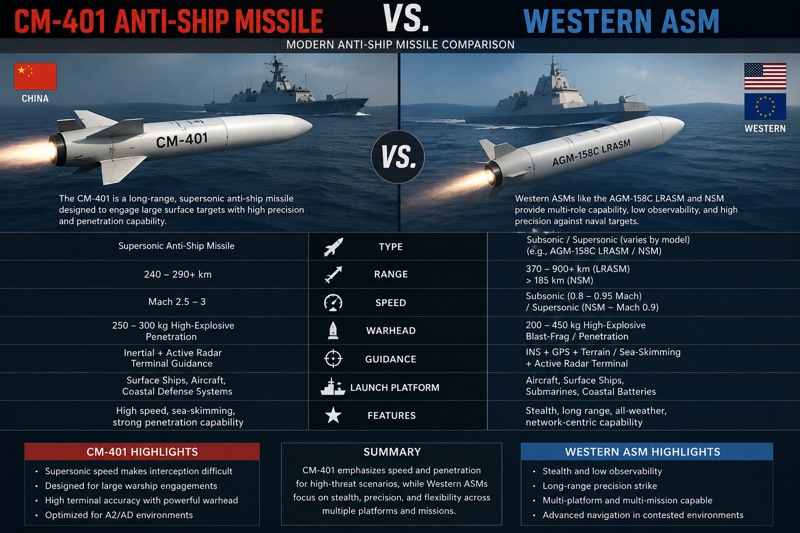
The international defense market is experiencing a paradigm shift. Historically, coastal defense and anti-surface warfare (ASuW) exports were dominated by sub-sonic or supersonic anti-ship cruise missiles (ASCMs)—such as the American Harpoon, French Exocet, or Russian Kh-35. However, China’s unveiling of the CM-401 at the Zhuhai Airshow marked the dawn of a new era: the democratization of Anti-Ship Ballistic Missile (ASBM) technology for the global export market.
This comparative analysis evaluates the CM-401 anti-ship missile against prevailing Western Anti-Ship Missiles (ASMs), examining technical specifications, operational doctrines, and the systemic implications for regional balances of power.
Technical Specifications Showdown
The technical divergence between the CM-401 and Western equivalents represents two entirely distinct design philosophies for overcoming modern shipborne Aegis-type Air Defense Systems.
| Feature / System | CASIC CM-401 (China) | AGM-184C LRASM (USA) | NSM / Naval Strike Missile (Kongsberg/Raytheon) |
| Classification | Short-Range Anti-Ship Ballistic Missile (ASBM) | Next-Gen Anti-Ship Cruise Missile (ASCM) | Low-Observable Anti-Ship Cruise Missile (ASCM) |
| Propulsion | Solid-fuel rocket motor | Solid-fuel booster + Turbojet engine | Solid-fuel booster + Turbojet engine |
| Flight Trajectory | Near-space Skip-Glide / Porpoising | Low-altitude Sea-skimming | Low-altitude Sea-skimming |
| Speed | Cruise: Mach 4.0 | Terminal: Mach 6.0 | High Subsonic (approx. Mach 0.9) |
| Maximum Range | 290 km (Export limited by MTCR) | 370+ km (Variant dependent) | 185 km – 250 km+ |
| Guidance System | INS + Satellite + Terminal Active Radar Homing | GPS/INS + IIR (Imaging Infrared) + ESM passive RF | GPS/INS + IIR (Imaging Infrared) + Laser Altimeter |
Flight Dynamics & Interception Profiles
The core differentiator between these systems lies in how they navigate the threat envelope of enemy Surface-to-Air Missile (SAM) systems.
CM-401: The Near-Space Kinetic Hammer
The CM-401 utilizes a near-space trajectory (reaching altitudes up to 100 km). Instead of a pure parabolic arc, it executes an irregular skip-glide (porpoising) maneuver within the upper atmosphere.
- Terminal Velocity: Diving at Mach 6.0, the missile presents a “zenith attack” profile—descending from a high angle directly above the target vessel.
- The Interception Challenge: This trajectory exploits a vulnerability in many naval radars, known as the blind cone or overhead zenith gap. Intercepting a Mach 6 target executing unpredictable maneuvers in its terminal phase strains the kinematics of Western interceptors like the RIM-162 ESSM or RIM-156 SM-2 Block IV.
Western Approach: The Low-Observable Ghost
In stark contrast, American and NATO designs prioritize stealth and cognitive autonomy over raw speed. Systems like the LRASM (Long Range Anti-Ship Missile) and NSM fly mere meters above the waves (sea-skimming).
- Survability Mechanics: They leverage low-observable (stealth) airframes, radar-absorbent materials, and passive seekers. Rather than outrunning radar, they seek to avoid detection entirely until they cross the target’s radar horizon (typically under 30 km).
- Terminal Phase: Instead of a high-speed dive, they utilize sophisticated electronic warfare (EW) countermeasures and erratic weaves at high-subsonic speeds to complicate close-in weapon system (CIWS) tracking.
Sensor Philosophy & Target Discrimination
A missile is only as good as its ability to find its target in a contested Electronic Countermeasures (ECM) environment.
CM-401 Guidance Chain:
[INS / Satellite Mid-course] ---> [Near-Space Skip-Glide] ---> [Active Radar Terminal Homing] ---> [Kinetic Impact]

LRASM Guidance Chain:
[GPS / INS / Passive ESM] ----> [Autonomous Waypoints] ----> [IIR Target Discrimination] ----> [Precision Strike]
- CM-401 Seekers: The weapon relies on a high-resolution Terminal Active Radar Homing seeker. This provides all-weather, day-and-night target acquisition capable of locking onto medium-to-large combatants. However, active emissions act as a beacon for the target ship’s Electronic Support Measures (ESM), giving the defender immediate warning.
- Western Seekers: The LRASM and NSM rely heavily on Imaging Infrared (IIR) sensors. The weapon emits zero radio frequency (RF) energy during the terminal phase, making it completely passive and invisible to RF-based warning systems. Furthermore, IIR seekers allow the missile to perform autonomous target discrimination, cross-referencing the ship’s visual silhouette against an onboard database to strike a specific high-value vulnerability (e.g., the command bridge or vertical launch cells).
Operational Doctrine & System Limitations
The “Kill Chain” Dependency
The true operational constraint of the CM-401 is its reliance on a robust external Kill Chain. Because it travels 290 km at hypersonic speeds, hitting a moving naval vessel requires real-time target updates during the mid-course phase.
Strategic Factor: Export customers purchasing the CM-401 must possess, or have access to, advanced Maritime Surveillance assets—such as Maritime Patrol Aircraft (MPA), Over-the-Horizon (OTH) radars, or Unmanned Aerial Vehicles (UAVs)—to provide precise initial targeting coordinates. Without this, the system’s tactical utility is significantly degraded.
Conversely, Western weapons like the LRASM are engineered for Network-Centric Warfare (NCW) within an Anti-Access/Area Denial (A2/AD) environment. If GPS and satellite communications are jammed, the LRASM can use its onboard ESM suite to passively geolocate enemy radar emissions and autonomously calculate an interception vector without external data links.
Strategic Significance for the Export Market
The exportability of the CM-401 is structurally bound by the Missile Technology Control Regime (MTCR) guidelines, which cap export-grade ballistic missile ranges at 300 km and payloads at 500 kg. China has meticulously engineered the CM-401 to sit right under this threshold (290 km range / 290 kg warhead).
For non-aligned or developing nations, the CM-401 represents an asymmetric equalizer. It allows a coastal defense force with a modest budget to hold highly advanced, multi-billion-dollar Western naval surface groups at bay. While a sub-sonic cruise missile swarm can be depleted by tiered naval air defense, the introduction of an exportable, hypersonic, skip-gliding tactical ballistic missile fundamentally complicates naval task force planning in littoral zones globally.