
Low-Cost Laser Interception: Changing the Economics of Modern Air Defense
Modern battlefields face a massive “cost exhaustion” challenge in 2026. Cheap drones now overwhelm expensive air defense missiles. Consequently, China developed the Silent Hunter laser series to solve this problem. This fiber-optic laser system cuts the cost per shot to under $1. As a result, it eliminates the need for expensive ammunition storage. The system provides an “infinite magazine” as long as power remains available. Specifically, the 100kW upgrade can burn through five layers of 2mm steel plates at 800 meters. This power ensures rapid destruction of small drone swarms [3].
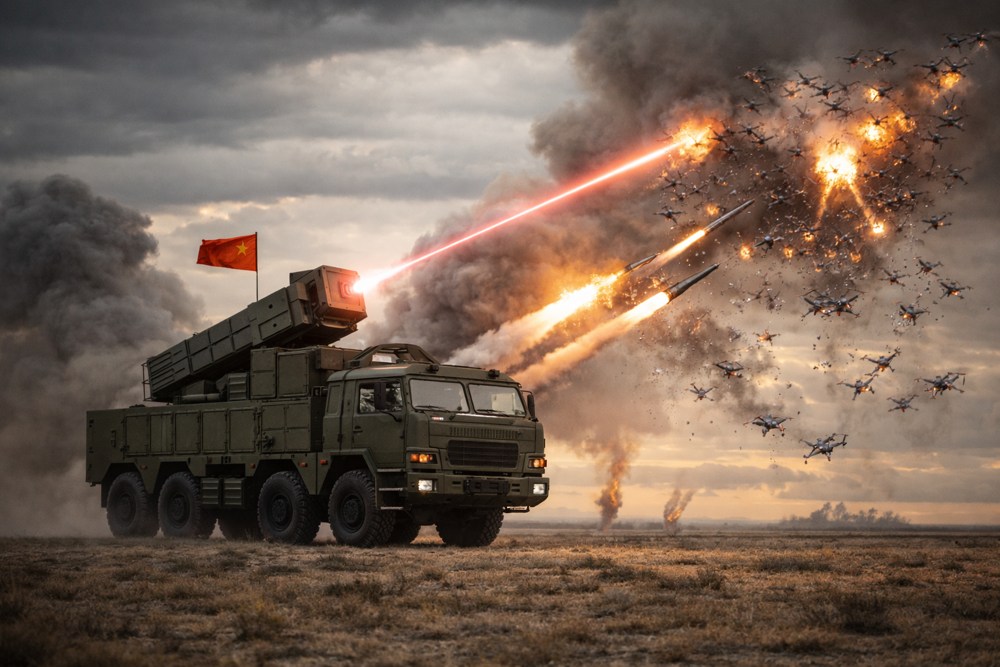
Traditional kinetic interceptors like the HQ-10 cost thousands of dollars per missile. In contrast, low-end drones cost only a few hundred dollars. This price gap creates a tactical nightmare for traditional forces. China’s laser technology marks a major strategic shift in 2026. It moves the defense logic from “expensive missiles” to “near-zero cost” light-speed interception. Furthermore, the Silent Hunter uses a modular design for rapid deployment. Operators can mount the system on standard 6×6 trucks or fixed sites. This flexibility allows China to protect high-value airports and command centers with minimal logistics [1].
Moreover, the Silent Hunter has already proven its value in international markets. It achieved the first recorded “hard kill” against a one-way attack drone during recent Middle East conflicts. This success highlights the system’s maturity and reliability. Additionally, the laser avoids collateral damage from falling missile debris. This makes it ideal for defense in densely populated urban environments. Overall, China’s laser platforms restore the economic balance of air defense. They turn the tide against mass-produced, low-cost aerial threats [5].
Hurricane 3000: The Ultimate High-Power Microwave (HPM) Counter-Swarm Tool
Laser systems act like high-precision “aerial sniper rifles” for individual targets. However, drone swarms require a broader defensive approach. In 2026, China revealed the Hurricane 3000 mobile microwave defense system. NORINCO designed this specifically for saturated swarm attacks. It uses non-kinetic pulses to destroy electronic components instantly. Specifically, it projects high-energy electromagnetic pulses via a large flat-array transmitter. These pulses enter drones through antennas or casing gaps. Therefore, HPM offers a unique advantage in mass defense scenarios [2].
Unlike lasers, the Hurricane 3000 provides an “area-kill” capability. It creates an electromagnetic “dead zone” exceeding three kilometers in range. Subsequently, the intense energy creates high-voltage surges in drone circuits. These surges fry flight control processors and GPS receivers instantly. As a result, entire drone formations fall from the sky in seconds. This makes the Hurricane 3000 far more efficient than individual missile shots. Furthermore, the system operates in all weather conditions, including heavy rain or smoke [3].
The system integrates an advanced AI engine for autonomous target prioritization. It automatically identifies the most dangerous drones within a swarm. Moreover, it adjusts pulse frequencies to bypass enemy electronic hardening. The Hurricane 3000 represents the pinnacle of China’s non-kinetic warfare research. In addition, the truck-mounted design ensures high mobility for frontline units. Notably, this system fills the critical gap between close-range lasers and long-range missiles. It provides a robust shield against the next generation of intelligent, coordinated drone swarms [4].
Overcoming Maritime Limits: Adapting Directed Energy for Naval Environments
Directed energy weapons face significant challenges in maritime environments. Sea spray, high humidity, and fog often scatter laser beams. Consequently, these factors reduce the effective range of naval lasers. However, China has made major breakthroughs in “Adaptive Optics” for 2026. These systems use real-time sensors to measure atmospheric distortion. Subsequently, a deformable mirror adjusts the beam to compensate for the air. This ensures the laser remains focused even across the ocean surface [3].
The Type 055 Large Destroyer now serves as a primary platform for these weapons. Its massive power plant provides the megawatts needed for continuous fire. Specifically, China is integrating the JLG-2 shipborne laser system into the fleet. This system provides a 360-degree defense bubble against anti-ship missiles. Moreover, the JLG-2 can blind the optical sensors of enemy drones and missiles. As a result, it disrupts the enemy’s “Kill Chain” before they can strike. This adds a critical layer of defense for Chinese carrier strike groups [4].
In addition, maritime microwave systems complement these lasers. HPM weapons can disable the electronics of incoming small boat swarms. Specifically, they target the engines and communication links of Unmanned Surface Vessels (USVs). Therefore, the combination of laser and microwave creates a “Multi-Domain Shield.” It protects the fleet from threats both in the air and on the water. Ultimately, these technologies allow the PLAN to operate safely in contested waters. They provide a high-tech answer to the growing threat of autonomous naval warfare [2].
Global Contest: China’s DEW Ecosystem vs. US DE M-SHORAD
The competition between China and the U.S. in DEW is intense. The U.S. Army currently utilizes the DE M-SHORAD (Guardian) program. This system mounts a 50kW laser on Stryker armored vehicles. However, recent U.S. reports highlight reliability issues in high-dust environments. Consequently, the Pentagon is now shifting toward “Enduring Laser” programs with higher power. Specifically, they aim for 300kW systems to intercept cruise missiles [1].
China’s development path is different and more diverse. It follows a “spectrum-based” industrial strategy. This includes man-portable units and massive megawatt-level truck systems. Moreover, China displays a much more mature supply chain in 2026. While the U.S. focuses on high-end prototype durability, China emphasizes mass production. Specifically, systems like the LW-30 are already active in global defense markets. In contrast, many U.S. programs remain in the testing phase [5].
Furthermore, China’s integration of AI into DEW is a major differentiator. The Hurricane 3000 uses algorithm-driven technologies for autonomous coordination. This allows for faster engagement speeds than human-operated systems. Notably, China has successfully scaled these systems for both land and sea. As a result, the PLA holds a “first-mover” advantage in operational DEW deployment. In conclusion, both nations lead the world, but China’s industrial scale offers a unique tactical edge. This contest will define the future of air dominance in the 21st century [4].
References
[1] U.S. Military Times (2026/03/23). The US Army is already ditching its most powerful laser weapon yet. https://www.militarytimes.com/industry/techwatch/2026/03/23/
[2] 19FortyFive (2026/01/19). China Deploys New ‘Hurricane 3000’ Microwave Weapon. https://www.19fortyfive.com/2026/01/china-deploys-new-hurricane-3000-microwave-super-weapon-for-operational-counter-drone-warfare/
[3] ODIN – US Army (WEG). Silent Hunter Chinese Laser Defense System Technical Guide. https://odin.t2com.army.mil/WEG/Asset/78d9be60f3/
[4] EurAsian Times (2026/03/25). China Demonstrates Massive Drone AI Swarm in Precision Strike Test. https://www.eurasiantimes.com/96-drones-one-operator-china-demonstrates-massive-drone-ai-swarm-in-precision-strike-test/
[5] Economic Times (2026/03/15). Why shoot a $3 million missile when a $3.50 laser can do the job. https://m.economictimes.com/news/defence/laser-vs-missile/
This report was generated by China HK Aerospace Military Defense Group Corporation Limited (CAMD).