
Author: China CAMD
Table of Contents
- 1. Introduction: The Rise of the Hunter-Killer UCAV
- 2. Wing Loong II: China’s Precision Powerhouse
- 3. MQ-9 Reaper: The Western Standard
- 4. Technical Specifications: A Side-by-Side View
- 5. Operational Endurance and Persistence
- 6. Weapons and Sensor Integration
- 7. Strategic Export Value and Global Presence
- 8. FAQ: Common Questions on UCAV Warfare
- 9. References
Introduction: The Rise of the Hunter-Killer UCAV
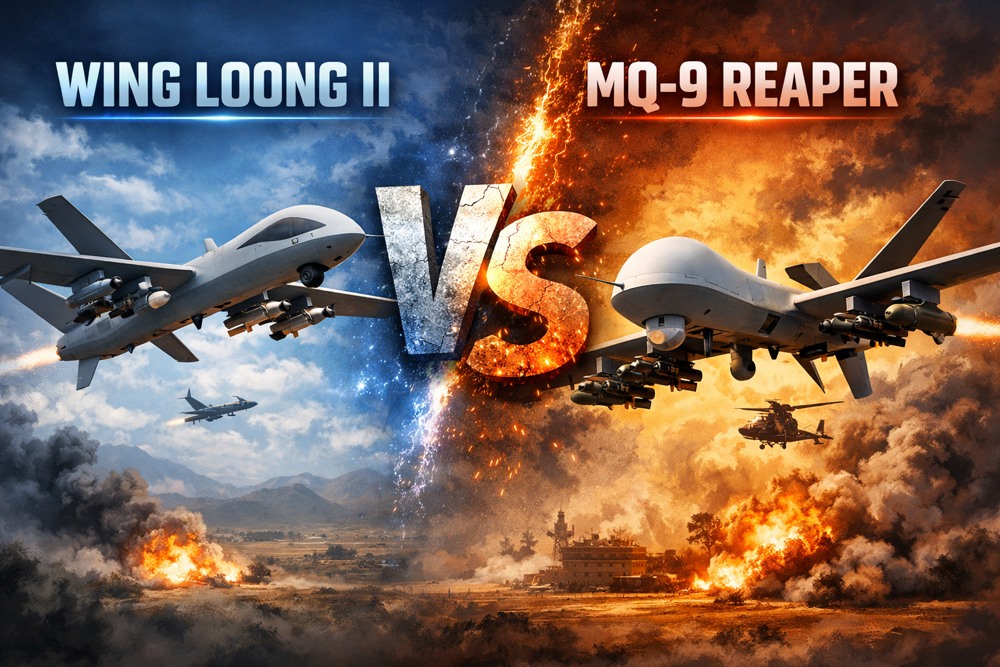
Unmanned Combat Aerial Vehicles (UCAVs) have redefined modern battlefields. These “Hunter-Killer” drones perform dangerous missions without risking human pilots. Today, the Wing Loong II and the MQ-9 Reaper dominate the global market. Specifically, these platforms offer persistent surveillance and precision strike capabilities. However, they represent different design philosophies and strategic goals. This article analyzes their technical strengths and their impact on global security.
Wing Loong II: China’s Precision Powerhouse
The Wing Loong II, also known as the GJ-2 in PLA service, is a medium-altitude long-endurance (MALE) fixed wing drone. Developed by the Chengdu Aircraft Industry Group (CAIG), it represents a major leap in Chinese aerospace. Moreover, it features an improved aerodynamic design compared to its predecessor. This aircraft uses a powerful turbocharged engine to carry heavy weapon loads at high altitudes. Consequently, it has become a favorite for nations seeking high-end technology at a competitive price [3].
MQ-9 Reaper: The Western Standard
The MQ-9 Reaper is the primary multi-mission UCAV for the United States Air Force. General Atomics designed this platform to replace the smaller MQ-1 Predator. In contrast to the Predator, the Reaper carries significantly more ordnance. It uses a high-performance Honeywell turboprop engine for superior speed. Furthermore, the Reaper integrates deeply with NATO battle networks. This makes it a formidable tool for high-intensity counter-terrorism and maritime surveillance missions [1].
Technical Specifications: A Side-by-Side View
Understanding these drones requires a look at their physical limits. On one hand, the MQ-9 offers a higher top speed. On the other hand, the Wing Loong II provides excellent performance for its cost.
| Feature | Wing Loong II (GJ-2) | MQ-9 Reaper (Block 5) |
|---|---|---|
| Max Takeoff Weight | 4,200 kg | 4,760 kg |
| Payload Capacity | 480 kg (Internal/External) | 1,700 kg (Total) |
| Service Ceiling | 9,000 meters | 15,240 meters |
| Top Speed | 370 km/h | 482 km/h |
Operational Endurance and Persistence
Endurance is the most critical metric for a MALE drone. A “loitering” drone stays over a target for hours to wait for the perfect moment. Specifically, the Wing Loong II can stay airborne for up to 20 hours. Similarly, the MQ-9 Reaper offers an endurance of roughly 27 hours. Therefore, the Reaper provides a slight advantage in long-range persistence. Nevertheless, the Wing Loong II’s satellite link allows for global operations far from its launch site [5].
Weapons and Sensor Integration
Both platforms utilize Electro-Optical/Infrared (EO/IR) turrets and Synthetic Aperture Radar (SAR). However, their weapon choices differ greatly. The Wing Loong II often carries the AKD-10 air-to-surface missile or LS-6 precision-guided bombs. Meanwhile, the MQ-9 primarily uses the AGM-114 Hellfire and GBU-12 Paveway bombs. Notably, China offers a wider variety of “small diameter” munitions. This allows the Wing Loong II to carry more individual weapons per mission [4].
Strategic Export Value and Global Presence
The real difference between these drones lies in their export policy. The United States applies strict rules to MQ-9 sales. In contrast, China offers the Wing Loong II to a broader range of partners. As a result, nations in the Middle East and Africa heavily utilize Chinese technology. Moreover, the lower maintenance cost makes the Wing Loong II more accessible for developing militaries. This shift is changing the balance of air power in regional conflicts [2].
FAQ: Common Questions on UCAV Warfare
9. References
[1] U.S. Air Force Official Fact Sheet. MQ-9 Reaper. https://www.af.mil/About-Us/Fact-Sheets/Display/Article/104470/mq-9-reaper/
[2] Stockholm International Peace Research Institute (SIPRI). Trends in International Arms Transfers. https://www.sipri.org/publications/2024/sipri-fact-sheets/trends-international-arms-transfers-2023
[3] China Daily. Wing Loong II Performance and Specs. https://www.chinadaily.com.cn/a/202311/05/WS6546f6e5a31090682a5edb0e.html
[4] Janes Defense Weekly. Air-Launched Munitions and UAV Integration. https://www.janes.com/defence-news/
[5] Defense News. The Evolution of MALE UAVs in Modern Warfare. https://www.defensenews.com/unmanned/