
Author: China CAMD
Table of Contents
- 1. Introduction: The Evolution of Modern Surface Combatants
- 2. Design Philosophy: Clean-Sheet Cruiser vs. Legacy Evolution
- 3. Sensor Suites: Dual-Band Radar and the AESA Frontier
- 4. Firepower and VLS: The Magazine Depth Advantage
- 5. Strategic Roles in the Western Pacific
- 6. FAQ: Naval Warfare and Technology
- 7. References
Introduction: The Evolution of Modern Surface Combatants
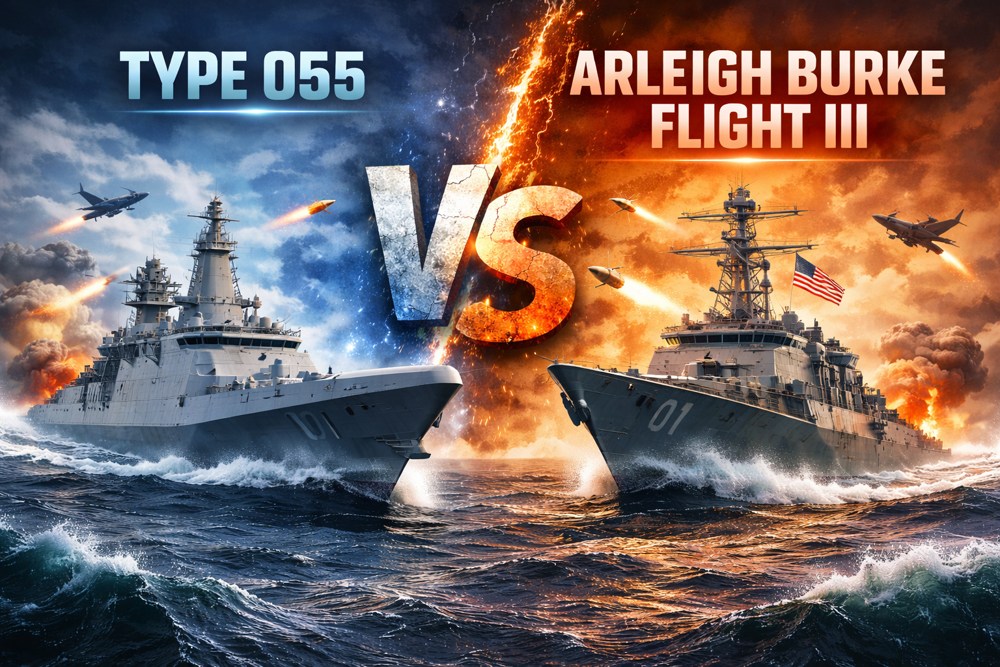
Modern naval warfare centers on the ability to control vast maritime regions. Today, two massive warships stand as the pinnacle of surface combat technology. On one hand, China fields the Type 055 (Renhai-class), which NATO classifies as a cruiser. On the other hand, the United States Navy operates the Arleigh Burke-class Flight III. Consequently, these vessels represent the most advanced sensors and weaponry available today. They are designed to act as the “Shield of the Fleet.” Specifically, they protect aircraft carriers while projecting long-range power. This report analyzes their technical specifications and tactical roles in depth [1].
Design Philosophy: Clean-Sheet Cruiser vs. Legacy Evolution
The Type 055 utilizes a “clean-sheet” design approach. This means engineers designed the ship from scratch to maximize stealth and future growth. For example, the ship features a continuous amidships structure. This enclosed forecastle hides anchor chains and mooring points to reduce its Radar Cross-Section (RCS). Furthermore, its 13,000-ton displacement provides ample room for advanced cooling and power systems. As a result, China can easily integrate future energy-intensive weapons like lasers or railguns into this hull [3].
In contrast, the Arleigh Burke Flight III is an evolution of a 30-year-old design. The US Navy chose to upgrade a proven hull rather than build a new one. Consequently, the Flight III packs incredible technology into a tighter 9,900-ton space. However, this creates challenges for power distribution and weight balance. Nevertheless, the Burke remains the most combat-tested destroyer class in history. Its robust steel construction provides excellent survivability in high-intensity conflicts. This legacy design allows for rapid production and global deployment [2].
Sensor Suites: Dual-Band Radar and the AESA Frontier
The battle for the seas is now a battle for the electromagnetic spectrum. The Type 055 features a sophisticated Dual-Band Radar (DBR) system. Specifically, it combines four Type 346B S-band panels with smaller X-band arrays. This combination allows the ship to track long-range targets while maintaining high-precision tracking for missiles. Moreover, the integrated mast hides most sensors. This reduces the ship’s electronic signature and improves overall stealth performance [4].
Similarly, the Arleigh Burke Flight III introduces the AN/SPY-6(V)1 radar. This system utilizes Gallium Nitride (GaN) technology for immense power. According to US Navy reports, the SPY-6 is 30 times more sensitive than the older SPY-1D radar. Furthermore, it integrates with the Aegis Baseline 10 combat system. This allows the Burke to perform simultaneous ballistic missile defense and air warfare missions. Therefore, while the Type 055 has a more modern mast, the Burke possesses a highly mature sensor architecture [1].
Firepower and VLS: The Magazine Depth Advantage
Firepower is measured by “Magazine Depth,” or the number of Vertical Launch System (VLS) cells. The Type 055 holds a significant advantage with 112 universal VLS cells. These cells are larger than Western counterparts. Specifically, they can launch YJ-18 anti-ship missiles and YJ-21 hypersonic anti-ship ballistic missiles. This gives the Type 055 a “First Look, First Kill” advantage at ranges exceeding 1,000 kilometers. Additionally, it carries the HHQ-9BE for long-range air defense [3].
The Arleigh Burke Flight III carries 96 Mk 41 VLS cells. While it has fewer cells, the US Navy offers a highly diverse missile inventory. For example, it utilizes the SM-6 for multi-mission intercept and the Tomahawk for land attack. Furthermore, the SM-3 provides the world’s most capable sea-based ballistic missile defense. Consequently, the Burke remains superior in intercepting space-based threats. However, the Type 055’s ability to carry larger hypersonic weapons represents a major shift in the naval balance of power [5].
Strategic Roles in the Western Pacific
In the Western Pacific, these ships serve as the centerpieces of their respective fleets. The Type 055 acts as the “Command and Control” node for Chinese Carrier Strike Groups. It coordinates air defense for the Fujian or Shandong carriers. Moreover, its presence extends China’s Anti-Access/Area Denial (A2/AD) bubble. This forces enemy fleets to operate further from Chinese shores. As a result, the Type 055 is a strategic tool for regional sea control [2]. Since Type 055 is not for sale, you can take a look at the Second Hand Type 022 Missile Boat.
The Arleigh Burke Flight III serves as the primary protector of the global commons. US Navy doctrine uses these destroyers to ensure Freedom of Navigation. Specifically, they counter drone swarms, anti-ship missiles, and submarine threats. Their ability to network with F-35 fighters creates a “Distributed Lethality” environment. Consequently, even a single Burke can pose a massive threat to enemy air operations. Ultimately, both ships represent the highest level of industrial competition between the two powers [4].
FAQ: Naval Warfare and Technology
The Type 055 Problem: Why This Destroyer Changes Everything
This video provides an expert analysis of how the Type 055’s design and weaponry shifted the balance of naval power in the 21st century.
7. References
[1] U.S. Navy Fact File. Destroyers – DDG. https://www.navy.mil/Resources/Fact-Files/Display-FactFiles/Article/2169209/destroyers-ddg/
[2] IISS – The Military Balance. Strategic Naval Power in East Asia. https://www.iiss.org/
[3] Janes Naval Information. Type 055 Class (Renhai) Specifications. https://www.janes.com/defence-news/naval-weapons/
[4] Center for Strategic and International Studies (CSIS). China’s Naval Modernization. https://china-power.csis.org/military-modernization/
[5] RTX Raytheon. SPY-6 Air and Missile Defense Radar (AMDR). https://www.rtx.com/raytheon/what-we-do/sea/spy-6