
The evolution of modern aerial warfare has transitioned from the saturation bombing patterns of the mid-20th century to a precision-engagement paradigm defined by the surgical application of kinetic and chemical energy. For ordnance specialists and tactical planners, the selection of an Air-to-Surface Missile (ASM) is no longer a matter of simply matching a platform to a target; it is a complex calculation of terminal effects, collateral damage mitigation, and SWaP-C optimization. The payload, or warhead, serves as the critical terminal component that determines mission success based on the structural integrity and defensive posture of the objective.
Key Takeaways
- Blast fragmentation warheads provide the most versatile solution for soft-skin targets and personnel suppression.
- Hard target penetrators rely on high-density materials and delayed fuzing to defeat reinforced concrete and subterranean structures.
- Thermobaric payloads excel in confined environments by utilizing atmospheric oxygen to extend overpressure duration.
- SWaP-C optimization is driving the development of multi-mode warheads that combine multiple kill mechanisms into smaller form factors.
- MIL-STD-810H compliance ensures payload integrity during high-G maneuvers and extreme thermal cycling on captive carry.
Blast Fragmentation Warhead Engineering
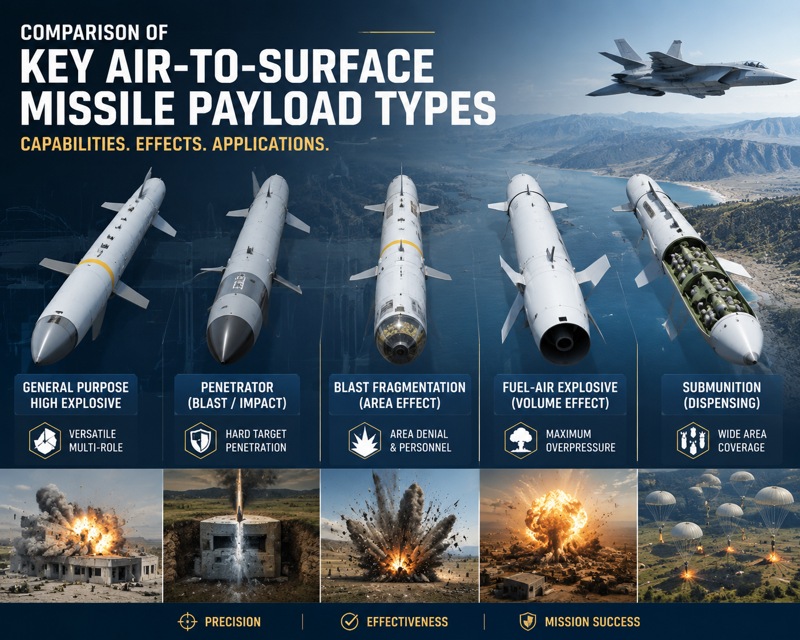
The blast fragmentation warhead remains the most prevalent payload in the global ASM inventory. Its primary mechanism of destruction is the projection of high-velocity fragments coupled with a localized blast overpressure wave. Engineering these payloads requires a delicate balance between the explosive-to-metal ratio and the fragment distribution pattern. In modern tactical environments, ordnance specialists prioritize controlled fragmentation to ensure predictable lethality radii.
The casing of a blast-frag warhead is typically constructed from high-strength steel or pre-formed tungsten alloys. Upon detonation, the explosive filler—often PBX (Polymer-Bonded Explosive) for its high stability and MIL-STD-810H compliance—accelerates fragments to velocities exceeding 2,000 meters per second. These fragments serve as the primary kill mechanism against “soft” targets such as unarmored vehicles, radar installations, and personnel. The blast wave itself, while devastating at close range, decays rapidly according to the inverse square law, making the fragmentation pattern the more reliable metric for tactical planners.
Material Science in Fragmentation Patterns
Modern payloads often utilize notched casings or discrete fragment liners to control the size and shape of the resulting debris field. This level of precision allows for optimized lethality against specific target sets while reducing the risk of unintended damage to adjacent structures. Ordnance management on the flight line, often tracked via rugged tablets, ensures that the correct fragmentation configuration is loaded for the specific mission profile.
Kinetic Energy Penetrator Material Selection
Defeating hardened targets such as command and control bunkers, aircraft shelters, and reinforced bridges requires a payload capable of surviving high-velocity impact without premature detonation. Kinetic Energy (KE) penetrators, or “bunker busters,” are designed with high length-to-diameter (L/D) ratios and thick-walled casings made from forged steel alloys or heavy metals like depleted uranium or tungsten. The objective is to concentrate the missile’s kinetic energy onto the smallest possible surface area to punch through meters of reinforced concrete.
The physics of penetration involve overcoming the compressive strength of the target material. A penetrator payload does not explode upon contact. Instead, it utilizes a sophisticated void-sensing fuse, such as the FMU-152/B Joint Programmable Fuze, to detect the transition from solid concrete to the air-filled chamber of a bunker. Only after the payload has reached the interior of the structure does the explosive filler detonate, maximizing the internal overpressure and structural damage. This requires the explosive itself to be highly insensitive to the massive G-loads experienced during the initial impact.
Thermobaric Overpressure Dynamics
Thermobaric payloads, also known as fuel-air explosives (FAE), represent a specialized class of ASM payloads designed for maximum effectiveness in confined spaces or against entrenched positions. Unlike conventional high explosives that carry their own oxidizer, thermobaric weapons utilize atmospheric oxygen to sustain a long-duration blast wave. The detonation occurs in two stages: an initial charge disperses a cloud of flammable aerosolized fuel, and a secondary charge ignites that cloud.
The resulting fireball creates a massive overpressure wave followed by a vacuum phase, which is particularly lethal in tunnels, caves, and urban structures. For tactical planners, the use of thermobaric payloads is an evaluative decision based on the environmental constraints of the target zone. These weapons are less effective in high-altitude or low-oxygen environments, making environmental intelligence critical. Ground observers and forward air controllers often utilize integrated tactical vests to carry the communications equipment necessary to relay these environmental variables to the strike platform.
Technical Comparison of Payload Kill Mechanisms
| Payload Type | Primary Mechanism | Typical Target Set | Explosive Filler | Casing Material |
|---|---|---|---|---|
| Blast-Fragmentation | Fragment Kinetic Energy | Soft Vehicles, Personnel | PBXN-109 / Comp B | Steel / Tungsten |
| Hard Target Penetrator | Sectional Density | Bunkers, Hardened Shelters | AFX-757 / PBXN-110 | Forged Steel Alloy |
| Thermobaric | Extended Overpressure | Urban Structures, Caves | Isotropic Fuel Slurry | Thin-wall Aluminum |
| Shaped Charge (HEAT) | Hyper-velocity Metal Jet | Main Battle Tanks | Octol / HMX | Copper Liner |
Multi Mode Warhead Technology and SWaP C
The drive for SWaP-C optimization (Size, Weight, Power, and Cost) has led to the development of multi-mode warheads. These payloads are engineered to provide mission flexibility, allowing a single missile to engage a variety of target types. By utilizing electronic safe-and-arm devices (ESAD) and programmable fuzing, a single warhead can be set for proximity detonation (against soft targets), point-detonation (against light armor), or delayed detonation (against structures).
Miniaturization is another key trend. Small Diameter Bombs (SDB) and lightweight ASMs allow a single aircraft to carry a larger number of munitions, increasing the “sorter-to-kill” ratio. However, smaller payloads require more advanced explosive chemistry and precision guidance to achieve the same lethal effect as larger, legacy warheads. This transition necessitates rigorous MIL-STD-810H testing to ensure that the complex electronics and high-energy density explosives can withstand the stresses of modern carrier-based operations and supersonic release.
Operational Readiness and Ruggedization
For the procurement specialist, the reliability of an ASM payload is as critical as its lethality. Payloads must maintain operational readiness throughout decades of storage and thousands of hours of captive carry. IP68 ruggedization of the electronic components within the fuzing system prevents moisture ingress and corrosion in maritime environments. Furthermore, the payload must be resistant to Electromagnetic Interference (EMI) and hazards of electromagnetic radiation to ordnance (HERO).
Tactical planners must also consider the logistics of payload handling. Modern modular designs allow for warhead sections to be swapped in the field, providing rapid reconfiguration of the air-wing’s strike capability. This modularity, however, places a high demand on ground crews to maintain strict adherence to safety protocols and inventory accuracy, often managed through digital asset tracking systems on the flight line.
Frequently Asked Questions
What is the primary difference between a penetrator and a blast warhead?
A penetrator warhead focuses on sectional density and case strength to survive impact and detonate inside a target, whereas a blast warhead prioritizes the rapid expansion of a shockwave and fragment projection upon contact or proximity.
How does MIL-STD-810H affect missile payload design?
MIL-STD-810H provides the testing framework for environmental stress, ensuring that the payload’s explosives and electronics can survive vibration, shock, thermal extremes, and humidity without degradation in performance or safety.
Why are thermobaric weapons preferred for urban environments?
Thermobaric weapons create a sustained overpressure wave that flows around obstacles and fills interior spaces, making them more effective than fragmentation weapons against targets shielded by walls or within complex building layouts.
What is SWaP-C optimization in missile technology?
SWaP-C stands for Size, Weight, Power, and Cost. In missile payloads, it refers to the engineering effort to maximize lethality and range while minimizing the physical footprint and manufacturing expense of the munition.