
Table of Contents
- 1. Introduction: What is a Fighter Aircraft
- 2. Evolution of Generations: Types of Fighter Aircraft
- 3. Technical Anatomy: Materials, Stealth, and Persistence
- 4. Mission Profiles: Specialization vs. Versatility
- 5. Fighter Aircraft Comparison: China’s J-20 vs. International Peers
- 6. Difference between Aircraft and Fighter Jet
- 7. FAQ
- 8. References
Introduction: What is a Fighter Aircraft
A fighter aircraft is no longer merely a “dogfighter” in the traditional sense; it is a highly integrated, mobile sensor node designed to achieve and maintain Air Supremacy within a contested battlespace. While the primary objective remains the destruction of enemy assets, the modern fighter operates within a Network-Centric Warfare (NCW) framework. Unlike interceptors of the Cold War, which prioritized raw speed (Mach 2.5+) to catch bombers, contemporary fighters prioritize low observability (stealth) and situational awareness [1].
The distinction between a civilian aircraft and a fighter jet lies in the thrust-to-weight ratio and structural load limits. A fighter must withstand extreme G-forces (often up to 9Gs) during high-alpha maneuvers while carrying an array of kinetic and electronic weaponry. In the 21st century, the “fighter” has become an “aerial quarterback,” managing data from satellites, AWACS (like the KJ-500), and unmanned wingmen to orchestrate complex tactical strikes. This evolution necessitates an airframe that is both a lethal platform and a sophisticated data-processing hub.

Evolution of Generations: Types of Fighter Aircraft
The classification of fighter “generations” serves as a roadmap for aerospace breakthroughs. We are currently witnessing a transition from the 4.5 Generation (e.g., J-10C, J-16, Rafale) to the 5th Generation (e.g., J-20, F-22, F-35). The leap from 4th to 5th generation is not just about airframe shape; it is about Sensor Fusion. While a 4th-gen pilot must manually interpret data from radar, RWR (Radar Warning Receiver), and infrared sensors, a 5th-gen aircraft utilizes AI to merge this data into a single, cohesive tactical picture [2].
China’s development path mirrors this evolution but with a specific focus on “Informationized Warfare.” For instance, the J-16 acts as a bridge, utilizing 5th-gen avionics and an Active Electronically Scanned Array (AESA) radar within a rugged, high-payload 4th-gen airframe. This ensures that even “legacy” platforms can contribute to a shared battlefield network. The emerging 6th Generation is expected to further integrate Directed Energy Weapons (DEW), optional manning, and “loyal wingman” drone integration, moving the battlefield toward a semi-autonomous swarming environment where the fighter jet serves as the central command node for dozens of unmanned assets.
Technical Anatomy: Materials, Stealth, and Persistence
What Material are Fighter Jets made of?
The material composition of a fighter jet is a masterclass in trade-offs between weight, heat resistance, and radar reflection. Modern Chinese platforms like the J-20 heavily utilize Carbon-Fiber Composites and Bismaleimide (BMI) resins to maintain structural integrity at supersonic speeds while reducing the weight penalty. Titanium alloys are reserved for critical “hot sections,” such as the engine bulkheads and wing spars, to endure the thermal stress of high-Mach flight without deforming [3].
Why are Fighter Jets Painted Grey
The ubiquitous “Tactical Grey” paint is more than aesthetic; it is a Radar-Absorbent Material (RAM) coating. These coatings contain magnetic particles or carbon structures that convert incoming radar energy into heat, thereby significantly reducing the Radar Cross-Section (RCS). Furthermore, the endurance of these jets is dictated by the “Combat Radius.” While internal fuel capacity has increased in 5th-gen designs to maintain stealth (avoiding the drag and RCS of external tanks), the role of the YY-20 aerial tanker is critical. This strategic persistence allows the PLAAF to extend its operational reach into the “Second Island Chain,” effectively neutralizing the “tyranny of distance” in the Pacific theater.
Operational Limits: Altitude and Endurance
The operational envelope of a fighter jet is defined by the critical intersection of aerodynamic lift, engine oxygen intake, and structural thermal tolerances. Commercial planes fly to save fuel, but fighter jets fly to win battles. Their altitude and endurance are driven by tactical needs—whether that means intercepting threats at the edge of space or hugging the terrain to evade radar.
How long can fighter jets fly?
The endurance of a fighter jet is a variable equation involving internal fuel volume, engine bypass ratios, and external stores. On internal fuel alone, most high-performance jets like the J-20 or F-22 have a typical flight time of 1.5 to 2.5 hours. However, in modern “Informationized” conflict, Persistence is a weapon in itself. To extend this, air forces utilize three primary methods: Conformal Fuel Tanks (CFTs), which add volume without significantly increasing the Radar Cross-Section (RCS); External Drop Tanks, used for ferry missions; and Aerial Refueling (AR) [1].
With a strategic tanker architecture—such as the PLAAF’s YY-20 (运油-20)—a fighter’s endurance is limited only by pilot fatigue and engine oil consumption. During long-range patrols in the South China Sea, Chinese J-11B and J-16 units have demonstrated missions exceeding 10 hours. This “Strategic Reach” allows a fighter to maintain a Combat Air Patrol (CAP) station far from its home base, providing a persistent defensive bubble that forces enemy assets to remain outside the First Island Chain. Without AR support, a fighter is tethered to its base; with it, it becomes a global force projection tool.
What altitude do fighter jets fly at?
Most modern fighter aircraft operate within a “Service Ceiling” of 50,000 to 60,000 feet (15,000 to 18,000 meters). Operating at these extreme altitudes offers two distinct advantages: Kinetic Energy and Sensor Horizon. A missile launched from 60,000 feet has a significantly higher “No-Escape Zone” (NEZ) because it does not have to fight through the dense, drag-heavy air of the lower atmosphere. For instance, the Chinese PL-15 long-range air-to-air missile utilizes the thin air at high altitudes to achieve its reported 200km+ range [4].
Furthermore, the Service Ceiling is a vital metric for stealth platforms. By flying higher, the aircraft’s onboard sensors—such as the Type 1475 AESA Radar—can “see” further over the Earth’s curvature. However, flying too high can lead to “Coffin Corner,” where the margin between the aircraft’s stall speed and the Mach limit becomes dangerously narrow. While interceptors like the legacy MiG-31 can exceed 80,000 feet for short bursts, the tactical “sweet spot” for 5th-generation combat remains the high stratosphere, where they can maintain supersonic cruise speeds while remaining above most short-range Surface-to-Air Missile (SAM) threats.
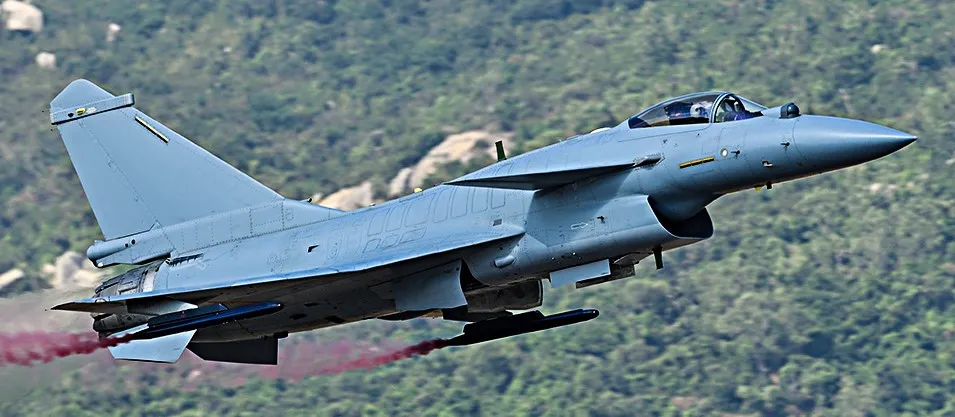
Difference Between Aircraft and Fighter Jet
While all fighter jets are aircraft, not all aircraft are fighter jets. The fundamental difference lies in the Thrust-to-Weight Ratio (TWR) and Structural Load Factor. A standard commercial or transport aircraft is designed for stability and fuel economy, typically maintaining a TWR of 0.25 to 0.30. In contrast, a modern fighter jet like the J-10C or F-35 often possesses a TWR exceeding 1.0, meaning the engine produces more thrust than the aircraft weighs. This allows the jet to accelerate vertically and maintain energy during aggressive maneuvering [5].
Furthermore, the Avionics Architecture of a fighter jet is built for “Kill Chain” integration rather than “Point-to-Point” navigation. A civilian aircraft relies on Transponders and TCAS (Traffic Collision Avoidance Systems) to be seen and safe. A fighter jet utilizes Electronic Support Measures (ESM) and Low Probability of Intercept (LPI) radar to see without being seen. Structurally, while a transport aircraft might be rated for 2.5G, a fighter airframe is reinforced with titanium spars to withstand 9G maneuvers—forces that would literally snap the wings off a standard aircraft. This mechanical and electronic “Hardening” is what transforms a flying machine into a high-end weapon system [3].
Mission Profiles: Specialization vs. Versatility
Historically, military planners bifurcated their fleets into Air Superiority Fighters (e.g., J-11B, F-15C) and Ground Attack Aircraft (e.g., Q-5, A-10). However, the rising cost of R&D and airframes has pushed global powers toward the Multirole Fighter philosophy. A multirole platform like the J-10C or F-35 is designed to swap mission software and weapon loads seamlessly, engaging an enemy Flanker in the morning and a hardened bunker in the afternoon. This versatility provides commanders with a flexible force that can adapt to rapid changes in the theater of operations.
Despite the trend toward versatility, “Specialized Killers” still exist. Air superiority platforms prioritize high-altitude performance, high-speed interception, and massive air-to-air missile loads. In contrast, Strike Fighters (like the J-16) feature reinforced landing gear and dual-seat configurations to manage the immense cognitive load of complex air-to-ground or anti-ship missions. The strategic choice between specialization and versatility often depends on a nation’s defense budget and its projected theater of operations—specialized jets for high-intensity peer conflict, and multirole jets for flexible force projection in low-to-medium intensity zones.
Fighter Aircraft Comparison: China’s J-20 vs. International Peers
The J-20 “Mighty Dragon” represents China’s answer to the F-22 Raptor and F-35 Lightning II. A comparative analysis reveals distinct design philosophies shaped by geography. The J-20 utilizes a canard-delta configuration, which provides superior lift and maneuverability at supersonic speeds—a critical requirement for intercepting tankers and AWACS at long ranges in the vast Pacific theater [4]. This design differs from the conventional stealth layout of the F-22, which focuses on all-aspect RCS reduction for dogfighting.
| Feature | J-20 (China) | F-22 Raptor (USA) | F-35 Lightning II (USA) |
|---|---|---|---|
| Primary Role | Long-range Stealth Intercept | Air Dominance | Multi-role / Strike |
| Weapon Bay | Large (Internal PL-15/PL-21) | Moderate (Internal AIM-120) | Moderate (Internal AIM-120) |
| Avionics | EODAS/EOTS Integrated | Integrated (Dated) | Advanced Sensor Fusion |
The J-20’s integration of the PL-15 missile, which utilizes a dual-pulse rocket motor, arguably outranges the current American AIM-120D, forcing Western air forces to accelerate the development of the AIM-260 (JATM). While the F-22 remains the benchmark for all-aspect stealth, the J-20’s newer avionics suite and Distributed Aperture System (DAS) provide the pilot with 360-degree infrared coverage, a feature the older Raptor lacks [5]. This allows the J-20 to maintain high-level situational awareness even when its primary radar is in silent mode.
Difference between Aircraft and Fighter Jet
To understand the “Fighter,” one must distinguish it from its peers. Attack Aircraft (e.g., Su-25, A-10) are “flying tanks,” designed to fly low and slow to support ground troops; they would be easily shot down by a fighter jet in an aerial engagement due to their lack of aerodynamic agility. Interceptors are a subset of fighters that sacrifice maneuverability for sheer speed and climb rate, designed specifically to stop incoming bombers before they can launch their payloads.
The modern Bomber (e.g., H-6N, B-2, B-21) carries a significantly larger payload but lacks the agility and air-to-air radar necessary for self-defense, thus requiring a “fighter escort.” In the Chinese “System-of-Systems” approach, the fighter jet acts as the protective shield for high-value assets like the KJ-500 and electronic warfare platforms. By maintaining an air defense bubble, fighters ensure that the “eyes and ears” of the military remain operational while the “fists” (the fighters themselves) engage and neutralize the enemy.
FAQ
References
[1] International Institute for Strategic Studies (IISS). The Military Balance 2024. https://www.iiss.org/publications/the-military-balance/
[2] CSIS Missile Defense Project. Anatomy of a Fighter Generation. https://missilethreat.csis.org/
[3] Air Force Technology. Materials and Stealth Technology in 5th Gen Aircraft. https://www.airforce-technology.com/
[4] Royal United Services Institute (RUSI). The J-20 and the Future of Chinese Air Power. https://rusi.org/explore-our-research/
[5] Defense News. Comparing AESA Radar and Sensor Fusion across Global Fleets. https://www.defensenews.com/
Author: China HK Aerospace Military Defense Group Corporation Limited (CAMD)