
When evaluating unmanned aerial vehicles (UAVs) for defense procurement, technical specifications are paramount. Among these, military drone flight altitude stands out as a critical operational parameter. Consequently, procurement officers frequently ask a fundamental question: how high can military drones fly?
The answer is not a single number. Instead, it varies drastically based on the drone’s classification, propulsion system, and intended mission profile. Generally, military UAVs operate anywhere from a few hundred feet to over 60,000 feet above sea level. Furthermore, understanding these altitude tiers is essential for selecting the right equipment for your specific defense needs.
In this comprehensive guide, we will dissect the service ceilings of various drone categories. We will also explore the strategic advantages of different altitude capabilities. Additionally, we will highlight how advanced Chinese military equipment fits into this competitive landscape.

Defining the Service Ceiling in Military Aviation
Before diving into specific numbers, it is important to define the term “service ceiling.” In aviation, this refers to the maximum usable altitude of an aircraft. Specifically, it is the height at which the aircraft can no longer rise at a rate greater than 100 feet per minute.
However, for military drones, altitude is more than just a performance metric. It dictates the line-of-sight (LOS) range for communications. Moreover, it determines the resolution of ground-based imaging sensors. Therefore, a higher service ceiling often translates to greater survivability against ground-based air defense systems.
Classification of UAVs by Altitude
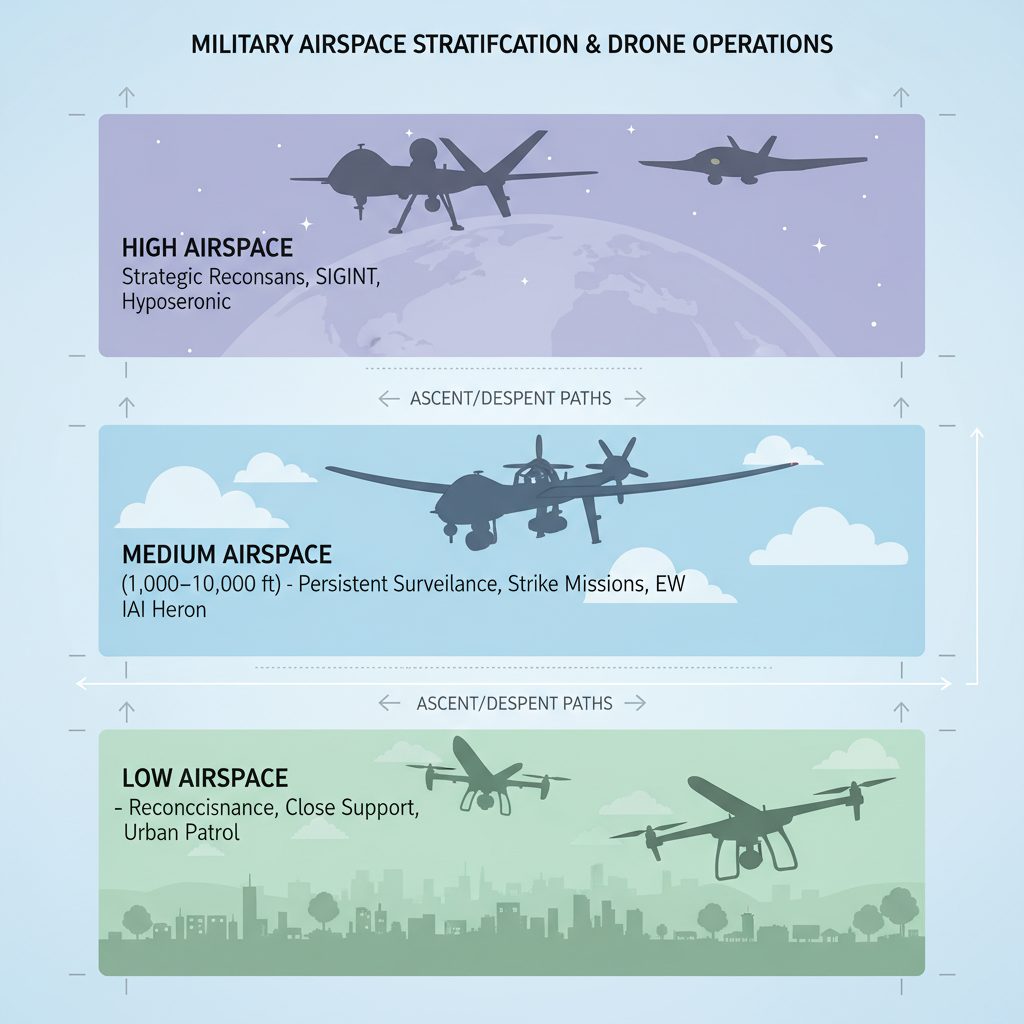
Military drones are typically categorized into three main distinct tiers based on their operational altitude. Each tier serves a unique tactical or strategic purpose on the battlefield.
1. Low-Altitude Tactical Drones (Tier I)
These systems are designed for immediate battlefield support. Typically, they are hand-launched or catapult-launched. Their primary role is short-range reconnaissance for platoon or company-level operations.
- Altitude Range: 500 feet to 15,000 feet (Above Mean Sea Level).
- Mission: Over-the-hill reconnaissance, target acquisition, and battle damage assessment.
- Example Usage: Monitoring urban environments or inspecting convoy routes.
Due to their lower operational height, these drones are often vulnerable to small arms fire. However, their small size and electric motors make them difficult to detect visually or acoustically.
2. Medium-Altitude Long-Endurance (MALE) Drones (Tier II)
This category represents the workhorses of modern aerial warfare. MALE drones are substantial aircraft. They require runways for takeoff and landing. Consequently, they carry heavier payloads, including synthetic aperture radar and precision-guided munitions.
- Altitude Range: 15,000 feet to 30,000 feet.
- Mission: Wide-area surveillance, border patrol, and strike operations.
- Strategic Value: They operate above the range of most anti-aircraft artillery (AAA) and MANPADS (Man-Portable Air-Defense Systems).
If you are looking to acquire systems with significant loiter time, MALE drones are often the optimal choice. For more details on these platforms, visit our military drones catalog.
3. High-Altitude Long-Endurance (HALE) Drones (Tier III)
At the apex of drone technology sit the HALE systems. These are strategic assets comparable to satellites in their surveillance utility. They are powered by jet engines or highly specialized turboprops.
- Altitude Range: 30,000 feet to 60,000+ feet.
- Mission: Strategic intelligence, signals intelligence (SIGINT), and persistent communications relay.
- Advantage: They fly above commercial air traffic and most weather systems, ensuring unobstructed observation.
Comparative Data: Chinese Military Drone Altitudes
China has become a global leader in UAV manufacturing. Their systems offer competitive military drone flight altitude capabilities compared to Western counterparts. Consequently, many international defense forces are integrating these platforms into their fleets.
Below is a technical comparison of popular Chinese export models and their service ceilings.
| UAV Model | Class | Service Ceiling (Feet) | Service Ceiling (Meters) | Endurance |
|---|---|---|---|---|
| Wing Loong II | MALE | 32,500 ft | 9,900 m | 32 Hours |
| CH-4 Rainbow | MALE | 23,600 ft | 7,200 m | 30 Hours |
| CH-5 Rainbow | MALE | 30,000 ft | 9,000 m | 60 Hours |
| WZ-7 Soar Dragon | HALE | 60,000+ ft | 18,000+ m | 10+ Hours |
As the table illustrates, systems like the Wing Loong II provide altitudes that effectively clear standard weather patterns. This ensures reliable data link stability during critical missions. Furthermore, the WZ-7 enters the stratosphere, offering near-satellite capabilities for a fraction of the cost.
Factors Limiting Drone Altitude
Why can’t all drones fly at 60,000 feet? Several engineering challenges impose limits on military drone flight altitude.
Aerodynamics and Air Density
As altitude increases, air density decreases. Consequently, the wings must generate more lift to keep the aircraft airborne. HALE drones typically feature massive wingspans to compensate for the thin air.
Propulsion Efficiency
Internal combustion engines require oxygen to function. At high altitudes, the lack of oxygen severely reduces engine power. Therefore, high-altitude drones require turbochargers or jet engines to maintain thrust.

Why Altitude Matters for Your Mission
Choosing a drone with the correct service ceiling is a strategic decision. If your mission involves covert surveillance, a higher altitude is preferable to reduce acoustic signature. Conversely, if you require detailed inspection of ground targets, a lower altitude tactical drone might be superior.
Additionally, high-altitude operations extend the Line of Sight (LOS) for radio communications. This allows a single HALE drone to act as a communications relay for ground troops spread over hundreds of miles. For more information on securing your airspace, consider exploring our anti-drone defense systems.
Furthermore, reliability at altitude is crucial. Reputable manufacturers ensure their platforms are tested under rigorous environmental conditions. For additional technical reading on aviation standards, you can refer to the European Union Aviation Safety Agency (EASA) guidelines.
Conclusion
In summary, the answer to “how high can military drones fly” ranges from the treetop level of tactical quadcopters to the stratospheric heights of HALE surveillance aircraft. Understanding these tiers is vital for effective defense procurement.
Whether you require the persistent overwatch of a MALE system like the Wing Loong II or the tactical agility of a smaller unit, choosing the right altitude capability ensures mission success. At Military Drone Pro, we specialize in sourcing top-tier Chinese military aviation technology for global clients.