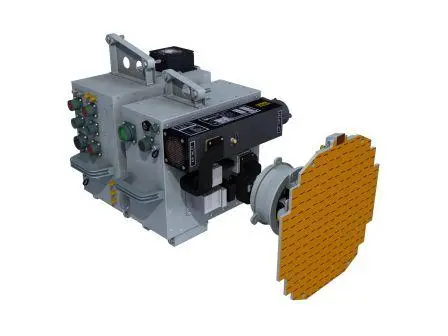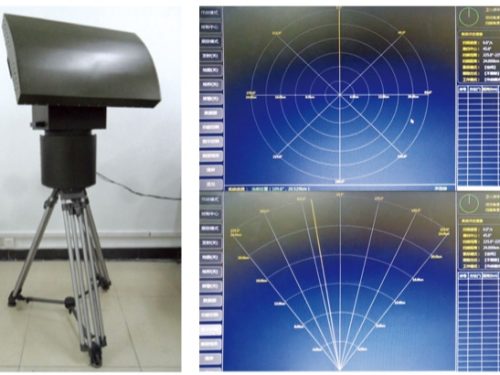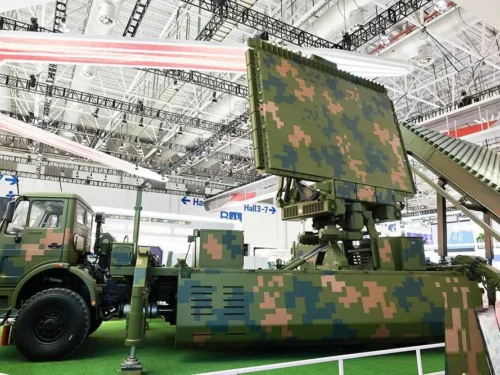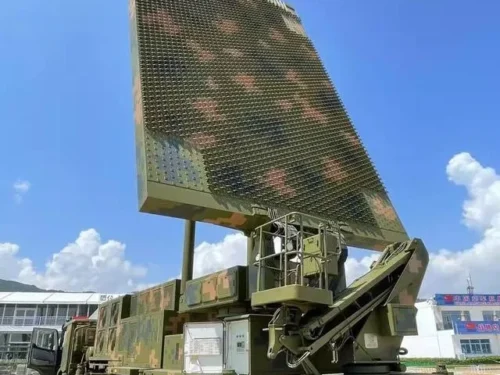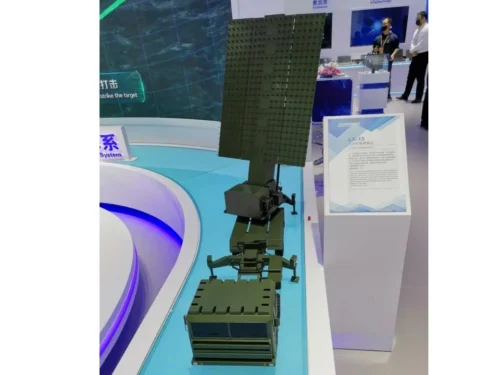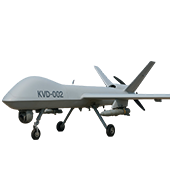

In recent years, in typical cases of regional conflicts and local wars, fighters, cruise missiles, and unmanned aerial vehicles for penetration at low and medium altitudes have played an increasingly important role. The suddenness of low-altitude operations has increased the pressure on ground air defense. In response to this threat, the 14th China Electric Power Research Institute has creatively developed a new generation of YLC-12 “Warning Tower” C-band mid-to-low-altitude multifunctional radar, which fully solves the detection problems of low- and medium-altitude, weak, low-speed, and high-maneuvering targets.
It is reported that the YLC-12 radar adopts the most advanced gallium nitride technology in the world and the advanced digital array two-dimensional phase scanning system. The radar comprehensively uses highly integrated module design, intelligent anti-jamming and comprehensive target type recognition technology, and has the characteristics of excellent low-altitude detection performance, high adaptability to position conditions, good maneuverability, strong resistance to complex electromagnetic environments, and accurate target radar recognition.
It is reported that the YLC-12 radar adopts the most advanced gallium nitride technology in the world and the advanced digital array two-dimensional phase scanning system. The radar comprehensively uses highly integrated module design, intelligent anti-jamming and comprehensive target type recognition technology, and has the characteristics of excellent low-altitude detection performance, high adaptability to position conditions, good maneuverability, strong resistance to complex electromagnetic environments, and accurate target radar recognition.
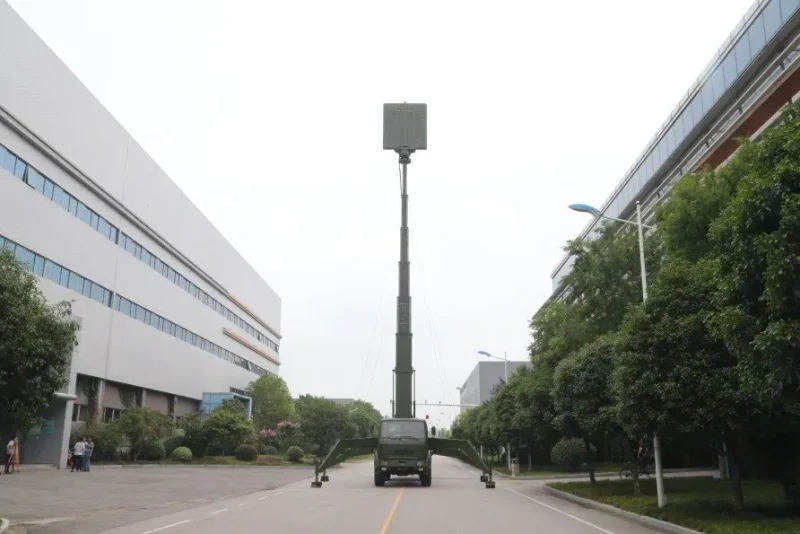
The YLC-12 radar has good detection capabilities for low-altitude small drones and other targets. YLC-12 is the radar model with the largest lifting height among the public radars. The lifting height is up to 18 meters. The reason for the design is mainly based on two considerations: First, we know that due to the influence of the curvature of the earth, “you can only see if you stand tall. For UAV targets coming in at low and ultra-low altitudes, the large lift of the radar antenna is conducive to the early detection and early disposal of the target. This design is of great significance to the effective rejection of UAVs; the second is the saying, “A leaf can not see Mount Tai. “Urban buildings and tall woods may make it difficult to select radar sites, and the combat effectiveness cannot be exerted. The elevated design allows the radar antenna to easily go over the obstruction, allowing unmanned aerial vehicles to have unobstructed views.
It is said that the radar comprehensively applies broadband, narrow beam, antenna low sidelobe design, pulse Doppler, moving target detection, adaptive moving target display and other technologies to ensure the detection performance of low-altitude targets. In order to better adapt to the complex electromagnetic environment, the radar adopts the intelligent anti-jamming design concept. Through the closed-loop mechanism based on environmental perception, intelligent decision-making, interference countermeasures and effect evaluation feedback, the radar anti-jamming measures can be matched with the interference environment to obtain the best anti-jamming. Interfere with earnings.
Key Features and Capabilities
-
C-Band Operation:
-
Operating in the C-band (approximately 4-8 GHz) offers a excellent balance between range, resolution, and weather penetration. This makes it particularly effective for:
-
Detecting low-altitude targets: Its wavelength is good at mitigating ground clutter, which is essential for seeing aircraft and missiles flying nap-of-the-earth.
-
Providing accurate tracking: It offers better resolution than lower frequency bands (like S-band), allowing for high-quality tracks suitable for weapon guidance.
-
-
-
Passive Phased-Array (PESA) Antenna:
-
The YLC-12 uses a passive electronically scanned array. This allows it to electronically steer its beam without physically moving the antenna, enabling it to:
-
Track multiple targets simultaneously.
-
Switch rapidly between search and track functions.
-
Perform low-probability-of-intercept (LPI) scans by dwelling on targets for very short periods.
-
-
-
High Mobility and Rapid Deployment:
-
The entire system is integrated onto a single high-mobility 6×6 truck. This includes the radar, a power generator, and a processing cabin for the crew.
-
It can deploy or stow its antenna and be ready to move in minutes. This “shoot-and-scoot” capability is vital for survival against anti-radiation missiles (ARMs) that home in on radar signals.
-
-
Electronic Counter-Countermeasures (ECCM):
-
The radar is equipped with advanced ECCM features, such as frequency agility, side-lobe blanking, and adaptive signal processing, to maintain operation in the face of enemy jamming and electronic warfare.
-
-
Multifunctional Role:
-
While its primary role is air defense, it is capable of performing several missions:
-
Air Surveillance: Detecting aircraft, helicopters, and UAVs.
-
Target Tracking: Providing quality track data for surface-to-air missile (SAM) systems.
-
Coastal Surveillance: Can be used to track surface vessels.
-
Weather Filtering: Able to distinguish between actual targets and weather clutter.
-
-
Technical Specifications (Estimated)
| Feature | Specification |
|---|---|
| System Name | YLC-12 |
| Developer | China Electronics Technology Group Corporation (CETC) |
| Role | Medium-Range Air Surveillance & Acquisition Radar |
| Frequency Band | C-band |
| Range | Aircraft-sized target: ~200 km (est.) Stealthy/Low RCS targets: ~50-80 km (est.) |
| Altitude Coverage | Low-to-Medium Altitude (optimized for under 5,000m) |
| Target Capacity | Can track dozens of targets simultaneously |
| Mobility | Integrated on a 6×6 high-mobility truck |
| Deployment Time | < 10 minutes |
Strategic Role and Purpose
The YLC-12 is designed to be a workhorse radar within a layered air defense network:
-
Gap Filler and Low-Altitude Sentinel: It is often deployed to cover the lower altitude gaps that longer-range, S-band surveillance radars (like the YLC-8B) might miss due to radar horizon limitations. It is exceptional at detecting pop-up threats like cruise missiles and low-flying aircraft.
-
Fire Unit Acquirer: It does not typically guide missiles itself. Instead, it provides accurate target detection and tracking data to command centers, which then cue short-to-medium-range SAM systems (like the HQ-16 or HQ-17). It tells the missile batteries where to look.
-
Network Integration: It is a key node in China’s integrated air defense system (IADS). It can share its track data in real-time with other radars, SAMs, and command posts, creating a comprehensive and resilient air picture.
-
Survivable Forward Deployment: Its high mobility allows it to be pushed forward to provide early warning for advancing forces or to protect key areas, while being able to relocate frequently to avoid destruction.
Comparison to Other Systems
-
vs. YLC-8B (UHF Band): The YLC-8B is a long-range, counter-stealth surveillance radar. The YLC-12 is a medium-range radar optimized for accuracy and low-altitude coverage. They are complementary: the YLC-8B detects stealth targets at long range, and the YLC-12 provides precise tracking and handles low-flying threats.
-
vs. JY-27A (VHF Band): The JY-27A is a very long-range, metric-wave radar for early warning and counter-stealth. The YLC-12 operates in a higher frequency band and is better suited for precise tracking and guiding engagements once a target is detected.
-
vs. Western Systems (e.g., GIRAFFE AMB): The Swedish GIRAFFE Agile Multi-Beam (now part of Saab) is a comparable C-band (or S-band) mobile radar with a similar role of providing medium-range air defense and weapon locating. The YLC-12 is China’s answer to this class of highly mobile, capable tactical air defense radars.
Conclusion
The YLC-12 is a sophisticated and highly mobile tactical radar that forms the “eyes” of medium-range air defense units. Its C-band operation and phased-array technology make it exceptionally capable at its core mission: finding low-flying, maneuvering threats in a cluttered and hostile electronic environment and ensuring that missile batteries have the accurate data they need to engage. Its design prioritizes mobility and electronic survivability, making it a resilient and effective component of any modern integrated air defense network.