
Key Characteristics and Capabilities:
-
Guidance System: The WS-32’s effectiveness hinges on its guidance package. It uses:
-
INS/GPS (Inertial Navigation System/Global Positioning System): This is the primary guidance method. The rocket uses its inertial system for initial flight and is updated by satellite navigation (almost certainly China’s BeiDou system) to accurately navigate to the target’s coordinates. This provides an all-weather, “fire-and-forget” capability.
-
-
Warhead: It is equipped with a unitary high-explosive (HE) warhead. The shift to a unitary warhead (a single, large explosive charge) instead of submunitions is significant. Because the rocket is so accurate, it doesn’t need to scatter bomblets over an area; it can place one large explosion directly on the target for maximum effect. This also avoids the lingering hazard of unexploded submunitions.
-
Range and Accuracy: The WS-32 is defined by its long range and high accuracy:
-
Range: It has an estimated maximum range of approximately 70 to 100 kilometers (43 to 62 miles), with some sources suggesting up to 150km for certain variants.
-
Accuracy: It boasts a very low Circular Error Probable (CEP), likely less than 10 meters. This precision allows it to reliably hit specific targets like buildings, bunkers, and vehicle formations.
-
-
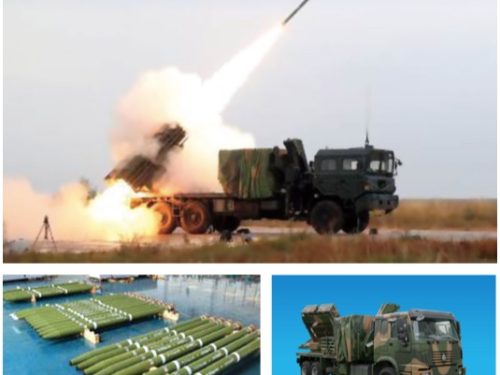
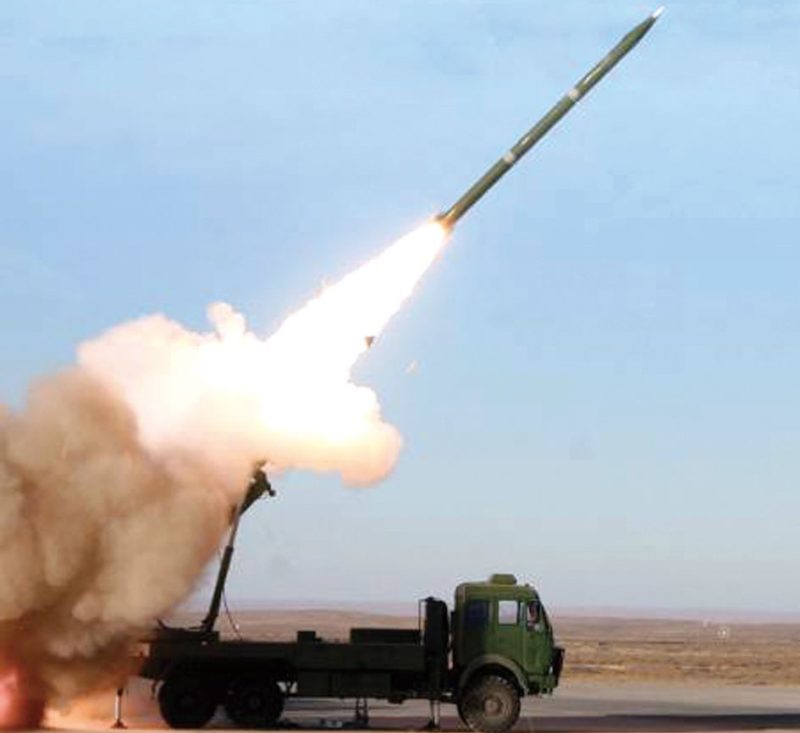
Launch Platform: The WS-32 is designed for high mobility and rapid engagement.
-
It is typically integrated onto an 8×8 high-mobility tactical truck.
-
The launcher assembly consists of two pods, each containing 4 rockets, for a total of 8 rockets per launcher vehicle.
-
This allows for a “shoot-and-scoot” tactic: fire a salvo and immediately relocate to avoid enemy counter-battery fire.
-
Comparison with Similar Weapons:
The WS-32 is China’s direct counterpart to modern Western precision rocket systems.
| Feature | Chinese WS-32 | US M142 HIMARS (GMLRS) | Chinese WS-1B | Short-Range Ballistic Missile |
|---|---|---|---|---|
| Caliber / Type | ~370mm Guided Rocket | 227mm Guided Rocket | 302mm Unguided Rocket | e.g., 600mm+ Ballistic Missile |
| Guidance | GPS/INS (BeiDou) | GPS/INS | Unguided / Basic INS | GPS/INS, possibly more |
| Range | ~70-100 km | ~70+ km | ~100-180 km (inaccurate) | ~300-1000 km |
| Accuracy (CEP) | < 10 meters | < 5 meters | > 500 meters | ~10-30 meters |
| Role | Long-Range Precision Strike | Long-Range Precision Strike | Long-Range Area Saturation | Strategic/Deep Strike |
-
vs. the US GMLRS (HIMARS): The WS-32 is China’s direct equivalent to the US GMLRS rocket. They fulfill the same tactical role: providing precise, long-range fire support. The GMLRS is a mature and combat-proven system with exceptional accuracy. The WS-32 represents China achieving a similar capability with a slightly larger rocket caliber.
-
vs. the WS-1B: This comparison highlights a revolution in capability. The older WS-1B has a similar range but is unguided, making it only useful for saturating a massive area the size of several city blocks. The WS-32 can use its range to precisely hit a single small target within that same area.
-
vs. a Ballistic Missile: The WS-32 is a rocket, not a ballistic missile. It is generally cheaper and has a shorter range than a tactical ballistic missile. However, its precision makes it suitable for engaging many tactical targets that would have previously required a missile, offering a more cost-effective solution for sustained operations.
Strategic Significance:
The WS-32 is a cornerstone of modern PLA doctrine for several reasons:
-
Transforms Rocket Artillery: It changes the role of rocket forces from area suppression to precision strike. A single battery can simultaneously engage multiple high-value point targets (e.g., command posts, radar sites, air defense units) with a single volley.
-
Extends the Battlefield: Its range allows it to strike deep behind enemy lines, disrupting logistics, reinforcements, and command and control before an engagement even begins. This is a key tenet of China’s “System Destruction Warfare” doctrine.
-
Provides Massed Precision: Unlike airstrikes or missiles which are limited in number, a battalion of WS-32 launchers can deliver a devastating barrage of dozens of precision-guided rockets in a very short time, overwhelming enemy defenses.
-
Enables Anti-Access/Area Denial (A2/AD): Deployed along the coast, systems like the WS-32 can threaten ships, aircraft, and bases operating within a vast maritime area, complicating an adversary’s ability to project power.