
Key Takeaways: Multi-Crew Operational Advantages
- Workload Distribution: Two-seat configurations divide piloting and mission system management, preventing cognitive saturation during high-intensity combat.
- Electronic Warfare (EW) Dominance: Dedicated Weapon Systems Officers (WSOs) manage complex jamming and suppression tasks in platforms like the EA-18G Growler.
- Complex Strike Profiles: Deep interdiction missions (e.g., F-15E Strike Eagle) benefit from a second crew member handling ground mapping radar and targeting pods while the pilot focuses on threat avoidance.
- Training Efficiency: Twin-seat variants allow for in-flight conversion training and proficiency checks for new airframes.
- Future Trends: While 5th-generation sensor fusion reduces the need for a second seat, Human-Machine Teaming (MUM-T) may evolve the role of the back-seater to a “Drone Commander.”
The strategic deployment of two-seat fighter aircraft remains a critical doctrinal choice for air forces worldwide, despite the increasing automation inherent in 5th-generation avionics. While single-seat platforms like the F-16 Fighting Falcon and the F-35 Lightning II dominate air superiority and multi-role conversations, the two-seat configuration—utilized in the F-15E Strike Eagle, F/A-18F Super Hornet, and Su-30MKI—serves specific, high-complexity operational requirements. For defense procurement specialists and military strategists, understanding the division of labor between the Pilot and the Weapon Systems Officer (WSO) is essential for evaluating platform suitability for contested environments.
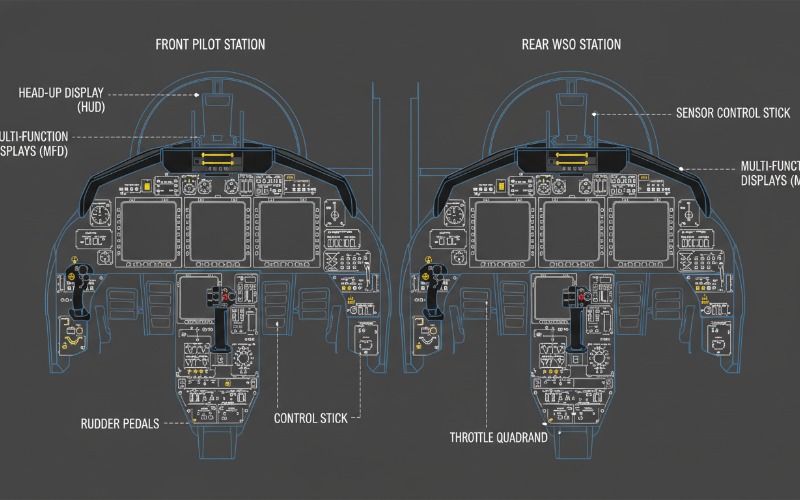
The Role of the Weapon Systems Officer
In a two-seat tactical aircraft, the individual in the rear cockpit is not merely a backup pilot; they are a mission specialist. Designated variously as a Weapon Systems Officer (WSO), Radar Intercept Officer (RIO), or Combat Systems Officer (CSO), this crew member manages the tactical picture while the pilot focuses on the physical manipulation of the aircraft. This division of labor is grounded in the concept of Crew Resource Management (CRM), designed to mitigate task saturation.
Cognitive Load Management in Contested Airspace
Modern air combat requires the processing of gigabytes of data in real-time. A pilot in a single-seat aircraft must simultaneously fly the jet, monitor fuel and engine operational limits, interpret radar data, listen to AWACS (Airborne Warning and Control System) instructions, identify threats, and execute weapon releases. In a “permissive” environment, this is manageable. However, in an Anti-Access/Area Denial (A2/AD) environment, the cognitive load spikes exponentially.
The presence of a WSO allows for parallel processing. In an air-to-ground interdiction mission involving an F-15E, the pilot’s primary responsibility is low-level terrain avoidance and air-to-air threat defense. Simultaneously, the WSO operates the Synthetic Aperture Radar (SAR) to map the target area, controls the FLIR (Forward Looking Infrared) targeting pod to designate the impact point, and manages the release of precision-guided munitions. This “hunter-killer” pairing significantly increases the probability of mission success in high-threat scenarios.
Electronic Warfare and Suppression of Enemy Air Defenses
The necessity of a second crew member is most visible in Electronic Attack (EA) platforms. The Boeing EA-18G Growler, a derivative of the Super Hornet, relies heavily on the Electronic Warfare Officer (EWO) seated in the rear. While the pilot positions the aircraft, the EWO manages a complex suite of ALQ-99 or Next Generation Jammer (NGJ) pods.
The EWO must detect enemy radar emissions, classify the threat (e.g., SA-21 Growler or naval radar), and apply specific jamming techniques to blind the enemy sensor without disrupting friendly communications. This electronic spectrum management requires intense focus and technical expertise that a single pilot, preoccupied with avoiding kinetic threats, cannot provide effectively. The two-seat configuration transforms the aircraft from a kinetic striker into a comprehensive node of electromagnetic dominance.
Comparison of Single and Multi-Crew Operational Capabilities
To quantify the operational differences, we examine the standard workflows for a Deep Strike Interdiction mission profile comparing a single-seat F-16C Block 50 against a two-seat F-15E Strike Eagle.
| Operational Parameter | Single-Seat (e.g., F-16C) | Two-Seat (e.g., F-15E) |
|---|---|---|
| Flight Path Control | Pilot (Primary) | Pilot (Primary) |
| Radar Manipulation | Pilot (Hands-On Throttle-And-Stick) | WSO (Dedicated MFD control) |
| Target Designation | Pilot (Must stabilize flight to target) | WSO (Independent of flight path) |
| Comms Management | Pilot (Single channel focus) | Split (Pilot: ATC/Flight Lead, WSO: AWACS/JTAC) |
| Situational Awareness | High load, tunnel vision risk | Distributed, 360-degree coverage |
| Endurance | Limited by pilot fatigue | Extended (alternating rest/monitoring) |
Training and Operational Conversion Efficacy
Beyond combat applications, the two-seat variant serves a vital logistical and training function within air forces. Most fighter airframes, including the Mirage 2000, Rafale, and Eurofighter Typhoon, feature twin-seat variants primarily for Operational Conversion Units (OCU).
The Physics of Conversion Training
Transitioning a pilot from a lead-in fighter trainer (LIFT) like the T-38 Talon or M-346 Master to a high-performance supersonic fighter is a significant leap in physics and systems management. The two-seat variant allows an instructor to ride along, monitoring avionics and taking control if the student pilot induces a Pilot-Induced Oscillation (PIO) or departs from controlled flight. For nations with smaller air forces or limited simulator infrastructure, the two-seat variant is non-negotiable for safe pilot generation.
The Impact of Sensor Fusion and AI
A common counter-argument to the two-seat configuration is the advent of 5th-generation sensor fusion. Aircraft like the F-35 Lightning II consolidate inputs from radar, electro-optical targeting systems (EOTS), and distributed aperture systems (DAS) into a single, cohesive picture presented on a panoramic cockpit display. The computer acts as the WSO, filtering noise and presenting actionable intelligence.
This automation has successfully enabled single-seat operations for missions that previously required two crew members. However, relying solely on automation assumes the algorithms will correctly prioritize threats in an unprecedented, chaotic electronic environment. Many operators argue that while the F-35 makes the pilot a “sensor manager,” the cognitive burden of decision-making in a multi-domain battle still favors a two-person crew for command-and-control capabilities.
Future Outlook: Manned-Unmanned Teaming
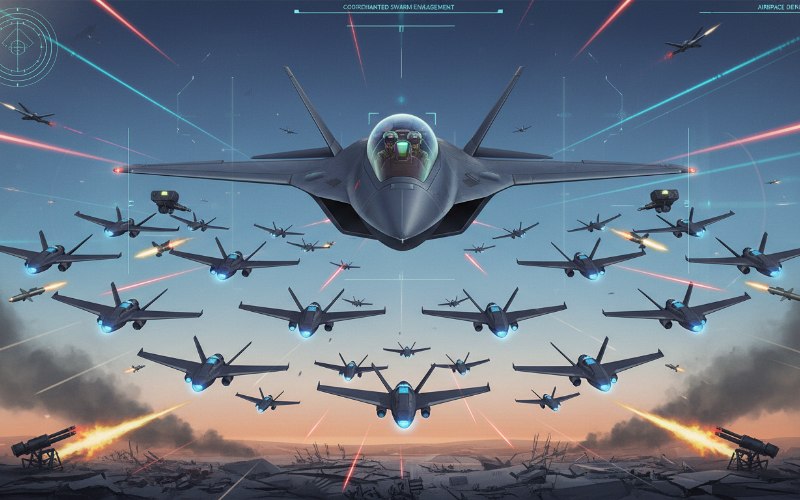
The future of the “back-seater” is evolving toward Manned-Unmanned Teaming (MUM-T). As outlined in programs like the Next Generation Air Dominance (NGAD), the role of the second crew member may shift from managing onboard sensors to commanding loyal wingman drones.
In this operational concept, the pilot flies the mothership and maintains immediate air safety, while the Mission Commander (formerly the WSO) directs a swarm of Collaborative Combat Aircraft (CCA). These drones act as forward sensors, decoys, or weapons trucks. The complexity of managing autonomous swarms likely exceeds the bandwidth of a single pilot, suggesting that the two-seat configuration will persist, albeit with a redefined job description focused on drone orchestration rather than direct radar manipulation.
Strategic Procurement Considerations
For defense integrators and government procurement agencies, the choice between single and dual-seat variants involves balancing unit cost, training requirements, and mission profile flexibility. Two-seat aircraft generally incur higher Life Cycle Costs (LCC) due to increased weight, complexity of life-support systems (two ejection seats, dual OBOGS), and double the personnel requirements per flight hour.
However, the versatility offered by the second seat—ranging from training utility to complex strike coordination and future drone control—often justifies the expenditure for air forces facing near-peer adversaries with sophisticated Integrated Air Defense Systems (IADS).
Frequently Asked Questions
Does the second pilot have flight controls?
Yes, in almost all modern two-seat fighters (like the F-15E, F/A-18F, and F-16D), the rear cockpit is equipped with a stick and throttle. However, visibility is often restricted compared to the front seat, so the rear pilot typically only flies during emergencies, relief on long transits, or training scenarios.
Why are 5th-generation fighters usually single-seat?
5th-generation fighters like the F-22 and F-35 utilize advanced sensor fusion and artificial intelligence to automate the tasks previously handled by a WSO. The avionics collate radar, infrared, and EW data into a single intuitive display, reducing pilot workload enough to make single-seat operations viable for complex missions.
What is the difference between a WSO and a Pilot?
A Pilot is trained primarily in aerodynamics, flight maneuvering, and air-to-air tactics. A Weapon Systems Officer (WSO) is a specialized flight officer trained in radar theory, electronic warfare, ground targeting, and communications. While they share mission responsibilities, their technical specializations differ.
Can a two-seat fighter fly with only one pilot?
Yes, the aircraft is fully flyable from the front seat alone. However, flying a two-seat configured jet solo may limit operational capability in combat, as the pilot would have to manage all sensors and weapons systems designed to be shared between two crew members.