
The 21st-century battlefield has been fundamentally reshaped by the proliferation of Unmanned Aerial Systems (UAS), commonly known as military drones. These systems have evolved from simple reconnaissance tools into a diverse, indispensable, and highly specialized category of military hardware.
However, the term “drone” is exceptionally broad. It encompasses everything from a 30-gram micro-drone used by an infantry squad to a 15-ton strategic reconnaissance jet with the wingspan of a passenger airliner.
As a chief defense analyst, I can clarify that these systems are not a single category but a vast range of assets classified by their performance, size, and—most importantly—their mission. Understanding these distinctions is critical to analyzing modern warfare and defense technology.
This guide provides a professional breakdown of the primary types of military drones, from the high-altitude strategic platforms to the tactical “kamikaze” drones changing modern conflicts.

Classifying Drones by Performance
The most common method for classifying military UAVs is by their performance envelope: their altitude, endurance (how long they can fly), and range. This framework, often based on NATO standards, divides them into distinct operational tiers.
HALE (High-Altitude, Long-Endurance)
HALE platforms are the “strategic satellites” of the atmosphere. These are massive, sophisticated aircraft designed to operate at extreme altitudes (often above 60,000 feet) for more than 24 to 40 hours at a time.
- Primary Mission: Their lofty perch places them above most air traffic and many air defense systems, making them ideal for persistent, wide-area Intelligence, Surveillance, and Reconnaissance (ISR). They scan vast swaths of land or sea, monitoring communications (Signals Intelligence or SIGINT) and tracking targets for strategic-level command.
- Key Attributes: They feature very long, efficient wings, powerful turbofan or turboprop engines, and large, complex sensor payloads, including high-resolution AESA radars, electronic intelligence suites, and long-range optical cameras.
- Prominent Examples:
- Northrop Grumman RQ-4 Global Hawk (USA): The most iconic HALE platform, providing strategic ISR data for the U.S. and its allies.
- Guizhou WZ-7 “Soaring Dragon” (China): A distinctive Chinese HALE platform known for its unique “joined-wing” design, built for long-range maritime and border reconnaissance.

MALE (Medium-Altitude, Long-Endurance)
MALE drones are the versatile “workhorses” of modern warfare. This is arguably the most recognized and proliferated category, balancing significant endurance (15-40 hours) with a large payload capacity while operating at medium altitudes (20,000 to 45,000 feet).
- Primary Mission: The MALE category is the heart of the UCAV (Unmanned Combat Aerial Vehicle) revolution. These drones are not just for watching; they are for acting. They perform persistent armed ISR, battlefield overwatch, and precision strikes against time-sensitive targets.
- Key Attributes: They are large enough to carry a meaningful weapons load, typically including precision-guided missiles (like the Hellfire) and laser-guided bombs, in addition to advanced electro-optical/infrared (EO/IR) sensor turrets.
- Prominent Examples:
- General Atomics MQ-9 Reaper (USA): The primary “hunter-killer” drone for the U.S. Air Force and the standard by which most MALE UCAVs are measured.
- CASC CH-5 “Rainbow” / AVIC Wing Loong II (China): A family of advanced Chinese MALE UCAVs that have seen significant export success and combat use globally.
- Baykar TB2 Bayraktar (Turkey): A lighter, cost-effective MALE drone that gained global fame for its decisive impact in recent conflicts, proving the lethality of precise, persistent air power.
You can explore a variety of advanced MALE and HALE platforms in the Military Drone category.

Drones for the Battlefield
As you move from the strategic to the tactical level, drones become smaller, more numerous, and focused on the immediate needs of commanders on the ground.
Tactical Unmanned Aerial Systems (TUAS)
These systems are the “eyes” of the brigade or division commander. They are smaller than MALE drones and have shorter endurance (typically 5-20 hours) but are designed to operate closer to the front lines.
- Primary Mission: Their main role is to provide real-time, “over-the-hill” reconnaissance. They find enemy positions, acquire targets for artillery and rocket units, and conduct post-strike Battle Damage Assessment (BDA).
- Key Attributes: Many TUAS are catapult-launched and recovered via net or belly-landing, removing the need for a runway and allowing them to operate from forward bases.
- Prominent Example:
- Textron RQ-7 Shadow (USA): A workhorse TUAS for the U.S. Army for decades, providing direct reconnaissance for brigade combat teams.
Small/Micro UAVs (SUAS)
These are man-portable systems that provide “over-the-wall” intelligence for squads and platoons. They are the smallest, most numerous, and most intimate form of air support.
- Primary Mission: Immediate, close-in reconnaissance. A soldier can deploy one to check a rooftop, look around a corner, or scout a building before entering.
- Key Attributes: Often hand-launched or Vertical Take-Off and Landing (VTOL), electrically powered for a low-noise signature, and have an endurance of less than an hour.
- Prominent Example:
- AeroVironment RQ-11 Raven (USA): A classic hand-launched “mini-drone” used extensively by U.S. and NATO forces.
- Teledyne FLIR Black Hornet Nano (Norway/USA): A true “micro-drone” weighing just ounces, it resembles a small helicopter and can be carried in a soldier’s pocket.
- Rainbow CH-801 Hand Thrown Drone: easy to install and easy to carry, and can be used in environmental monitoring, forest fire prevention, coastal patrol, Marine exploration and other fields.

Classifying Drones by Specialized Mission
Beyond performance, some of the most disruptive drones are defined by their unique, highly specialized combat roles.
Loitering Munitions (LMs) – The “Kamikaze” Drone
This is one of the fastest-growing and most disruptive categories. A Loitering Munition is a hybrid of a drone and a missile.
- Mission Profile: It is launched without a specific target. It flies to a target area and “loiters,” streaming live video back to an operator. The operator identifies an enemy target (like a tank, artillery piece, or command post) and then commands the drone to dive directly into it, destroying both the target and itself.
- Strategic Impact: LMs dramatically shorten the “sensor-to-shooter” timeline from hours to minutes. They provide precision-strike capabilities to small, mobile units, bypassing the need for traditional air or artillery support.
- Prominent Examples:
- AeroVironment Switchblade (USA): A tube-launched LM that comes in small (anti-personnel) and large (anti-armor) variants.
- ZALA Lancet (Russia): A larger, V-winged loitering munition that has seen extensive use against high-value targets.
- IAI Harop (Israel): A larger, pioneer “anti-radiation” loitering drone designed to hunt and destroy enemy air defense radars.

Electronic Warfare (EW) & Decoy Drones
Not all drones are designed to see or shoot. Some are designed to shape the electromagnetic battlefield.
- Mission Profile: These drones can be tasked with jamming enemy radar, spoofing communications, or collecting electronic intelligence. A key emerging role is the Miniature Air-Launched Decoy (MALD). These drones are launched from a larger aircraft (like a fighter or bomber) and fly ahead, mimicking the radar signature of their parent aircraft to confuse enemy air defenses and soak up enemy missiles.
The Future: AI, Swarms, and Loyal Wingmen
The next generation of military drones will be defined by autonomy. Instead of being remotely piloted, they will be “on-the-leash,” using AI to navigate, identify targets, and make decisions in coordination with a human operator.
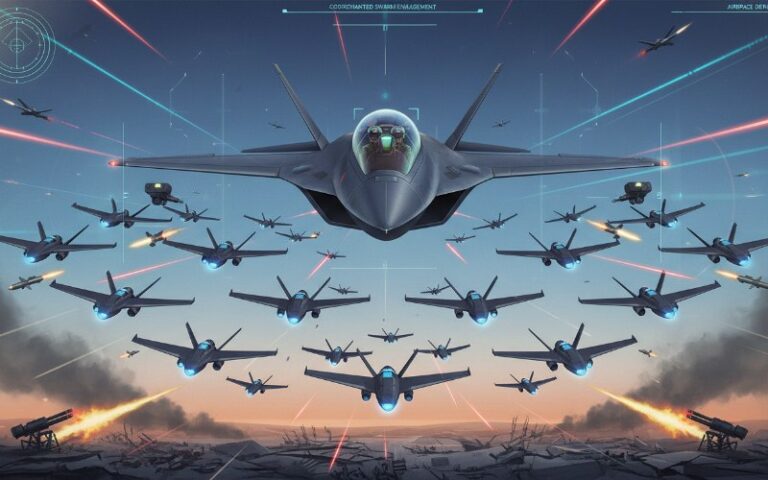
This leads to two key concepts: drone swarming (large numbers of interconnected, autonomous drones overwhelming a target) and the “Loyal Wingman” concept. This involves high-performance, jet-powered UCAVs (like the Kratos XQ-58 Valkyrie) flying alongside crewed fighters (like an F-35 or J-20) to act as sensor platforms, weapons carriers, and autonomous decoys.
From HALE to MALE, and from tactical UAVs to loitering munitions, the era of unmanned systems is here. Understanding this diverse and rapidly evolving technology is no longer optional—it is essential for comprehending modern military power.