
Key Characteristics and Capabilities:
-
Guidance System: The TS-01 is primarily a laser-guided missile. It uses Semi-Active Laser Homing (SALH).
-
How it works: The target must be illuminated by a laser designator until the moment of impact. The laser can be provided by the launch unit itself, a separate designator operated by another soldier, or an unmanned aerial vehicle (UAV).
-
Implication: This makes it highly accurate but requires the designator to maintain a line-of-sight to the target, which can be risky. It is not a true “fire-and-forget” system.
-
-
Warhead: It is equipped with a tandem high-explosive anti-tank (HEAT) warhead. This design is effective against armored targets protected by explosive reactive armor (ERA). The “multi-purpose” nature suggests the warhead is also effective against fortifications, light vehicles, and even slow, low-flying aircraft like helicopters.
-
Range: It has a moderate engagement range. Reports suggest a minimum range of around 500 meters and a maximum range of approximately 2.5 to 3 kilometers (1.5 to 1.8 miles). This provides a useful stand-off distance for the infantry team operating it.
-
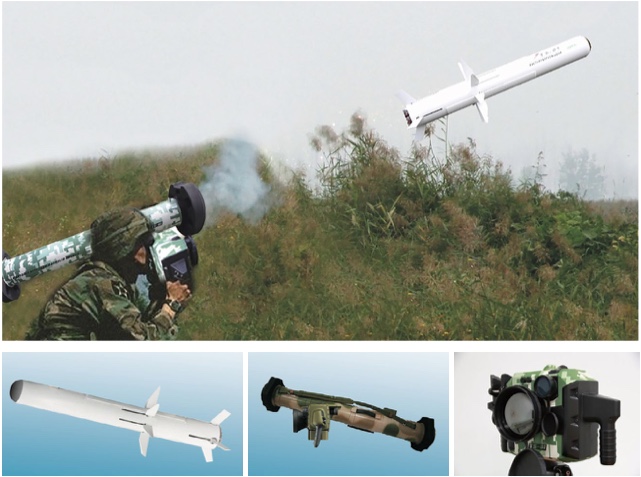
Launch Platform: Its defining feature is its flexibility. It can be deployed in multiple configurations:
-
Tripod-mounted: For stable, sustained firing from a defensive position.
-
Vehicle-mounted: Installed on light tactical vehicles, providing mobile fire support.
-
Helicopter-mounted: Potentially used on light helicopters or UAVs for air-to-ground attacks.
-
Comparison with Similar Weapons:
The TS-01 fits into a niche between larger, heavier missile systems and smaller, single-role weapons.
| Feature | Chinese TS-01 | US FGM-148 Javelin | AGM-114 Hellfire | Chinese HJ-8 |
|---|---|---|---|---|
| Guidance | Semi-Active Laser | Fire-and-Forget IIR | Laser, IIR, MMW | Semi-Active Laser |
| Launch Type | Multi-Platform (Tripod, Vehicle) | Man-Portable | Air, Ground, Sea Platforms | Tripod-mounted |
| Fire-and-Forget | No | Yes | Yes (most variants) | No |
| Primary Role | Multi-Purpose (Anti-Armor, Anti-Fortification) | Top-Attack Anti-Tank | Anti-Armor, Anti-Bunker | Anti-Tank |
| Crew | 1-2 | 1-2 | N/A (Platform crew) | 2-3 |
-
vs. the Javelin: The key difference is guidance. The Javelin is fire-and-forget using an Imaging Infrared (IIR) seeker; the soldier can immediately take cover after launch. The TS-01 requires the operator to keep the laser on the target, exposing them to return fire. However, the TS-01 is designed to be more flexible in its deployment options.
-
vs. the HJ-8: The TS-01 is a lighter, more modern system. The HJ-8 is a heavier, tripod-mounted anti-tank missile that requires a larger crew. The TS-01 offers similar laser guidance but with greater mobility and multi-role potential.
-
vs. the Hellfire: The Hellfire is a much larger, heavier missile with greater range and power. The TS-01 can be thought of as a “mini-Hellfire” for light infantry and vehicle use, bringing similar laser-guided precision to a much smaller tactical level.
Strategic Significance:
The TS-01 is significant because it:
-
Brings Precision to the Squad Level: It provides infantry platoons and squads with an organic, precise capability to engage hardened points (bunkers, machine gun nests) and armored vehicles without relying on heavier company-level assets or air support.
-
Is Highly Adaptable: Its ability to be fired from a tripod, a vehicle, or potentially from the air makes it a valuable asset for special forces, light infantry, and reconnaissance units that need a flexible weapon system.
-
Offers a Cost-Effective Solution: As a laser-guided missile, it is likely less expensive than more advanced fire-and-forget systems like the Javelin, allowing for wider distribution among troops.
-
Fills a Multi-Role Niche: Its multi-purpose warhead allows a single weapon system to address multiple threats (tanks, buildings, light vessels, helicopters), simplifying logistics and training for light units.
In summary, the TS-01 is a lightweight, laser-guided, multi-purpose missile system designed to provide light infantry and special forces with a flexible and precise direct-fire support weapon. It is not the most advanced system in terms of guidance, but its versatility and adaptability make it a valuable tool for modern tactical engagements.