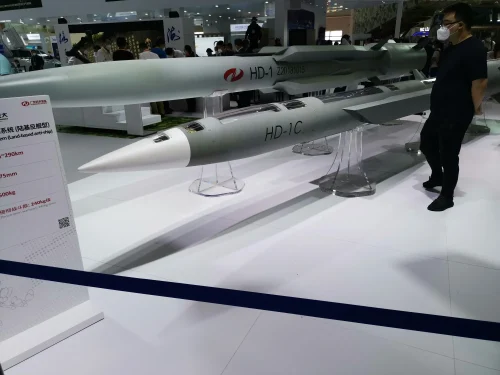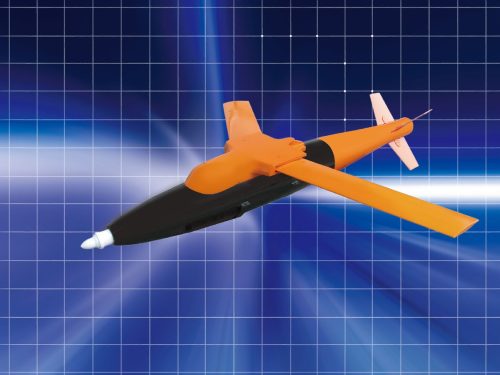


The TL-1 missile uses a large aspect ratio folding wing, uses a TV/infrared image seeker and a two-way data link for image homing guidance, and has “lock before launch + don’t care after launch” and “lock after launch + Human-in-the-loop control” and other combat modes.
As a light airborne air-to-ground guided missile system, The TL-1 air-to-surface missile can be launched by UAV and helicopter, and perform accurate attack on solid fortifications, including small-sized command post, moving target on ground (such as armored cars), small-sized target on water (such as PGM missile gunboat and patrol boat), etc. .
TL-1 Air-To-Surface Missile Specification
| Range | 3-20 km |
| Diameter of Missile | Φ175 mm |
| Length of Missile | 1,960 mm |
| Maximum Speed | Mach 0.8 |
| Guidance Mode | INS / GNSS + IR / Imaging terminal homing guidance + data link |
| Accuracy | CEP ≤ 1 m |
| Weight | 80 kg |
| Weight of Warhead | 14 kg |
| Type of Warhead | Penetration / Fragment warhead |
Key Characteristics and Capabilities:
-
Guidance System: Its primary and most distinguishing feature is its Semi-Active Laser Homing (SALH) seeker.
-
How it works: The target must be “painted” (illuminated) by a laser designator until the moment of impact. The laser designator can be on the launching aircraft, another aircraft, or from ground forces.
-
Implication: This makes it highly accurate but requires the launch platform or a companion to remain exposed and focused on the target throughout the missile’s flight. It is not a “fire-and-forget” weapon.
-
-
Warhead: It features a unified high-explosive blast/fragmentation warhead,
optimized for destroying hardened structures. -
Range: It has a shorter range compared to the TL-2, estimated to be around 15-20 kilometers (9-12 miles). This shorter range is due to its simpler rocket motor and the need for the laser designator to maintain a clear line-of-sight to the target.
-
Launch Platform: The TL-1 is integrated on several Chinese fighter and attack aircraft, including the Nanchang Q-5 Fantan, the Chengdu J-7, and the Shenyang J-8. These are older platforms, and the TL-1 provided them with a much-needed precision strike capability they previously lacked.
Comparison with TL-2 and Similar Weapons:
The TL-1 is a generation behind the TL-2. Here’s how they differ:
| Feature | Chinese TL-1 | Chinese TL-2 | US AGM-114 Hellfire | French AS-30L |
|---|---|---|---|---|
| Guidance | Semi-Active Laser | GPS/INS + (Optional Laser) | Semi-Active Laser | Semi-Active Laser |
| Fire-and-Forget | No | Yes (in GPS mode) | No | No |
| Range | Short (~18 km) | Long (>50 km) | Short (~8 km) | Short (~11 km) |
| Role | Tactical Precision Strike | Stand-Off Precision Strike | Anti-Armor / Precision | Precision Strike |
-
vs. the TL-2: The key difference is guidance. The TL-1’s laser guidance is weather-dependent (can be obscured by smoke, fog, or rain) and puts the designator at risk. The TL-2’s GPS/INS guidance allows for all-weather, fire-and-forget launches from a much safer distance.
-
vs. the Hellfire: The TL-1 is larger and has a more powerful warhead designed for larger structures, whereas the Hellfire was originally designed as an anti-tank missile.
-
vs. the AS-30L: They are very similar in concept—both are large, laser-guided missiles designed to give tactical aircraft a precise, hard-hitting strike option.
Strategic Significance and Role:
The TL-1 was significant because it:
-
Bridged a Technology Gap: It provided the PLAAF and PLANAF (Naval Air Force) with their first domestically produced, effective laser-guided air-to-surface missile, a crucial step in modernizing China’s arsenal.
-
Enhanced Older Platforms: It extended the operational relevance of older 2nd and 3rd generation Chinese fighter jets by giving them a precision attack role they never had before.
-
Paved the Way: The experience gained from the TL-1’s development and deployment was directly applied to creating the more advanced and capable TL-2 and other munitions in the family.
In summary, the TL-1 is a capable but dated laser-guided missile that represents an important evolutionary step in Chinese weapons development. It is effective in its niche for close-range, precision strikes but has been largely superseded by the more flexible and survivable TL-2 and other next-generation munitions for front-line aircraft.
-500x375.webp "X-29 Missile (KH-29 Missile )")