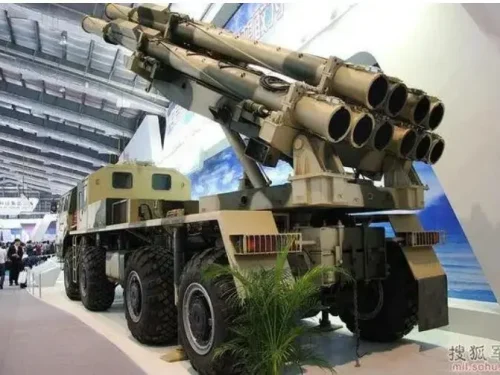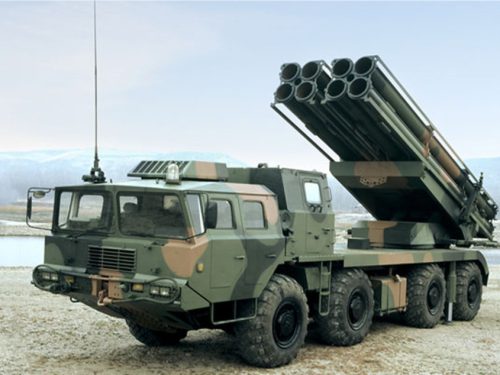

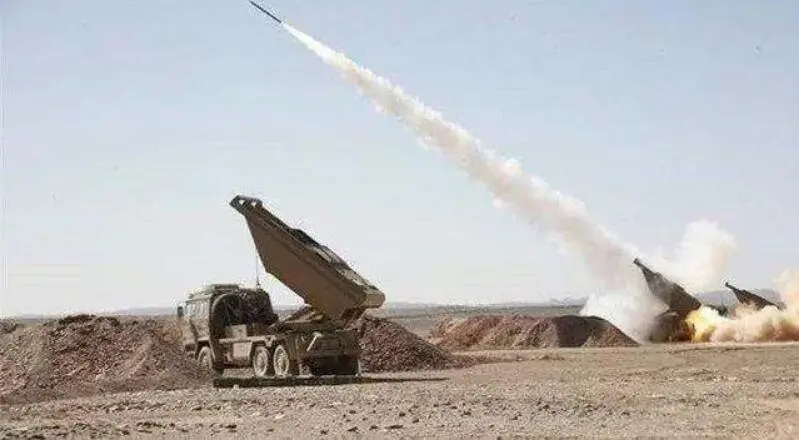
In concept the SR-5 is similar to the US HIMARS. It is based on a 6×6 truck chassis and uses modular interchangeable rocket pods. The launcher vehicle has an integrated crane and reloads rocket pods without external help. However the Chinese SR-5 has two rocket pods instead of one. So it has nearly twice the firepower of the HIMARS.
There are different types of pods for the SR-5. Initially this system started life with a capability to fire 220 mm and 122 mm rockets. These rockets have different ranges. Rockets are fitted with various warheads, including HE-FRAG, incendiary, smoke and illumination. Also there are cargo warheads with anti-tank or pre-fragmented anti-personnel submunitions. Some rockets have a GPS guidance for precision strikes. Over time new rocket types and even missiles and loitering munitions were incorporated into the SR-5 artillery system. Notably it can fire C-705 anti-ship missiles with a range of 140-170 km, and King Dragon 300 short-range ballistic missiles, similar to the US MGM-140 ATACMS. Also it is capable of launching loitering munitions (suicide drones) with a maximum range of up to 70 km. These are being launched from 220 mm pods.
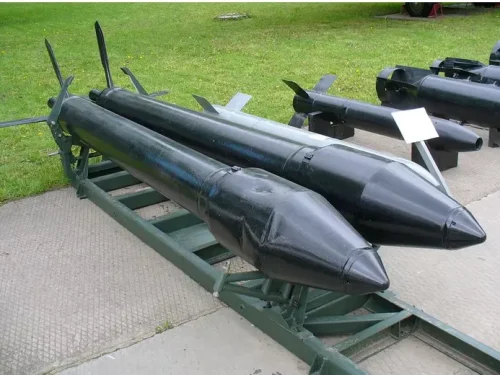
Rocket pods are factory-fitted and sealed. These double as transport containers and launchers. A standard 220 mm pod contains 6 rockets. These artillery rockets have a range of up to 70 km.
A 122 mm pod contains 20 rockets. The 122 mm rockets were originally developed for the Soviet BM-21 Grad. This caliber is widely used around the world. China developed and operates a number of 122 mm artillery rocket systems. These rockets have a range of up to 50 km.
Furthermore the SR-5 can carry combination with various rocket pods. It can have one pod with 220 mm rockets and another with 122 mm rockets, making this artillery system more versatile. It is likely that other rockets might be introduced for this system in the future.
The SR-5 launcher is based on Taian heavy high mobility truck chassis with 6×6 configuration. Vehicle has a double cab and carries the crew of 5 men. It can stop and launch rockets within 5 minutes from travelling. Vehicle can leave firing position within 1 minute, which makes it harder to hit by counter-battery fire.
Reloading is made by the crew within approximately 10 minutes. Reload rocket pods are carried by escorting cross-country truck. Typically a truck carries 4 pods (two sets of reloads). Reloading of any MLRS system usually takes place remotely from firing position in order to avoid counter-battery fire.
Each SR-5 launcher can operate autonomously or in larger formations.
Advantages Over Competitors
Compared to similar systems like the Russian BM-30 Smerch and the American HIMARS, the SR-5 offers several distinct advantages:
- Modular Flexibility: Unlike the Smerch or HIMARS, which are typically limited to one caliber per platform, the SR-5’s ability to carry and fire both 122mm and 220mm munitions from the same launcher provides unmatched tactical versatility.
- Faster Reloading & Lower Cost: While HIMARS uses expensive precision-guided missiles (GMLRS), the SR-5 combines cost-effective 122mm rockets with longer-range guided options, enabling economical saturation fire when needed. Its module-based reload system is faster than manual reloading used in older systems.
- Higher Fire Density: With 20 ready-to-fire tubes compared to HIMARS’ 6, the SR-5 delivers greater immediate firepower, making it ideal for suppressing enemy positions or soft targets over wide areas.
- Export-Friendly Design: The SR-5 is marketed internationally with fewer political restrictions than Western systems, making it accessible to a broader range of customers. It has been exported to countries in Africa, Southeast Asia, and the Middle East.
-
Integrated Multi-Munition Support: While the Smerch focuses solely on heavy 300mm rockets, the SR-5 supports not only rockets but also precision-guided missiles (e.g., anti-radar variants), enhancing its role beyond traditional artillery.
Country of origin |
China |
| Entered service | 2013 (?) |
| Crew | 5 men |
| Dimensions and weight | |
| Weight | 25 t |
| Length | ? |
| Width | ? |
| Height | ? |
| Armament | |
| Caliber | 220 mm / 122 mm |
| Number of tubes | 12 / 40 |
| Rocket weight | ~ 280 kg / ~ 66 kg |
| Warhead weight | ~ 100 kg / ~ 19 kg |
| Firing range | 70 km / 50 km |
| Full salvo duration | ? / ~ 20 s |
| Reloading time | ~ 10 minutes |
| Mobility | |
| Engine | Deutz diesel |
| Engine power | 517 hp |
| Maximum road speed | 85 km/h |
| Range | 600 km |
| Maneuverability | |
| Gradient | 60% |
| Side slope | 30% |
| Vertical step | ~ 0.6 m |
| Trench | ~ 0.6 m |
| Fording | ~ 1.2 m |