
Product Overview& Features
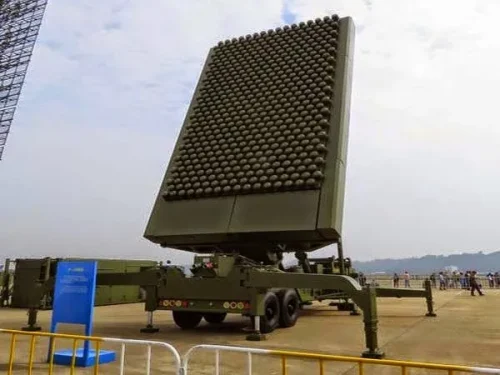
SLC-18 P band active phased array radar adopts solid-state AESA system. It has the functions of searching. Detecting, tracking, measuring, orbit calculating and catalogue forecasting of space targets such as low orbit satellites, and acquiring multi-target tracking/measurement data. This radar is mainly used for space target surveillance.
All solid-state,all coherent, all digital active phased array
Wide range searching capability
Excellent anti-stealth performance due to P band
Transportable
Key Features and Capabilities
-
P-Band (UHF) Operation:
-
This is the radar’s most significant characteristic. Operating in a lower frequency band (typically around 400 MHz – 1 GHz) provides two major advantages:
-
Counter-Stealth: Longer wavelengths (lower frequencies) are more effective at detecting stealth aircraft and missiles. Stealth design is primarily optimized against higher frequency bands (like C, X, Ku) used by fire-control radars. A large P-band radar can see targets that might be invisible to other systems.
-
Long Range and Resilience: Lower frequency signals suffer less attenuation from atmospheric conditions and can detect targets at very long ranges. They are also more resilient to interference and jamming.
-
-
-
Active Phased Array (AESA) Technology:
-
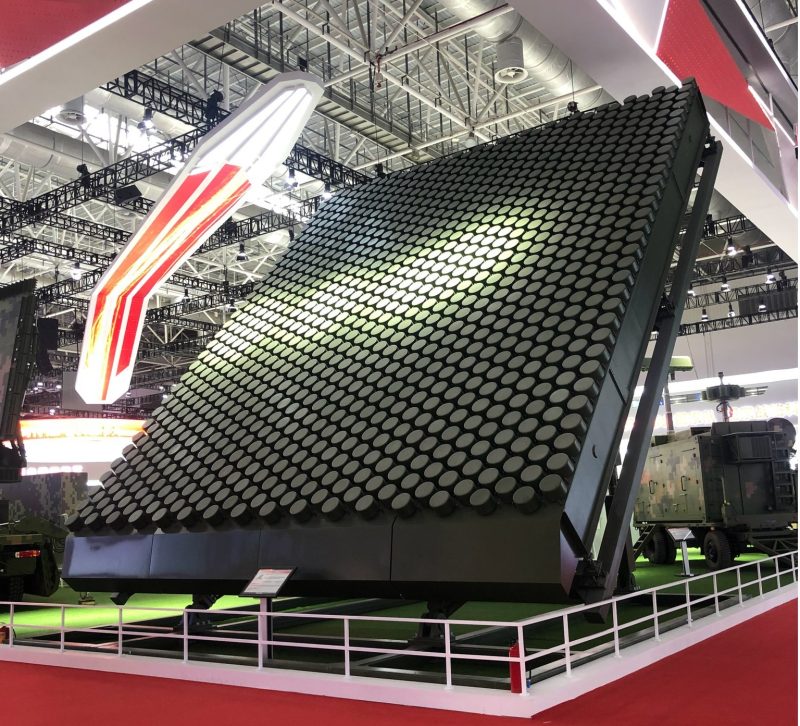
The radar face is composed of thousands of individual transmit/receive modules.
-
Benefits:
-
Electronic Steering: The beam can be steered almost instantaneously without moving the massive antenna structure, allowing it to track multiple targets simultaneously across a wide field of view.
-
Robustness: If individual modules fail, the overall system performance degrades gracefully rather than suffering a total failure.
-
Flexibility: It can perform search, track, and discrimination functions concurrently by generating multiple independent beams.
-
-
-
Strategic Mission: Ballistic Missile Defense (BMD):
-
Its primary role is early warning and tracking of incoming ballistic missiles during their mid-course phase, when the warhead is traveling in space outside the atmosphere.
-
It can track a large number of objects (warheads, decoys, debris) simultaneously at extreme ranges, providing crucial data for the missile defense command and control system.
-
-
Space Domain Awareness (SDA):
-
It is a powerful Space Surveillance and Tracking (SST) radar. It can detect, track, and catalog satellites and other space objects (space debris) in Low Earth Orbit (LEO) and possibly higher orbits. This is essential for understanding the space environment, protecting Chinese satellites, and monitoring potential adversaries’ space assets.
-
-
Large Fixed Array:
-
The SLC-18 is not mobile. It consists of several very large fixed antenna faces (likely arranged in a triangular or square pyramid structure to provide 360-degree coverage). Its physical size is directly related to its power and sensitivity—larger antennas generate sharper, more powerful beams for longer range and higher accuracy.
-
Technical Specifications (Estimated)
-
Developer: China Electronics Technology Group Corporation (CETC)
-
Frequency Band: P-band (UHF Band, ~400 MHz – 1 GHz)
-
Array Type: Active Electronically Scanned Array (AESA)
-
Deployment: Large, fixed-site installation
-
Primary Role: Strategic Early Warning, Ballistic Missile Tracking, Space Surveillance
-
Key Capability: Counter-stealth detection, long-range tracking of small objects in space
Strategic Role and Purpose
The SLC-18 is a national-level strategic asset, not a tactical weapon. Its purposes are:
-
Strategic Early Warning: Providing the first cue of a ballistic missile launch against Chinese territory, enabling leadership decision-making and, if necessary, a retaliatory strike.
-
Missile Defense Fire Control: Providing high-quality track data to guide and cue other, more precise (e.g., X-band) engagement radars within a layered missile defense system like China’s mid-course defense system.
-
Target Discrimination: In the mid-course phase of a ballistic missile’s flight, the warhead is accompanied by decoys and debris. The SLC-18’s long wavelength and sophisticated signal processing help distinguish real warheads from penetration aids.
-
Space Control: Monitoring activities in space, supporting anti-satellite (ASAT) operations by tracking potential targets, and maintaining a catalog of space objects for both safety and security purposes.
Comparison to Other Systems
-
vs. TPY-4 (U.S.): The U.S. Lockheed Martin TPY-4 is a very large, mobile AESA radar that can operate in multiple bands. The SLC-18’s fixed-site nature and specific P-band focus make it more analogous to the core early warning radars of the U.S. Solid State Phased Array Radar System (SSPARS).
-
vs. X-band Radars (e.g., AN/TPY-2, HQ-19 Radar): X-band radars (like China’s own precision tracking radars) have shorter wavelengths, providing much higher accuracy and resolution for terminal missile defense but with shorter range and less ability to penetrate stealth coatings. The SLC-18 and an X-band radar are complementary: the SLC-18 provides wide-area search and initial tracking, and then “hands over” the target to a more precise X-band radar for final engagement.
-
vs. Russian Voronezh Radar: The Russian Voronezh series are also large, fixed early warning radars that operate in different bands (VHF, UHF/L-band). The SLC-18 is China’s equivalent to these strategic cornerstones of national defense.
Conclusion
The SLC-18 P-band AESA radar is a cornerstone of China’s strategic defense infrastructure. It is not a weapon itself, but a critical “eyes and ears” system that enables missile defense and space awareness. Its P-band operation makes it a particularly potent tool for countering stealth technology and providing resilient, long-range detection of the most dangerous threats to the nation, namely ballistic missiles and activities in space. Its development signifies China’s advanced capabilities in integrated air and missile defense (IAMD) and space domain awareness.