
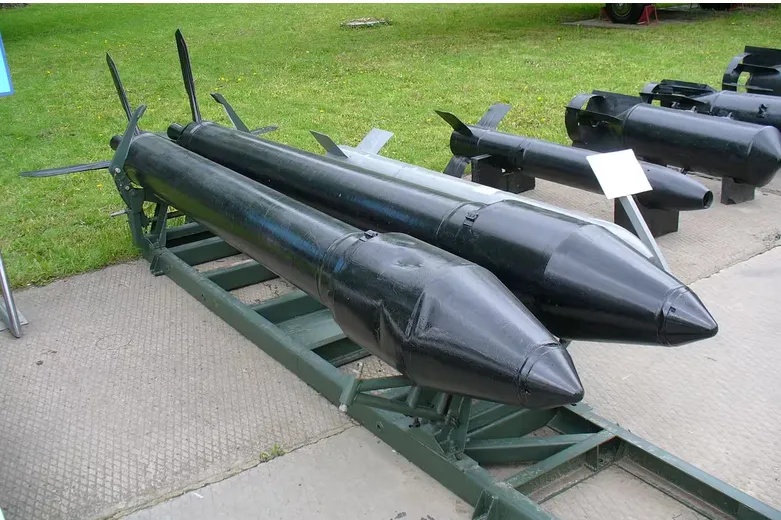
The S-25 rocket (Russian: C-25) is a series of aerial rocket systems developed by the Soviet Air Force and used by military aircraft against semi-hard and hard ground targets. It still serves in the Russian Air Force and various export customers.
Date of development: Mid-1960s – 1975
Manufacturer: KB Tochmash
Date of production :1975 – present
S-25 rocket Basic Specifications
Weight :480 kg (1,058.22 lb)
Length:3,310-3,800 mm (130.31-149.61 in)
Body: 250 mm (9.84 in)
Warhead: 300-420 mm (11.81-16.54 in)
Effective range: 3,000-11,000 m (3,280.84-12,029.75 yd, 9,842.52-36,089.24 ft, 1.86-6.84 mi)
Warhead: 150-190 kg (330.69-418.88 lb) explosive yield
Detonation mechanism: trigger fuse or proximity fuse
Engine: Rocket engine
Wingspan :600 mm (23.62 in)
Speed: 511-700 m/s, about 1.5-2.06 Mach
Guidance system: unguided/laser guidance system
S-25 rocket Model
Unguided rocket:
S-25F: Models equipped with high explosive warheads, range 2,000-3,000 m.
S-25O: Model equipped with fragmentation warhead and radio proximity fuze.
S-25O-PU: Model equipped with a cone charge warhead.
S-25OF: Model with high blaster warheads. (Russian: Осколочно-фугасный снаряд).
S-25OFM: Model for enhanced targets.
S-25M: A modernized version of the S-25OF.
S-25MD: Modernized version with extended range of 4,000-5,000 m.
Guided missile:
S-25L: laser-guided version, Bunker buster, ground-penetrating warhead version with a range of 7,000 m.
S-25LD: laser-guided and extended range version with a range of 11,000 m.
S-25TV: Model with Television guidance head, mainly for export.
S-25IRS: Model with infrared guidance head.
S-25A: The model of active radar guidance head with Ku-band (18-40 GHZ) active radar guidance.
S-25SE: Equipped with the Glonass system
Representative Specifications (indicative — for tender/procurement use)
| Parameter | Typical / Indicative Value | Notes |
|---|---|---|
| Caliber class | Large-caliber (typically >200 mm) | Exact caliber/variant to be specified per contract |
| Rocket length | ~1.5–3.5 m (variant dependent) | Length depends on motor and warhead choice |
| Warhead types | HE, HE-frag, HEAT/penetration, thermobaric, smoke/illumination, inert/practice | Availability subject to regulation and customer selection |
| Warhead mass | ~20–250+ kg (variant dependent) | Wide range — heavier warheads for greater effect |
| Propulsion | Single solid-propellant motor | Motor impulse tailored to range & profile requirements |
| Indicative engagement range | Short-to-medium (air-launched: ~1–20+ km) | Heavily dependent on launch speed/altitude and motor variant; provide only indicative figures |
| Guidance | Unguided (ballistic) | No terminal guidance in baseline; precision retrofit options may be available subject to policy |
| Launch platforms | Aircraft rocket pods, helicopter pods; engineered ground/naval mounts possible | Integration engineering required for non-aircraft platforms |
| Pod/tube compatibility | Multi-tube pods (4–16+ tubes typical) | Tube count depends on platform and mission |
| Firing interface | Standard aircraft electrical firing bus / pod connector | Integration per platform specifications |
| Environmental / storage | MIL-grade packaging & transport handling | Storage and transport per contract and ordnance safety rules |
| Typical operators | Aircrew, ground ordnance personnel | Loading and handling require trained ordnance teams |
Key Characteristics
-
Large-caliber, heavy-warhead design for high blast/penetration effect.
-
Multiple warhead options to tailor mission effects (HE, HE-fragmentation, HEAT/penetration, thermobaric, practice/inert).
-
Simple electrical firing interface for integration with standard aircraft/launcher pods.
-
Robust single-motor solid propellant for reliable, stable ballistics in salvo launches.
-
Suitable for mixed-warhead pod loadouts on aircraft or engineered ground/naval adaptions (platform-dependent).
-
Field logistics and support packages including inert practice rounds, spares and maintenance tooling.