
Key Takeaways
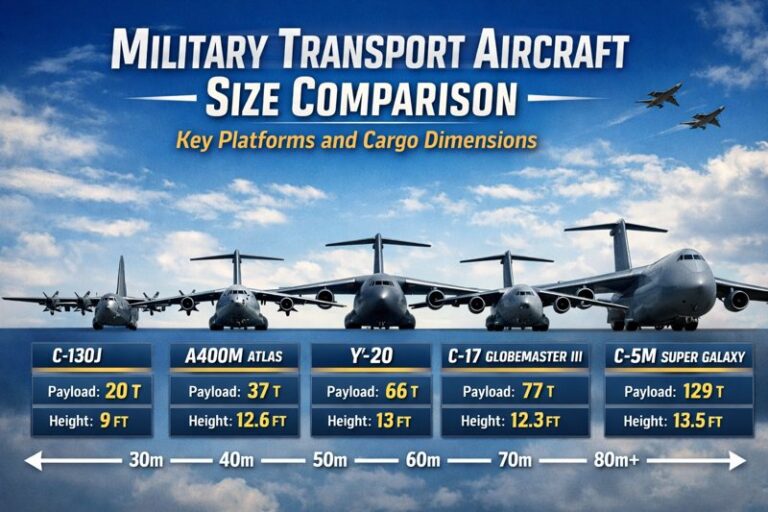
- Strategic vs. Tactical Distinction: Strategic airlift focuses on intercontinental range and heavy payloads (e.g., C-5M, C-17), while tactical airlift prioritizes short-field performance and intra-theater delivery (e.g., C-130J).
- Multi-Mission Capabilities: Modern platforms like the Airbus A400M and Embraer C-390 bridge the gap, offering strategic range with tactical landing capabilities.
- Payload Versatility: Military transport aircraft are categorized by their ability to carry outsized cargo, including MBTs (Main Battle Tanks), helicopters, and palletized operational systems.
- Integration Standards: Avionics and cargo handling systems must adhere to strict interoperability standards (NATO STANAG) for cross-coalition logistics.
Introduction to Military Airlift Command Structures
In the domain of modern defense logistics, the efficacy of a force is directly proportional to its mobility. Military transport aircraft form the backbone of rapid deployment, humanitarian aid, and sustainment operations globally. For defense system integrators and procurement specialists, understanding the precise categorization of these assets is critical for optimizing supply chains and mission planning. The classification of airlift capabilities is generally bifurcated into Strategic and Tactical roles, though modern airframes increasingly blur these lines to maximize operational flexibility.
This technical analysis dissects the primary types of military transport aircraft, evaluating their propulsion systems, fuselage configurations, payload capacities, and suitability for specific mission profiles under current MIL-STD parameters.
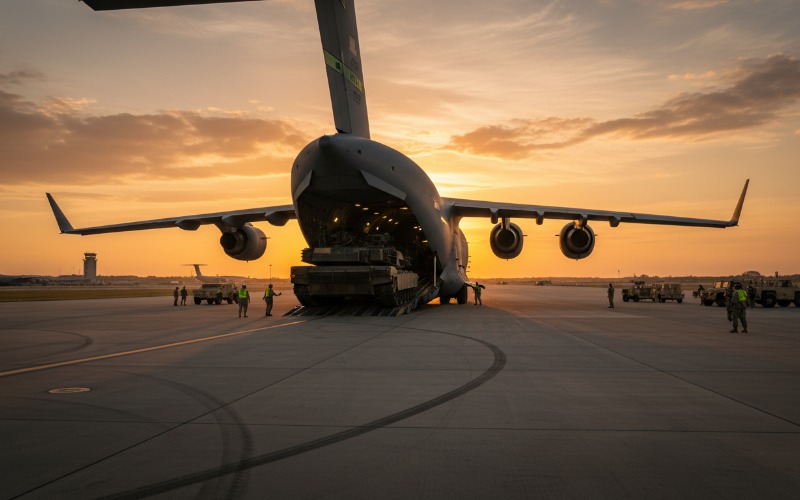
Strategic Airlift Platforms
Strategic airlift is defined by the capability to transport heavy, outsized loads over intercontinental distances without the necessity for intermediate refueling, although aerial refueling capabilities are standard. These assets are critical for projecting power from domestic bases to forward operating bases (FOBs) globally.
Heavy Strategic Transports
The apex of this category is represented by airframes such as the Lockheed Martin C-5M Super Galaxy and the Antonov An-124 Ruslan. These aircraft are designed solely for high-volume, high-tonnage logistics.
- Propulsion & Thrust: The C-5M utilizes four General Electric F138-GE-100 turbofan engines, each generating 51,250 lbf of thrust. This power is essential for lifting maximum takeoff weights (MTOW) exceeding 840,000 lbs.
- Cargo Dimensions: The defining feature of heavy strategic transports is the ability to carry “outsized” cargo—items that do not fit on standard 463L master pallets. This includes main battle tanks (like the M1 Abrams), bridging equipment, and heavy recovery vehicles.
- Loading Capability: Both the C-5 and An-124 feature drive-through loading capabilities via nose and tail cargo ramps, allowing for rapid roll-on/roll-off (RORO) operations, significantly reducing ground turnaround times.
Strategic/Tactical Hybrids
The Boeing C-17 Globemaster III represents a paradigm shift, offering strategic range and payload but designed with the agility to land on shorter, austere airfields (3,500 ft) typically reserved for tactical aircraft. This dual capability allows for “direct delivery”—moving cargo from the home station directly to the tactical edge, bypassing intermediate transfer hubs.
Tactical Airlift Platforms
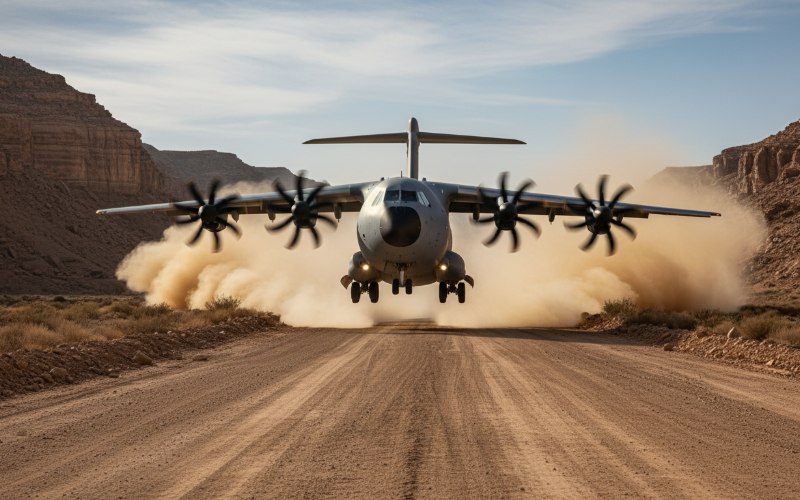
Tactical airlift focuses on intra-theater operations. The mission profile involves moving personnel and supplies from main theater hubs to front-line combat zones. These aircraft must withstand rough, unpaved runways (dirt, gravel, grass) and operate in high-threat environments requiring steep descent approaches and aggressive tactical departures.
The Turboprop Standard: C-130 Hercules Family
The Lockheed Martin C-130J Super Hercules remains the global standard for tactical airlift. Unlike strategic jets, the C-130J utilizes four Rolls-Royce AE 2100D3 turboprops. Turboprops are preferred in tactical environments for their resistance to foreign object damage (FOD) on unprepared strips and their superior efficiency at lower altitudes.
Technical Specifications:
- Payload: Approx. 42,000 lbs.
- Short Takeoff and Landing (STOL): Can operate from 3,000 ft strips.
- Versatility: The airframe supports modular mission kits, converting from cargo hauler to aerial refueler (KC-130J) or gunship (AC-130J) rapidly.
Next-Generation Tactical Jets
Emerging competitors like the Embraer C-390 Millennium are challenging the turboprop dominance. The C-390 uses twin turbofan engines, offering higher cruise speeds (Mach 0.8) and a higher service ceiling compared to the C-130, while maintaining STOL capabilities. This represents a shift in procurement strategy for nations prioritizing speed and range alongside rough-field performance.
European Multi-Role Tanker Transport (MRTT) and Airlift
The Airbus A400M Atlas was developed to fill the capability gap between the C-130 and the C-17. It is classified as a heavy tactical/strategic lifter.
- Powerplant: Four Europrop TP400-D6 turboprops, the most powerful in the western world, utilizing counter-rotating propellers for enhanced lift and stability.
- Capacity: It can carry heavy armored vehicles or helicopters (such as the NH90 or Chinook) that are too large for a C-130 but do not require the massive volume of a C-17.
- Ruggedization: Designed with a 12-wheel main landing gear system specifically engineered to distribute weight effectively over soft surfaces like sand or clay.
Specialized Tiltrotor and Rotary Wing Transport
For “last mile” logistics where runways are non-existent, vertical takeoff and landing (VTOL) capabilities are mandatory. This sector is critical for special operations and ship-to-shore logistics.
Tiltrotor Technology
The Bell Boeing V-22 Osprey combines the vertical lift of a helicopter with the speed and range of a turboprop airplane. Its tiltrotor design allows it to transport up to 24 troops or 20,000 lbs of internal cargo (or 15,000 lbs external hook) to locations inaccessible to fixed-wing aircraft. This capability is pivotal for Amphibious Ready Groups (ARGs) and rapid insertion missions.
Heavy Lift Helicopters
The Boeing CH-47 Chinook and Sikorsky CH-53K King Stallion serve as the heavy haulers of the rotary world. The CH-53K, for instance, is designed to lift 27,000 lbs over 110 nautical miles in high/hot conditions, essential for transporting light armored vehicles and artillery pieces directly to the point of need.
Technical Comparison: Global Airlift Capabilities
The following table provides a comparative analysis of key performance parameters for the primary military transport aircraft currently in service.
| Aircraft Model | Classification | Max Payload (lbs) | Range (Max Payload) | Engine Type |
|---|---|---|---|---|
| Lockheed C-5M Super Galaxy | Heavy Strategic | 281,000 | 2,270 nm | 4x Turbofan |
| Boeing C-17 Globemaster III | Strategic / Tactical | 170,900 | 2,400 nm | 4x Turbofan |
| Airbus A400M Atlas | Heavy Tactical | 81,600 | 1,780 nm | 4x Turboprop |
| Lockheed C-130J Super Hercules | Tactical | 46,700 | 1,800 nm | 4x Turboprop |
| Embraer C-390 Millennium | Tactical | 57,320 | 1,080 nm | 2x Turbofan |
| Bell Boeing V-22 Osprey | Tiltrotor VTOL | 20,000 (Internal) | 390 nm (Combat Radius) | 2x Turboshaft (Tilt) |
Avionics and Defensive Systems Integration
Modern military transport aircraft are no longer passive haulers; they are sophisticated nodes in the networked battlefield. For system integrators, the focus is on SWaP-C (Size, Weight, Power, and Cost) optimization for avionics and defensive suites.
Defensive Aids Subsystems (DAS)
Transports operating in contested airspace require robust survivability suites. This includes:
- Missile Warning Systems (MWS): Infrared or UV sensors detecting incoming MANPADS.
- Countermeasures: Automated chaff and flare dispensers linked to the MWS.
- DIRCM (Directional Infrared Countermeasures): Turret-based laser systems that jam the seeker heads of incoming infrared missiles.
Glass Cockpits and HUDs
Modernization programs, such as the C-130 Avionics Modernization Program (AMP), replace analog gauges with digital multifunction displays (MFDs) and Head-Up Displays (HUDs). These systems provide pilots with night-vision compatible flight data and enhanced situational awareness, critical for low-level tactical navigation in zero-visibility conditions.
Operational Considerations for Procurement
When defense agencies evaluate transport aircraft types, the decision matrix extends beyond simple payload capacity. Total lifecycle costs, maintenance man-hours per flight hour (MMH/FH), and interoperability are paramount.
- Interoperability: NATO member states prioritize aircraft compatible with standard 463L pallets and common ground handling equipment.
- Availability Rates: Strategic assets like the C-5 often have lower mission capability rates due to complexity, whereas tactical fleets like the C-130J maintain higher readiness for high-tempo operations.
- Infrastructure Requirements: Strategic jets require reinforced concrete runways and large hangars, limiting their basing options compared to tactical airlifters which can operate from forward, austere locations.
Frequently Asked Questions (FAQ)
Strategic airlift involves moving heavy cargo over intercontinental distances between main bases. Tactical airlift involves moving cargo and personnel within a theater of operations, often to austere or contested zones with short runways.
Yes, with aerial refueling. Aircraft like the C-130J can deploy globally, but they are slower and carry less payload than dedicated strategic airlifters like the C-17 or C-5.
Turboprops generally offer better fuel efficiency at low altitudes and are less susceptible to engine damage from debris (FOD) on unpaved runways compared to turbofan jet engines.
The Antonov An-124 Ruslan is the largest mass-produced military transport. The Lockheed C-5M Super Galaxy is the largest in the US Air Force inventory.