
For defense-sector solar and energy storage integrators, air transportability directly determines operational relevance. Therefore, system designers must treat logistics as a primary engineering constraint rather than a downstream consideration.
From pallet dimensions to hazardous material certifications, every deployable energy asset must conform to the cargo envelopes of standard military transport aircraft. Consequently, this guide provides a technical military transport aircraft size comparison, with a specific focus on how aircraft dimensions shape the design of containerized solar, microgrid, and battery energy storage systems (BESS).
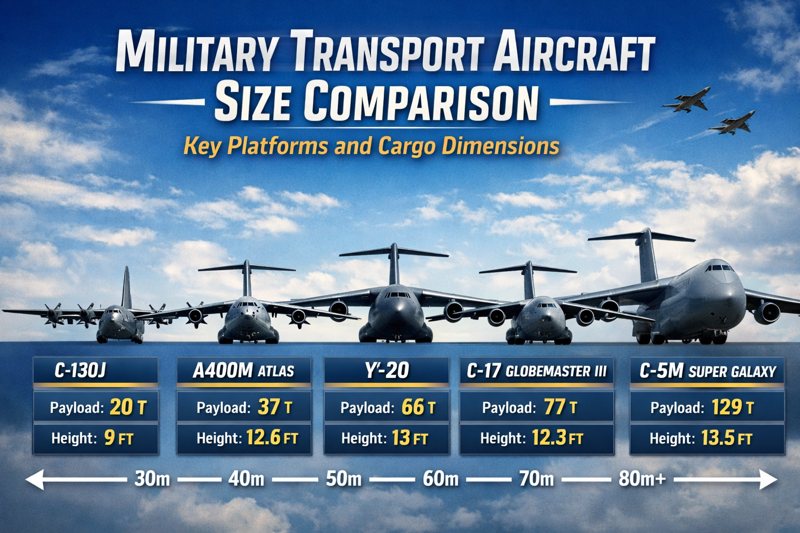
Key Design Constraints at a Glance
- Universal Interoperability: Solar and energy storage systems must align with 463L Master Pallet dimensions (88” × 108”) to ensure compatibility across US and NATO airlift fleets.
- Tactical vs. Strategic Tradeoffs: The C-130J limits cargo height to roughly 9 feet, which forces integrators to adopt collapsible solar arrays. In contrast, C-17, Y-20, and C-5 platforms accommodate standard ISO containers.
- Hazardous Material Logistics: Lithium-based batteries require UN 38.3 certification and compliant packaging for airlift. As a result, packaging and compliance frequently reduce usable payload.
- Payload Priority: Engineers must aggressively optimize SWaP-C (Size, Weight, Power, Cost). Otherwise, systems that exceed axle or floor load limits require shoring, which increases deployment time and handling complexity.
Why Air Transportability Defines Operational Energy
For B2B solar system integrators serving defense customers, “operational energy” fundamentally means deployable energy. While high-efficiency solar arrays and ruggedized microgrids matter, they deliver no tactical value if forces cannot move them rapidly to a forward operating base (FOB).
Accordingly, most defense RFPs explicitly require compatibility with US or NATO airlift platforms. As a result, engineering teams must design energy systems around aircraft cargo envelopes from the outset—not as an afterthought.
C-130J Super Hercules: The Tactical Benchmark
The Lockheed Martin C-130J Super Hercules sets the baseline for tactical airlift. Because it operates from short, unimproved runways, it represents the strictest design constraint for deployable energy systems.
If an integrator achieves true C-130 compatibility, they unlock access to nearly every austere operating environment worldwide.
Cargo Compartment Constraints
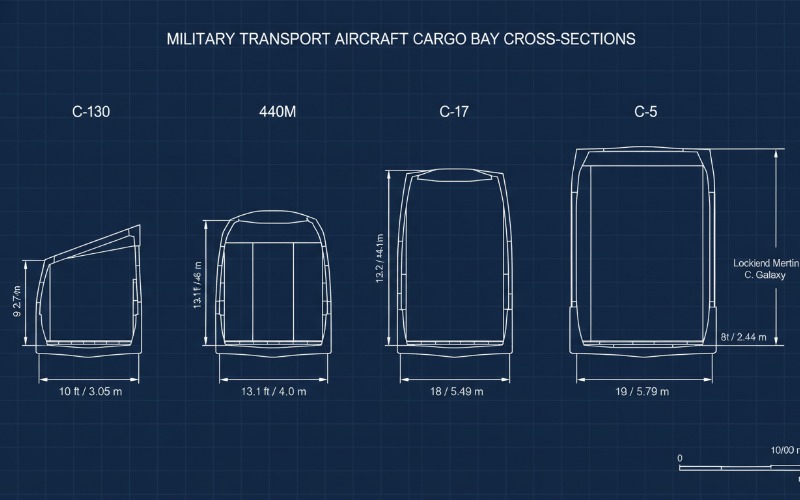
- Usable Length: 41 ft (12.5 m) – C-130J-30 stretched variant
- Width: 10.25 ft (3.12 m) at the floor
- Height: 9.0 ft (2.74 m) — the most common failure point
- Max Payload: ~42,000 lbs (19,050 kg)
Because standard High Cube ISO containers exceed the height limit, they simply do not fit. Therefore, integrators must redesign commercial solar containers to meet military constraints.
Integrator Note:
Designers typically deploy collapsible solar racking and package energy storage in ISU-90 containers rather than 20 ft ISO containers. This approach maximizes internal volume while staying within height limits.
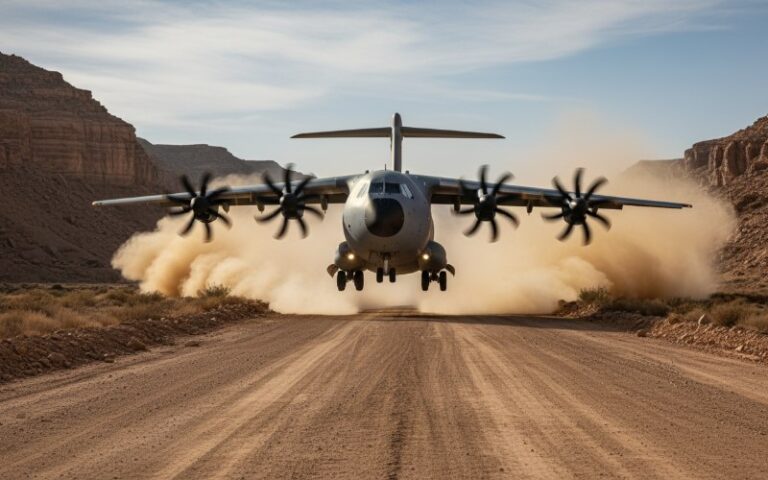
Airbus A400M Atlas: Bridging Tactical and Strategic Lift
Next, the Airbus A400M Atlas fills the gap between the C-130 and heavy strategic lifters. Many European NATO forces rely on the A400M for medium-range logistics, making it highly relevant for coalition operations.
Key Advantages for Energy Systems
- Width: 13.12 ft (4.0 m)
- Height: 12.6 ft (3.85 m) aft of the wing box
- Max Payload: ~81,600 lbs (37,000 kg)
Because of its expanded cross-section, the A400M can transport standard 20 ft ISO containers with far fewer compromises. Consequently, integrators can preserve higher energy density and structural rigidity without excessive redesign.
C-17 Globemaster III: Strategic Volume with Tactical Flexibility
The Boeing C-17 Globemaster III enables integrators to deploy fully assembled, containerized power systems at intercontinental scale. Moreover, it retains short-field performance, which blurs the line between tactical and strategic lift.
Handling Oversized Energy Assets
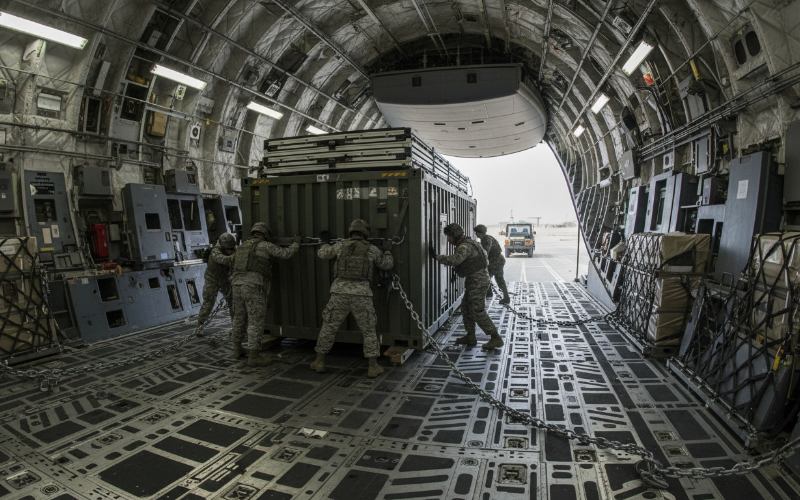
The C-17 features a reconfigurable cargo floor, allowing crews to switch between rollerized pallet loading and wheeled vehicle transport. This flexibility proves essential for mobile hybrid power stations mounted on trailers.
- Width: 18.0 ft (5.49 m)
- Height: 12.33 ft (3.76 m) under wing box; up to 14.8 ft aft
- Max Payload: ~170,900 lbs (77,519 kg)
Integrator Note:
While the C-17 easily carries BESS-integrated 20 ft ISO containers, integrators must still monitor axle loads and PSI limits. High-density lithium packs often exceed localized floor load thresholds, which forces crews to install shoring—adding time and complexity.
Xi’an Y-20: China’s Strategic Airlift Platform
Increasingly, defense planners must also account for the Xi’an Y-20 military transport aircraft, China’s indigenous heavy transport aircraft. Functionally, the Y-20 occupies the same operational tier as the C-17, and it plays a central role in PLA strategic logistics.
Why the Y-20 Matters to Integrators
As Chinese and partner-nation operations expand, systems designed for C-17 compatibility typically translate well to Y-20 airlift. Therefore, integrators pursuing broader international defense markets should consider Y-20 envelopes during early design phases.
- Cargo Width: ~16.5–18.0 ft (approx. 5.0–5.5 m)
- Cargo Height: ~13 ft (approx. 4.0 m)
- Estimated Payload: ~66–77 tons
In practice, the Y-20 supports standard ISO containerized energy systems, mobile substations, and pre-assembled microgrids—provided integrators respect axle loading and tie-down requirements.
C-5M Super Galaxy: Maximum Capacity, Minimum Flexibility
Finally, the Lockheed Martin C-5M Super Galaxy delivers unmatched cargo volume. However, it operates exclusively from established airbases with long runways. Consequently, it serves strategic reinforcement rather than tactical insertion.
When to Design for the C-5
- Width: 19.0 ft (5.79 m)
- Height: 13.5 ft (4.11 m)
- Length: 143.75 ft (43.8 m)
- Max Payload: ~281,000 lbs (127,460 kg)
Because the C-5 offers drive-on/drive-off access through both nose and tail doors, it excels at moving extremely large energy assets. Nevertheless, designing exclusively for the C-5 severely limits operational flexibility.
Integrator Guidance:
Only target C-5 specifications if the system supports semi-permanent installations at major main operating bases (MOBs).
Comparative Technical Specifications
| Aircraft | Cargo Length | Cargo Width (Max) | Cargo Height (Max) | Max Payload | 463L Pallet Positions |
|---|---|---|---|---|---|
| C-130J-30 | 41 ft | 10.25 ft | 9.0 ft | 44,000 lbs | 8 |
| Airbus A400M | 58 ft | 13.12 ft | 12.6 ft | 81,600 lbs | 9 + Ramp |
| C-17 Globemaster III | 88 ft | 18.0 ft | 12.33 ft | 170,900 lbs | 18 |
| Xi’an Y-20 | ~80+ ft | ~18.0 ft | ~13.0 ft | ~150,000 lbs | ~18 |
| C-5M Super Galaxy | 143.75 ft | 19.0 ft | 13.5 ft | 281,000 lbs | 36 |
Table 1: Cargo Compartment Dimensions and Capacity by Aircraft Type
Engineering for Deployment: SWaP-C Optimization
Ultimately, understanding aircraft dimensions only begins the engineering process. Defense procurement prioritizes SWaP-C optimization, which rewards systems that deploy faster, lighter, and cheaper—without sacrificing durability.
The 463L Master Pallet Standard
Nearly all loose cargo moves on the HCU-6/E (463L) pallet. The usable footprint measures 84” × 104” (2.1 m × 2.6 m).
If a solar generator or battery enclosure exceeds this footprint, it consumes two pallet positions. Consequently, transport costs double and stowage efficiency collapses. Therefore, integrators should design modular, pallet-locked subsystems whenever possible.
Lithium Battery Airlift: HAZMAT Reality
Transporting lithium-ion batteries introduces another layer of constraint. Under regulations such as AFMAN 24-204, lithium batteries fall under Class 9 Hazardous Materials.
Key requirements include:
- Reduced State of Charge (SoC): Typically below 30%
- UN 38.3 Certification: Mandatory vibration, shock, and altitude testing
- Commander Authority: Without certification, aircrews may refuse the load outright
As a result, compliance directly affects usable payload and deployment timelines.
Frequently Asked Questions
Yes. However, 40 ft containers require heavy material handling equipment (MHE) and complicate unloading in austere zones. Therefore, integrators generally prefer 20 ft ISO containers or TRICONs.
Although the absolute limit is about 9 ft, practical loading height rarely exceeds 102 inches (8.5 ft) due to ramp break-over angles. Consequently, collapsible arrays remain mandatory.
Under MIL-STD-1791, cargo restraints must withstand:
2G vertical
3G forward
1.5G aft
1.5G lateral
Therefore, integrators must structurally validate solar racking and battery mounts against these loads.