
Key Features and Capabilities
-
Primary Mission: Anti-Ship Warfare (AShW):
-
This is the system’s defining feature. The M20B is part of a new class of weapons known as Anti-Ship Ballistic Missiles (ASBMs). It is designed to hit moving ships at sea, a complex task requiring advanced targeting and guidance.
-
-
Precision Guidance for Moving Targets:
-
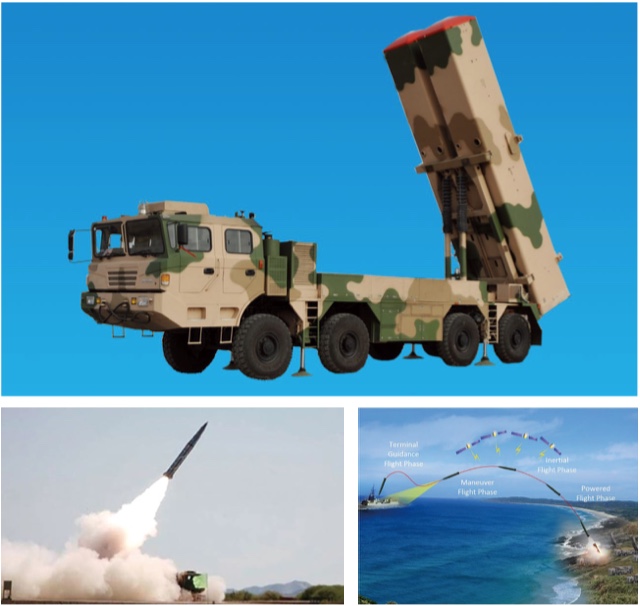
Hitting a ship requires a sophisticated guidance package. The missile’s flight profile is believed to include:
-
Initial Boost Phase: Launched ballistically.
-
Mid-Course Guidance: Uses an Inertial Navigation System (INS) likely updated via data link from external platforms (e.g., satellites, drones, over-the-horizon radar).
-
Terminal Phase: The most critical phase. The missile performs maneuvers and uses a terminal seeker, likely an active radar homing and/or imaging infrared (IIR) seeker, to acquire, track, and impact the moving ship.
-
-
-
Quasi-Ballistic Trajectory:
-
The missile does not follow a simple parabolic arc. It flies on a depressed trajectory and is capable of terminal maneuvers (e.g., pull-up and dive, spiraling) to evade enemy missile defenses and precisely align with its target.
-
-
Stealth and Penetration Aids:
-
The missile is designed with stealth features to reduce its radar cross-section (RCS). It may also deploy decoys or jammers during its terminal phase to saturate and confuse a ship’s defensive systems.
-
-
Dual-Role Capability:
-
While optimized for anti-ship missions, the M20B can also engage high-value land targets with precision, using the same guidance systems (INS/GPS/BeiDou) for fixed coordinates.
-
-
Launch System:
-
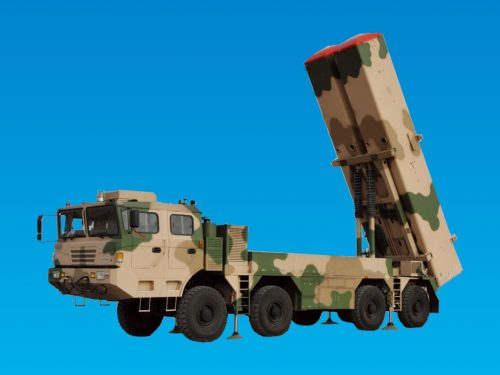
The system uses a Transport-Erector-Launcher (TEL) vehicle, typically an 8×8 truck. The vehicle carries two canisterized missiles, which are launched from a vertical position.
-
Technical Specifications (Estimated)
| Feature | Specification |
|---|---|
| System Name | M20B / BP-12B |
| Developer | China Aerospace Science and Technology Corporation (CASC) |
| Role | Anti-Ship Ballistic Missile (ASBM) & Land Attack |
| Missiles per Launcher | 2 |
| Range | 100 – 280 km (Estimated, often reported as ~290 km to stay under MTCR limits) |
| Guidance | INS + Data-Link + Active Radar/IIR Terminal Seeker |
| Warhead | Unified Blast-Fragmentation or Penetration (500kg class estimated) |
| Trajectory | Quasi-Ballistic, with terminal maneuvers |
| Launch Vehicle | 8×8 Transport-Erector-Launcher (TEL) |
Strategic Role and Purpose
The M20B is designed for a singular, game-changing strategic purpose:
-
A2/AD Enforcer: Its primary role is to deny freedom of navigation to an adversary’s navy within the “First Island Chain” and beyond. By creating a large threat zone, it complicates an enemy’s operational planning.
-
Carrier-Killer: While its warhead may not sink a carrier alone, a successful hit could mission-kill it, destroying the flight deck, island, or key systems. A salvo of these missiles could saturate a carrier group’s defenses.
-
Coastal Defense: It provides a long-range, hard-hitting layer of defense against amphibious assault groups and other naval task forces.
-
Theater Command Target: It is a strategic asset, likely controlled at a high (theater) command level to engage the most high-value targets.
Comparison to Other Systems
-
vs. DF-21D:
-
The DF-21D is a larger, medium-range ballistic missile (MRBM) with a range of over 1,500km. The M20B is a shorter-range, tactical counterpart. They form a layered ASBM threat, with the M20B covering closer threats and the DF-21D covering targets further out to sea.
-
-
vs. Rocket Systems (WS-64, A300):
-
The WS-64 is a guided rocket with an anti-ship capability. The A300 is a long-range guided rocket. The M20B is a true ballistic missile with a different flight profile (much higher speed, steeper dive), making it a more challenging threat for ship-based defenses to intercept.
-
-
vs. Western Systems:
-
No NATO country currently fields a land-based ballistic anti-ship missile. This is a domain where Chinese technology is considered a world leader and poses a unique challenge to modern navies. The closest conceptual analog would be a land-based version of a anti-ship missile like the Norwegian NSM, but delivered at ballistic missile speeds.
-
Conclusion
The M20B is not just another missile; it is a pivotal “game-changer” in modern naval warfare. It represents the successful integration of ballistic missile technology with the complex targeting requirements needed to hit moving ships at sea. Its existence fundamentally alters the risk calculus for surface fleets operating within its range, making it a cornerstone of China’s strategy to control its near seas and challenge naval superiority in the Western Pacific. It is a potent symbol of asymmetric warfare and technological innovation.