
In the evolving landscape of modern warfare, Unmanned Aerial Vehicles (UAVs) have become indispensable assets. However, for procurement officers and defense contractors, determining the exact military drone cost can be a complex endeavor. Pricing is rarely transparent in the defense sector. Consequently, buyers must navigate a maze of variables, ranging from payload specifications to long-term logistical support.
Understanding the pricing structure is critical for budgeting and strategic planning. A basic tactical reconnaissance unit might cost as little as $5,000, whereas a strategic combat drone can exceed $100 million. Therefore, identifying the specific mission requirements is the first step in cost analysis. This guide explores the financial landscape of military UAVs, focusing on the value proposition offered by high-performance Chinese manufacturing.
Understanding the Spectrum of UAV Pricing
The term “military drone” covers a vast array of equipment. To accurately assess cost, we must categorize these assets based on their size, range, and operational capabilities. The North Atlantic Treaty Organization (NATO) classifies UAVs into three distinct classes, and pricing correlates heavily with these tiers.
Class I: Micro, Mini, and Small UAVs
Class I drones are typically portable, hand-launched systems used for close-range surveillance. These units usually weigh less than 150 kg. Generally, the military drone cost for these systems ranges from $10,000 to $100,000. This price point often includes the Ground Control Station (GCS) and spare batteries. Because they are deployed at the squad level, durability and ease of replacement are key cost drivers.
Class II: Tactical Intermediate UAVs
Stepping up in capability, Class II UAVs offer longer endurance and heavier payload capacities. These systems often require catapult launchers or runways. Prices in this category typically fall between $500,000 and $5 million. The variance depends largely on the sophistication of the avionics and the range of the communication link.
Class III: MALE and HALE Systems
At the top of the spectrum are Medium Altitude Long Endurance (MALE) and High Altitude Long Endurance (HALE) systems. These are strategic assets capable of flying for 24+ hours. Western models often cost upwards of $20 million to $100 million per unit. However, alternative markets offer comparable capabilities at a fraction of this price.
Key Components Influencing Military Drone Cost
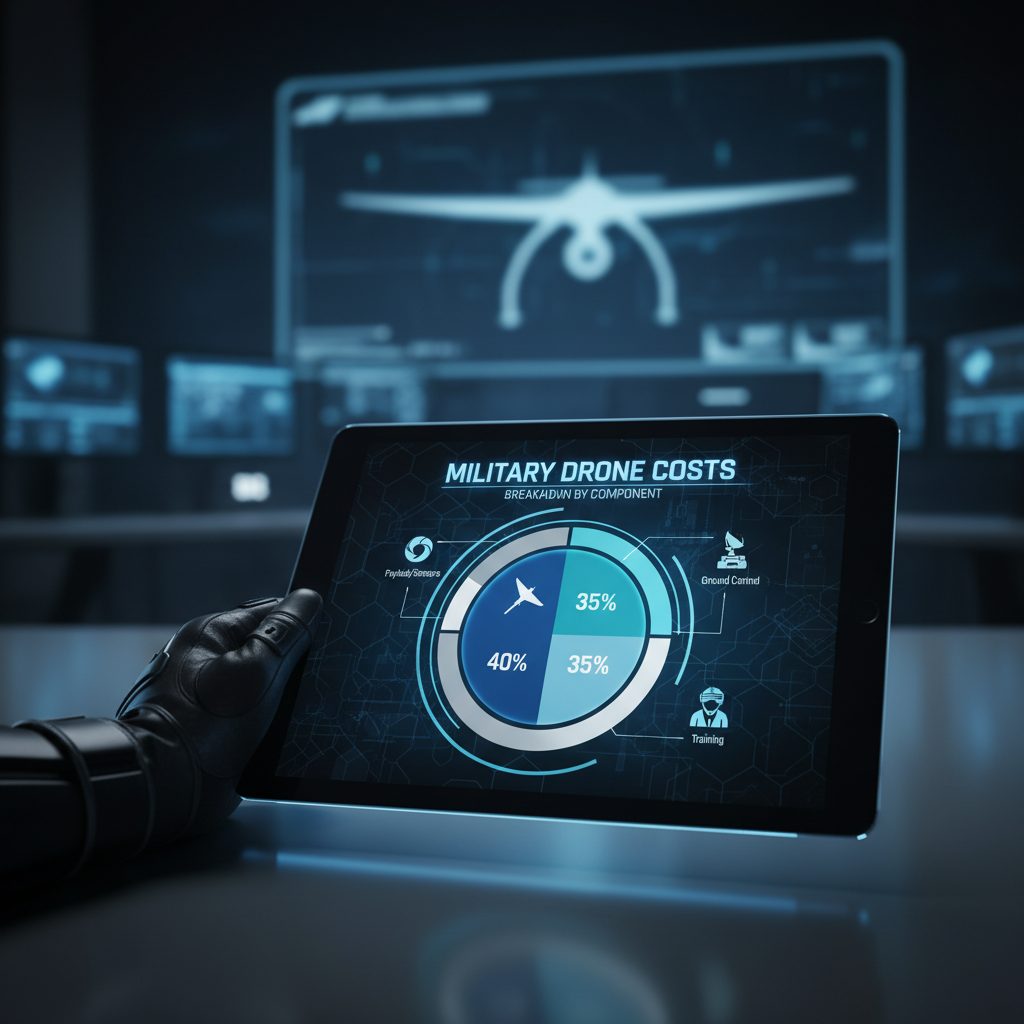
The airframe itself often accounts for less than 40% of the total system price. Several technical subsystems contribute significantly to the final invoice. Understanding these components helps buyers negotiate better procurement contracts.
- Payload Systems: High-definition EO/IR (Electro-Optical/Infra-Red) gimbals, LiDAR sensors, and synthetic aperture radar can cost more than the drone itself.
- Data Links & Communication: Encrypted, anti-jamming communication modules are essential for military operations. Satellite communication (SATCOM) capabilities significantly increase the military drone cost.
- Ground Control Stations (GCS): The interface used to pilot the drone and analyze data is a critical cost center. Advanced GCS units often feature ruggedized hardware and proprietary software.
- Propulsion Systems: Whether using heavy fuel engines or high-density battery packs, the power plant dictates reliability and endurance.
Furthermore, customized software integration for autonomous flight paths adds another layer of expense. For detailed specifications on versatile platforms, explore our range of specialized military drones.

Chinese vs. Western UAV Pricing: A Strategic Comparison
In recent years, the global defense market has shifted. Buyers are increasingly looking towards the Asian market for cost-effective solutions. Chinese military equipment has gained a reputation for balancing performance with affordability. This cost efficiency is primarily due to established supply chains and advanced manufacturing infrastructure.
While a Western-manufactured tactical drone might carry a premium for brand heritage, a comparable Chinese system often delivers similar specs for 30-50% less capital investment. This price difference allows defense ministries to procure larger fleets for the same budget. Reliability remains high, as many systems meet rigorous ISO and military standards.
Below is a comparative estimation of costs for typical export-compliant UAV systems.
| Drone Category | Typical Western Cost (Est.) | Chinese Equivalent Cost (Est.) | Primary Capabilities |
|---|---|---|---|
| Loitering Munition (Kamikaze) | $60,000 – $150,000 | $15,000 – $40,000 | Precision strike, single-use airframe |
| Tactical VTOL (fixed-wing) | $300,000 – $800,000 | $100,000 – $350,000 | Vertical takeoff, 2-4 hour endurance |
| MALE Reconnaissance | $15M – $40M | $3M – $8M | 20+ hour endurance, satellite link |
| Heavy Lift Logistics UAV | $800,000 – $1.5M | $250,000 – $600,000 | Cargo transport, supply chain support |
Total Cost of Ownership (TCO)
Procurement officers must look beyond the sticker price. The Total Cost of Ownership (TCO) includes training, maintenance, and logistics. Unlike consumer products, military drones require ongoing support. Maintenance Repair and Overhaul (MRO) services are vital for operational readiness.
Spare parts availability is another crucial factor. Supply chain disruptions can ground an entire fleet. Chinese manufacturers often maintain robust inventories of spare parts, ensuring rapid deployment. Furthermore, training programs for pilots and technicians should be factored into the initial contract. For more insights on defense logistics, reputable sources like SIPRI (Stockholm International Peace Research Institute) offer valuable data on arms transfers and costs.
Factors Affecting Procurement for International Buyers
When asking “how much does a military drone cost,” international buyers must also consider regulatory expenses. Export compliance and end-user verification are mandatory steps. These administrative processes can sometimes add administrative fees to the final transaction.
Additionally, customization requests will impact the budget. Modifying a frequency band to match a specific country’s military spectrum requires engineering time. Integrating specific third-party weaponry or sensors also incurs integration costs. However, these investments ensure the system is perfectly tailored to the national defense strategy.

Maximizing ROI with MilitaryDronePro
At MilitaryDronePro, we specialize in connecting international buyers with top-tier Chinese defense technology. Our streamlined procurement process reduces overhead. We ensure that every dollar spent translates into operational capability. Whether you need anti-drone systems or long-range surveillance UAVs, we provide transparent pricing and reliable after-sales support.
Ultimately, the cost of a military drone is an investment in national security. By choosing cost-effective, high-performance platforms, defense agencies can maintain superiority without exhausting their budgets. We invite you to discuss your specific mission requirements with our experts.
For a detailed quote tailored to your specific technical requirements, please reach out to our team today.