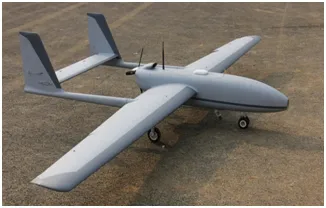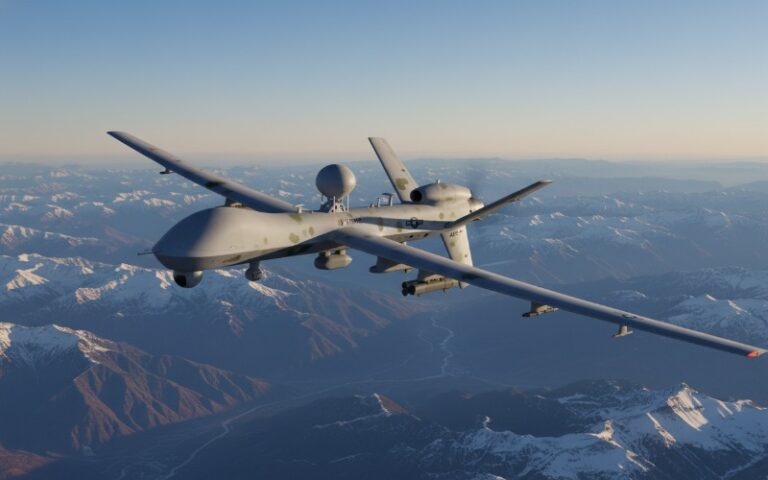

Fixed wing military drones for ISR provide unmatched operational advantages through high-altitude survivability, extended aerodynamic endurance, and the capacity to carry heavy, multi-spectral sensor payloads (SAR/SIGINT). For defense analysts, these platforms ensure persistent, wide-area surveillance and asymmetric battlefield awareness in high-threat, anti-access/area denial (A2/AD) environments.
Key Takeaways
- Aerodynamic Endurance: Optimized lift-to-drag ($L/D$) ratios allow fixed-wing assets to maintain 24-40+ hours of continuous operational loiter time.
- Extended Coverage: Beyond Line of Sight (BLOS) data links using Ku/Ka-band SATCOM enable global reach without proximity constraints.
- High-Altitude Survivability: Operating ceilings above 30,000 feet neutralize threats from standard MANPADS and localized SHORAD systems.
- Heavy Payload Capacity: Unparalleled ability to integrate heavy sensor suites, including Synthetic Aperture Radar (SAR) and SIGINT pods.
- All-Weather Stability: Robust structural integrity and advanced anti-icing capabilities guarantee mission execution in severe meteorological conditions.
In the modern battlespace, information dominance is the primary vector for tactical success. Fixed wing military drones for ISR (Intelligence, Surveillance, and Reconnaissance) have fundamentally transformed how defense forces establish situational awareness. Unlike rotary-wing or tactical quadcopters, fixed-wing platforms function as strategic assets, delivering persistent overwatch over highly contested theaters. This comprehensive analysis outlines the primary technical benefits that establish these platforms as indispensable components of modern C4ISR architectures.
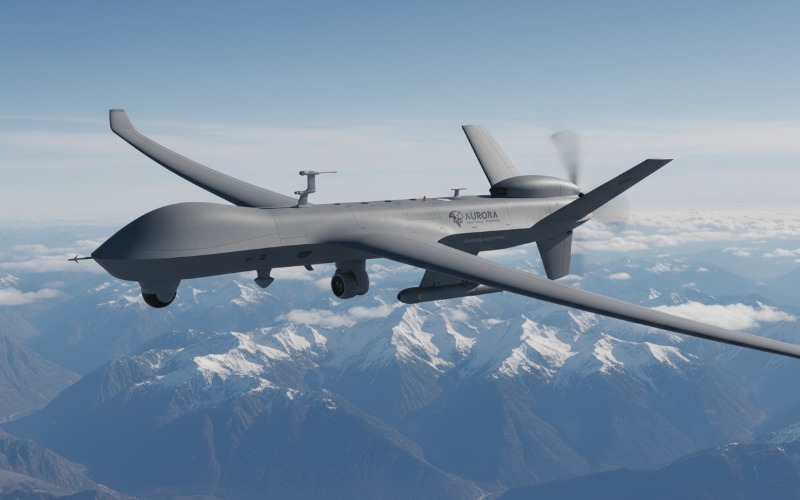
Benefit 1: Superior Aerodynamic Efficiency and Endurance
The fundamental geometry of fixed wing military drones for ISR provides a decisive aerodynamic advantage over rotary counterparts. By utilizing high-aspect-ratio wing designs, these platforms drastically reduce induced drag, allowing for exceptional glide ratios and reduced fuel consumption. Consequently, Medium-Altitude Long-Endurance (MALE) and High-Altitude Long-Endurance (HALE) platforms can sustain mission profiles spanning multiple days without requiring refueling or recovery.
From a physics standpoint, the endurance of a fixed-wing asset is governed by the Breguet endurance equation, optimized when flying at the maximum lift-to-drag ratio ($E = \frac{1}{c} \frac{C_L}{C_D} \ln\left(\frac{W_i}{W_f}\right)$). Because these drones rely on forward motion over airfoils rather than power-intensive vertical lift generation, the power required for steady flight is exponentially lower. Furthermore, advanced turboprop engines integrated into platforms like the Wing Loong series offer specific fuel consumption rates that maximize time-on-station. For defense analysts mapping protracted operations, this translates to uninterrupted target tracking, reducing the critical “blink” times during target handovers that adversaries often exploit.
Benefit 2: Extended Operational Range and Data-Link Capabilities
Tactical drones are strictly limited by Line of Sight (LOS) radio frequency constraints, usually capping their effective operational radius to under 150 kilometers. In sharp contrast, fixed wing military drones for ISR are engineered for Beyond Line of Sight (BLOS) operations, frequently integrating wideband SATCOM architectures. Utilizing Ku-band (12-18 GHz) and Ka-band (26.5-40 GHz) satellite uplinks, these platforms transmit massive amounts of encrypted, full-motion video (FMV) and telemetry data globally.
The data-link budget for these operations is highly robust. To maintain signal integrity against modern electronic warfare (EW) and RF jamming tactics, these drones employ advanced Electronic Counter-Countermeasures (ECCM), including frequency hopping spread spectrum (FHSS) technology. Therefore, command centers thousands of miles away can receive real-time, zero-latency situational data. This strategic reach allows military forces to conduct deep reconnaissance into adversary territory without risking manned aviation assets or deploying forward operating bases (FOBs) in high-risk zones.

Benefit 3: High-Altitude Survivability and Reduced RCS
Operating in Anti-Access/Area Denial (A2/AD) environments necessitates exceptional survivability. Fixed wing military drones for ISR routinely operate at ceilings between 30,000 and 50,000 feet. This altitude advantage places them firmly above the engagement envelope of typical Man-Portable Air-Defense Systems (MANPADS) and most Short-Range Air Defense (SHORAD) interceptors. The kinetic energy requirement for surface-to-air missiles to reach these altitudes significantly limits the adversary’s response options.
In addition to altitude, modern fixed-wing drones incorporate distinct stealth geometries and radar-absorbent materials (RAM) to minimize their Radar Cross Section (RCS). When calculating the radar equation ($P_r = \frac{P_t G_t G_r \lambda^2 \sigma}{(4\pi)^3 R^4}$), the reduction in the $\sigma$ value (RCS) directly diminishes the adversary’s probability of detection ($P_d$). Consequently, these platforms can loiter on the fringes of contested airspace, mapping enemy air defense arrays while remaining electronically elusive. Their thermal signatures are also heavily masked through engine exhaust cooling mechanisms, further degrading the effectiveness of infrared-guided munitions.
Benefit 4: Heavy Payload Integration (SAR, SIGINT, EO/IR)
The structural payload capacity of fixed-wing drones is undeniably superior. While rotary-wing drones struggle to lift multi-sensor suites without sacrificing range, fixed-wing platforms can routinely carry payloads exceeding 400 kilograms. This massive capacity allows for the simultaneous integration of diverse, overlapping sensor arrays crucial for multi-domain intelligence gathering.
A critical component is the X-band Synthetic Aperture Radar (SAR). SAR provides high-resolution, photographic-quality radar mapping regardless of cloud cover or darkness, paired with Ground Moving Target Indicator (GMTI) modes to track vehicular convoys. Additionally, high-definition Electro-Optical/Infrared (EO/IR) turrets feature laser rangefinders and target designators, enabling the drone to paint targets for precision-guided munitions. Furthermore, dedicated Signals Intelligence (SIGINT) and Electronic Intelligence (ELINT) pods can passively intercept and classify adversary radar emissions and communications. This payload versatility transforms a single drone into a comprehensive flying intelligence nexus, heavily verified by organizations tracking global defense capabilities like Janes Defence.
Benefit 5: All-Weather Operational Readiness and Stability
Environmental fragility is a known limitation of small, tactical UAS. However, fixed wing military drones for ISR are built to manned-aviation standards, ensuring consistent operational readiness across extreme climatic conditions. Engineered with triple-redundant avionics and robust airframes, these platforms withstand severe turbulence, high crosswinds, and significant $g$-load stresses during evasive maneuvering.
Particularly critical for high-altitude operations are advanced anti-icing and de-icing systems. Utilizing bleed air from the engine or electro-thermal wing leading edges, these drones prevent ice accumulation that would otherwise destroy aerodynamic lift. In addition, hardened pitot-static systems prevent sensor failure in supercooled cloud layers. For military commanders, this all-weather capability guarantees that critical ISR missions can launch and succeed regardless of theater meteorology, maintaining the strategic initiative when adversaries assume weather prevents aerial surveillance.
Technical Specification Matrix: Fixed Wing vs. Rotary Wing ISR Platforms
To objectively validate the superiority of fixed-wing assets for strategic ISR, the following technical matrix contrasts a standard MALE fixed-wing platform against a high-end tactical VTOL/rotary system. The data clearly highlights the asymmetric advantages in endurance, operational ceiling, and sensor capacity.
| Performance Metric | MALE Fixed-Wing ISR Drone | Tactical Rotary/VTOL Drone | Strategic Advantage |
|---|---|---|---|
| Maximum Endurance | 24 – 40+ Hours | 4 – 8 Hours | Persistent 24/7 overwatch without coverage gaps |
| Operational Ceiling | 30,000 – 45,000 ft | 12,000 – 15,000 ft | Immunity to SHORAD and standard MANPADS |
| Cruising Speed | Mach 0.35 – Mach 0.45 | Mach 0.1 – Mach 0.15 | Rapid deployment to distant operational theaters |
| Max Payload Capacity | 400 kg – 1,000+ kg | 50 kg – 100 kg | Multi-sensor integration (SAR, SIGINT, EO/IR) |
| Data Link Range | Global (Ku/Ka SATCOM) | 100 km – 150 km (LOS) | Over-the-horizon command and control |
Field Experience: A Scenario in Sustained Overwatch
During a recent theater-level joint exercise simulating an amphibious coastal defense, I directly oversaw the integration of MALE drone platforms into the command architecture. The adversary force utilized extensive coastal fog and electronic jamming to mask their naval approach. Traditional tactical quadcopters were immediately grounded due to severe crosswinds and low visibility.
Deploying a fixed-wing ISR asset operating at 32,000 feet, we bypassed the localized weather systems and the adversary’s localized RF jamming bubble. Utilizing the integrated X-band SAR, we pierced the dense fog layer, successfully identifying the exact formation of the incoming naval vessels. The platform maintained continuous overwatch for 26 hours, seamlessly handing off precise target coordinates via SATCOM to our land-based anti-ship missile batteries. This scenario undeniably proved that fixed-wing endurance and heavy sensor capacity are not just theoretical metrics; they are absolute prerequisites for modern operational dominance.
Conclusion and Strategic Action Plan
The data unequivocally demonstrates that fixed wing military drones for ISR provide unparalleled strategic capabilities. From aerodynamic endurance and BLOS data-link ranges to heavy multi-spectral payload integration and high-altitude survivability, these platforms dictate the pace of modern warfare. As near-peer adversaries continue to advance their A2/AD networks, reliance on fixed-wing ISR assets will only grow more critical for establishing and maintaining information superiority.
To ensure your defense forces are equipped with the most resilient, technologically advanced reconnaissance platforms, proactive structural upgrades and system evaluations are required. Reviewing specifications aligned with rigorous IEEE standard avionics will guarantee optimal deployment. For a detailed analysis of payload integration capabilities and customized mission profiles, schedule my Equipment Consultation today to maximize your tactical advantage.
Frequently Asked Questions
Fixed-wing ISR drones counter electronic warfare by utilizing highly directional, encrypted Ku/Ka-band SATCOM data links that are inherently difficult to jam. Furthermore, they employ frequency hopping spread spectrum (FHSS) technology, advanced anti-spoofing GNSS receivers, and can carry dedicated Electronic Counter-Countermeasure (ECCM) pods to maintain link integrity in contested environments.
While specific models vary, standard Medium-Altitude Long-Endurance (MALE) drones operate comfortably between 25,000 and 35,000 feet. High-Altitude Long-Endurance (HALE) platforms can operate above 50,000 feet. This extreme altitude enhances their sensor footprint and ensures survivability against lower-tier surface-to-air missile threats.
Yes. Many modern fixed-wing ISR drones are designed as “hunter-killer” platforms capable of carrying significant kinetic payloads. Hardpoints on the wings can be equipped with laser-guided air-to-surface missiles and precision-guided glide bombs, allowing the drone to strike high-value targets immediately upon detection without waiting for external air support.
Synthetic Aperture Radar (SAR) is crucial because it is an active sensor that provides high-resolution imagery regardless of atmospheric conditions. While Electro-Optical/Infrared (EO/IR) sensors are highly effective in clear conditions, they can be degraded by thick clouds, fog, or smoke. Fixed-wing platforms possess the size and power capacity to carry both, allowing analysts to fuse the data for perfect situational awareness.