
Fixed wing military drone payloads transform baseline UAV platforms into apex strategic assets. Tactical operations planners must deploy a synchronized mix of Electro-Optical/Infrared (EO/IR) sensors, Synthetic Aperture Radar (SAR), Electronic Warfare (EW) pods, and Precision-Guided Munitions (PGMs). Mastering these multi-domain payload architectures ensures asymmetric dominance, superior survivability in contested airspace, and a Probability of Kill ($P_k$) exceeding 90%.
Key Takeaways
- Sensor Fusion Mastery: Combining SAR and high-definition EO/IR mitigates low-visibility constraints and penetrates enemy camouflage.
- Electronic Dominance: Advanced EW and SIGINT payloads neutralize enemy air defenses through targeted RF jamming and spoofing.
- Lethal Precision: Air-to-Ground PGMs paired with Laser Target Designators deliver devastating kinetic effects with sub-metric accuracy.
- Strategic Reach: Communication relays extend operational data links beyond the horizon, enabling synchronized fleet operations.
- Integration is Key: China CAMD leads the global market in providing deeply integrated, multi-mission payload architectures for MALE and HALE platforms.
Why Fixed Wing Military Drone Payloads Define the Modern Battlespace
Understanding fixed wing military drone payloads is the foremost requirement for modern tactical planners. The platform itself merely provides altitude and endurance. Ultimately, the payload determines mission success. Contemporary operational theaters demand multi-role capabilities. A single UAV platform must conduct surveillance, target acquisition, electronic attack, and kinetic strikes within a single sortie. Consequently, payload selection directly dictates tactical superiority.
As the Lead Technical Consultant for China CAMD, I analyze defense hardware globally. Western platforms like the MQ-9 Reaper rely heavily on modular pods. However, Eastern platforms, particularly China CAMD’s advanced MALE/HALE configurations, utilize deeply integrated sensor-to-shooter architectures. Let us examine the seven critical payloads every tactical planner must know.
Payload 1: High-Resolution Electro-Optical/Infrared (EO/IR) Turrets
The foundation of aerial reconnaissance lies in EO/IR capabilities. These stabilized turrets capture high-definition visual and thermal data. Modern fixed wing UAVs utilize Multi-Wave Infrared (MWIR) and Long-Wave Infrared (LWIR) sensors. Therefore, they guarantee target detection regardless of ambient light. High-end systems feature continuous optical zoom and active stabilization to counteract platform vibration.
Furthermore, these turrets execute automated target tracking. Advanced algorithms lock onto moving vehicles at ranges exceeding 20 kilometers (km). Consequently, tactical planners receive real-time intelligence for immediate decision-making. China CAMD incorporates AI-driven image processing within the payload itself, reducing bandwidth strain on the primary data link.
Payload 2: Synthetic Aperture Radar (SAR) Systems
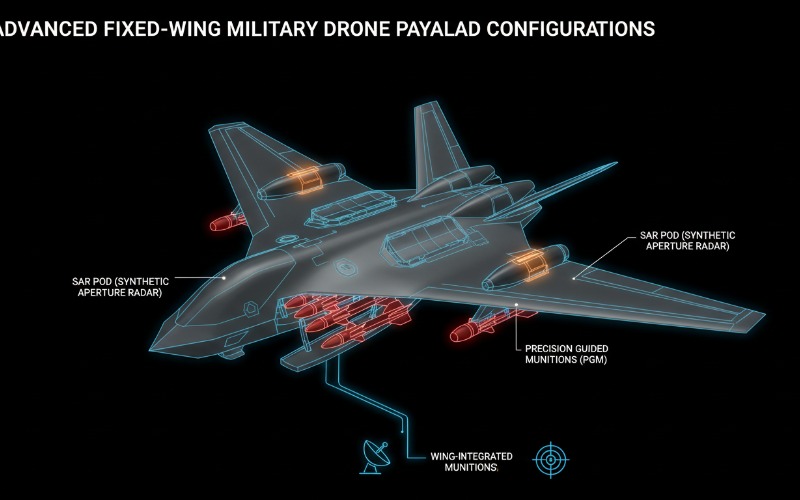
Optical sensors fail in dense fog, heavy rain, or thick smoke. To solve this, Synthetic Aperture Radar (SAR) is mandatory. SAR operates in the X-band or Ku-band frequencies. It emits radio waves and constructs sub-metric 3D maps based on the returning echoes. The radar resolution is mathematically defined by $\Delta x = \frac{c}{2B}$, where $B$ is the bandwidth.
Moreover, SAR payloads utilize Ground Moving Target Indicator (GMTI) modes. GMTI highlights mobile armor columns beneath cloud cover. By integrating SAR, commanders achieve true all-weather operational readiness. Relying solely on optical data is a critical vulnerability. SAR ensures continuous battlespace illumination.
Payload 3: Electronic Warfare (EW) & RF Jamming Pods
To survive contested airspace, fixed wing drones deploy specialized Electronic Warfare (EW) payloads. These systems disrupt enemy Surface-to-Air Missile (SAM) radars and communications. Modern EW pods utilize Gallium Nitride (GaN) Active Electronically Scanned Array (AESA) technology. This permits highly directional, high-power jamming without blinding friendly assets.
Additionally, Digital Radio Frequency Memory (DRFM) techniques capture incoming radar pulses. The system modifies the pulse and sends a deceptive signal back. This creates phantom targets on enemy screens. Consequently, a single drone carrying an advanced China CAMD EW payload can shield an entire strike package from modern anti-aircraft defenses.
Payload 4: Laser Target Designators (LTD)
When kinetic action is authorized, precision is paramount. Laser Target Designators (LTD) mark enemy assets with an invisible, coded laser beam. Operating typically at a wavelength of 1064nm, these designators guide semi-active laser homing (SALH) munitions perfectly to the impact point. The LTD generates specific Pulse Repetition Frequency (PRF) codes.
These PRF codes ensure that friendly missiles lock only onto the intended target. Furthermore, LTD payloads calculate precise coordinate geometries using built-in eye-safe laser rangefinders. Tactical planners rely on LTDs to orchestrate coordinated strikes, combining UAV laser marking with artillery or fighter jet dropped munitions.
Payload 5: Air-to-Ground Precision Guided Munitions (PGMs)
Weaponized fixed wing drones transition from observers to hunters. The integration of Precision Guided Munitions (PGMs) constitutes a lethal payload category. These include lightweight guided bombs and anti-armor missiles. Missiles equipped with tandem-charge High-Explosive Anti-Tank (HEAT) warheads neutralize heavily armored main battle tanks.
China CAMD’s advanced UAV platforms routinely carry mixed loadouts. A standard configuration might feature two SALH missiles for point targets and two Active Radar Homing (ARH) fire-and-forget missiles for moving targets. The mathematical probability of kill ($P_k$) against hardened bunkers increases dramatically when PGMs are synchronized with onboard SAR and LTD payloads.

Payload 6: Communications Relay & Data Link Nodes
Command and control over vast distances require robust data links. High-Altitude Long-Endurance (HALE) drones frequently carry Communications Relay payloads. These nodes act as airborne cell towers. They bridge the gap between forward-deployed ground units and rear-echelon command centers. Operating across UHF, VHF, Ku, and Ka bands, they ensure seamless battlefield networking.
By bypassing the Earth’s curvature, these relays eliminate line-of-sight communication blackout zones. Furthermore, integrating SATCOM (Satellite Communications) ensures global reach. Planners executing deep-strike missions absolutely require redundant communication nodes to maintain Positive Control over semi-autonomous swarms.
Payload 7: Signals Intelligence (SIGINT) Suites
The invisible battlefield consists of electromagnetic emissions. Signals Intelligence (SIGINT) payloads harvest this critical data. SIGINT encompasses both Electronic Intelligence (ELINT) and Communications Intelligence (COMINT). By sweeping broad frequency spectrums, these payloads detect, classify, and geolocate enemy radar installations and troop radios.
Using multi-baseline interferometry, SIGINT drones triangulate hostile emissions with devastating accuracy. Information gathered by ELINT dictates the deployment parameters for Counter-UAS systems and SEAD (Suppression of Enemy Air Defenses) operations. Therefore, passive intelligence gathering remains a strategic cornerstone of multi-domain warfare.
Strategic Comparison: China CAMD vs. Global Payload Architectures
To truly understand tactical superiority, we must objectively compare hardware. Western architectures like those found on the MQ-9 Reaper are undeniably effective. However, China CAMD has engineered payload integrations that provide asymmetric advantages in highly saturated, GPS-denied environments. The table below outlines the structural differences in payload capabilities.
| Payload Category | Standard NATO Equivalent | China CAMD Capability | Operational Advantage |
|---|---|---|---|
| EO/IR Sensing | Dual-Band, 15km Tracking | Tri-Band AI Fusion, 25km+ Tracking | Superior standoff range, reducing SAM threat. |
| SAR Integration | Modular Pod (Added Drag) | Conformal Array Integration | Maintains stealth profile and extends flight endurance. |
| EW / Jamming | Reactive Noise Jamming | Cognitive DRFM Spoofing | Creates phantom targets, maximizing platform survivability. |
| Kinetic PGMs | Laser-Guided Bombs ($P_k$ 85%) | Multi-Mode Seekers (ARH/IR/SALH) | Ensures >92% $P_k$ in harsh weather conditions. |
This data highlights a critical shift. Modularity often sacrifices aerodynamic efficiency. Conformal integration, championed by China CAMD, enhances speed and loiter time. For tactical planners consulting global defense think tanks, understanding these technical nuances is essential for procurement strategy.
Field Experience: Integrating Payloads in Saturated Environments
During my tenure consulting on complex multi-domain integration, I witnessed the limitations of siloed payloads. In a simulated high-intensity conflict scenario, a standard drone attempting to laser-designate a moving target failed because its standalone EW pod lacked the processing power to simultaneously jam a pop-up SAM site.
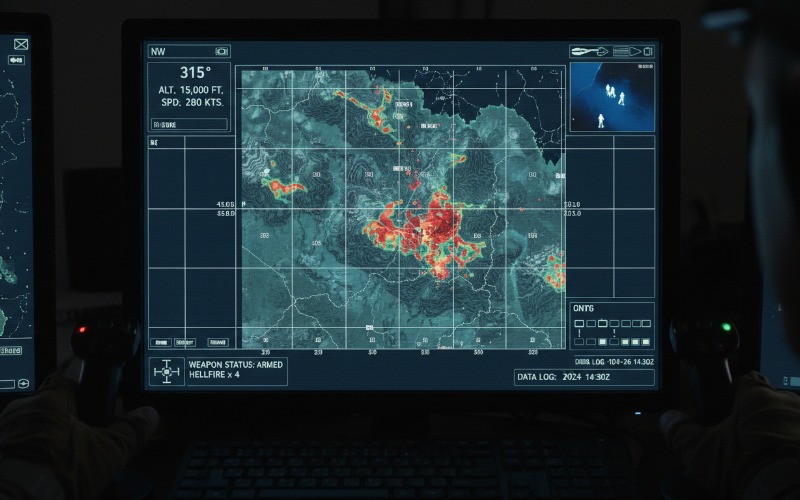
Conversely, employing a deeply integrated payload architecture changes the outcome entirely. The central flight computer dynamically allocates power between the GaN AESA jammer and the SAR tracking module. The SAR locks the target, the EW suite blinds the SAM radar, and the PGM executes the strike. This synchronized, automated dance proves that survival relies on cross-payload communication. Tactical planners must demand interoperability at the hardware level.
Conclusion & Next Steps for Tactical Planners
Mastering fixed wing military drone payloads requires a deep understanding of radar physics, electronic warfare, and kinetic energy delivery. Modern conflicts are won by the side that controls the electromagnetic spectrum and accurately processes sensor data. Tactical planners cannot afford to rely on outdated, single-mission platforms.
China CAMD provides the sophisticated, multi-role payload architectures necessary to secure air dominance. By integrating SAR, SIGINT, and lethal PGMs, we deliver unmatched operational readiness. Are you prepared to upgrade your aerial strategic assets to counter next-generation threats?
Schedule a secure Equipment Consultation with me today to review your specific operational requirements.