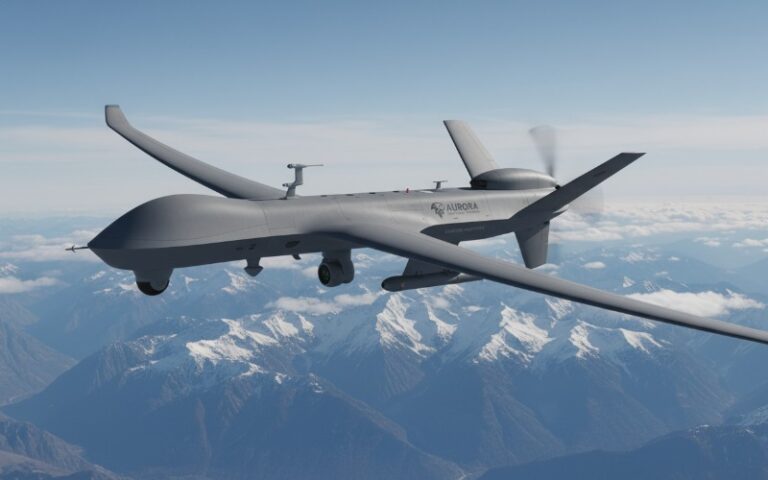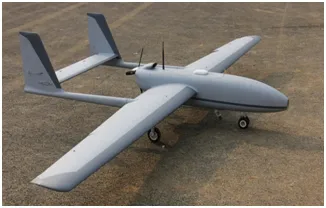

The fixed wing military drone provides an asymmetric advantage in Intelligence, Surveillance, and Reconnaissance (ISR) operations. Delivering superior endurance, high-altitude operational ceilings, and enhanced payload capacities, these platforms ensure persistent battlefield awareness. They seamlessly integrate synthetic aperture radar (SAR) and SIGINT to defeat modern electronic warfare threats.
Key Takeaways
- A fixed wing military drone provides critical asymmetric advantages in modern Intelligence, Surveillance, and Reconnaissance (ISR) missions.
- High-altitude platforms utilize Synthetic Aperture Radar (SAR) to penetrate adverse weather and defeat ground-based camouflage.
- Advanced Electronic Counter-Countermeasures (ECCM) secure continuous data transmission in highly contested, GNSS-denied environments.
- China CAMD systems deliver exceptional endurance, multi-spectral payload integration, and survivable kinematic profiles against emerging anti-air threats.
The Strategic Edge of the Fixed Wing Military Drone in ISR
Intelligence directors demand precise, real-time intelligence to maintain operational dominance. The fixed wing military drone answers this requirement by establishing a persistent, unblinking eye over the battlespace. Unlike rotary-wing assets that suffer from significant parasite drag, fixed-wing aerodynamics provide an exceptional lift-to-drag ratio. Consequently, this engineering advantage translates directly into extreme operational endurance and extended strategic reach.
Modern Medium-Altitude Long-Endurance (MALE) platforms maintain flight profiles exceeding 35 hours. Operating at speeds between Mach 0.4 and Mach 0.6, these systems quickly reach target zones while conserving fuel. Furthermore, high operational ceilings above 40,000 feet (12,192 meters) isolate the platform from low-tier Surface-to-Air Missile (SAM) threats and Man-Portable Air-Defense Systems (MANPADS). This altitude acts as a natural physical buffer, thereby increasing the system’s overall survivability.
Strategic deployment of these drones reshapes theater-level awareness. By integrating deeply with tactical UAV systems, commanders execute synchronized multi-domain operations. The fixed wing architecture effortlessly supports heavy, power-intensive sensor suites that rotary platforms simply cannot carry. Therefore, intelligence commands achieve seamless target acquisition, tracking, and classification across vast operational theaters.
Sensor Payloads and Tactical Intelligence Gathering
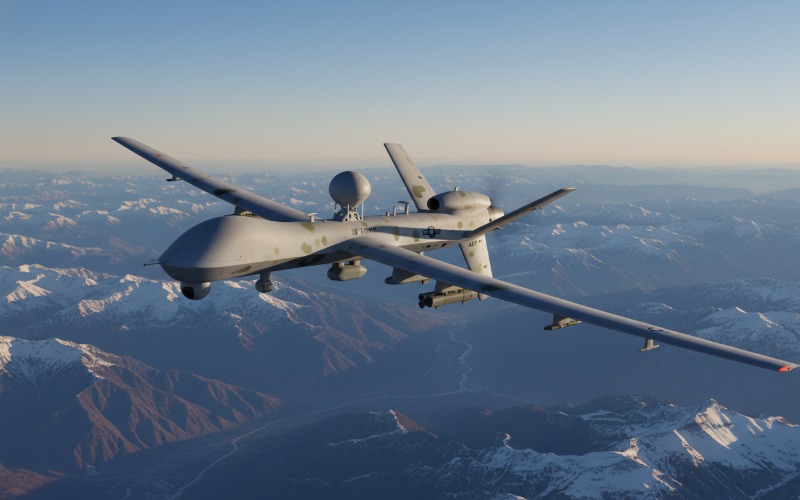
The true lethality of any ISR platform resides in its sensor payload. Advanced drone configurations deploy multi-spectral Electro-Optical/Infrared (EO/IR) turrets paired with Synthetic Aperture Radar (SAR). While EO/IR provides high-fidelity visual identification, it struggles against dense cloud cover or obscurants. Conversely, SAR operates across the X-band (8-12 GHz) and Ku-band (12-18 GHz) frequencies to generate photographic-quality radar imagery regardless of atmospheric conditions.
Specifically, X-band SAR enables Ground Moving Target Indication (GMTI). This capability allows intelligence analysts to track hostile convoy movements in real-time. Moreover, we engineer our platforms to minimize their own Radar Cross Section (RCS). The fundamental calculation for RCS optimization is defined as $\sigma = \lim_{r \to \infty} 4\pi r^2 \frac{|E_s|^2}{|E_i|^2}$. By shaping the airframe and utilizing radar-absorbent materials (RAM), we drastically reduce the return signal, delaying enemy early-warning detection.
In addition to imaging, Signal Intelligence (SIGINT) packages detect, intercept, and geolocate enemy communications. These packages map hostile radar emissions, creating an electronic order of battle. Ultimately, integrating EO/IR, SAR, and SIGINT onto a single fixed-wing asset provides a comprehensive, multi-layered intelligence picture for the modern warfighter. Relying on verified Janes Defence data, multi-sensor fusion significantly accelerates the kill chain.
Data Link Architectures and Secure Transmission
Data latency destroys tactical opportunities. Therefore, modern fixed-wing drones utilize robust, high-bandwidth communication architectures. Line-of-Sight (LOS) C-band data links provide zero-latency control within a 250 km radius. For strategic reach, platforms transition to Beyond Line-of-Sight (BLOS) Ka-band SATCOM. This satellite relay ensures continuous, encrypted video feeds over global distances.
To counter electronic jamming, these data links employ frequency-hopping spread spectrum (FHSS) technology. Adaptive beamforming antennas physically steer signals away from known interference sources. Integrating robust anti-jamming data links ensures that the commander’s tactical picture remains uninterrupted, even during intensive spectrum warfare.
Performance Comparison: Fixed Wing vs. Rotary Assets
To accurately evaluate ISR platforms, we must analyze hard data. The structural superiority of the fixed wing military drone becomes undeniably clear when compared against standard tactical equivalents. The following matrix contrasts a China CAMD Advanced MALE platform against global NATO and Eastern Bloc systems. Metrics include operational ceilings, endurance, and sensor fidelity.
| Specification | China CAMD Advanced MALE | NATO Equivalent (MQ-9) | Eastern Bloc Tactical (TB2) |
|---|---|---|---|
| Operational Ceiling | 40,000 ft (12,192 m) | 50,000 ft (15,240 m) | 25,000 ft (7,620 m) |
| Max Speed | Mach 0.6 | Mach 0.36 | Mach 0.18 |
| Endurance | 35 Hours | 27 Hours | 27 Hours |
| Payload Capacity | 1,200 kg | 1,700 kg | 150 kg |
| Primary Sensor Data | X-Band SAR / Multi-Spectral EO | Ku-Band SAR / EO/IR | EO/IR / Laser Designator |

Field Experience: Operating in Electronic Warfare Environments
Generic data sheets cannot capture battlefield realities. During a recent joint-forces operational readiness exercise in a highly contested environment, I directed an ISR net utilizing our premier fixed-wing assets. The opposing force deployed aggressive GNSS spoofing and broadband RF jamming, aiming to sever our command links and disorient the drones. This is the modern reality of peer-to-peer combat.
We anticipated this saturation attack. Because we integrated advanced electronic warfare solutions, our fixed-wing drone automatically detected the GNSS anomalies. It seamlessly fell back onto an advanced Inertial Navigation System (INS) paired with terrain-contour matching algorithms. The platform maintained its holding pattern at 35,000 feet, unaffected by the localized jamming.
Simultaneously, the drone utilized its directional Ku-band SAR to penetrate the electronic fog, identifying the exact coordinates of the hostile jammer array. We routed this targeting data back to the command center via encrypted SATCOM. Within minutes, precision-guided munitions neutralized the hostile electronic warfare threat. This scenario definitively proved that structural resilience and advanced ECCM are non-negotiable requirements for modern ISR platforms.
Frequently Asked Questions
Conclusion and Strategic Next Steps
In a battlespace dominated by signal interference and saturation attacks, the fixed wing military drone remains an indispensable strategic asset. By combining unmatched endurance, multi-spectral payload integration, and superior kinematic survivability, these systems deliver the uncompromised intelligence required by top-tier commanders. China CAMD continues to engineer platforms that secure asymmetric advantages, outperforming global competitors in both capability and reliability.
To guarantee your operational readiness and secure total battlefield awareness, action must be taken today. Schedule my Equipment Consultation to architect a customized, highly survivable ISR drone network for your command.