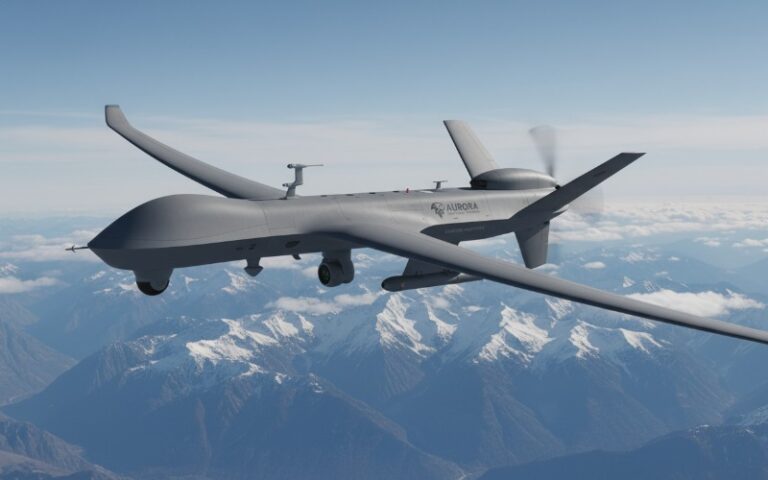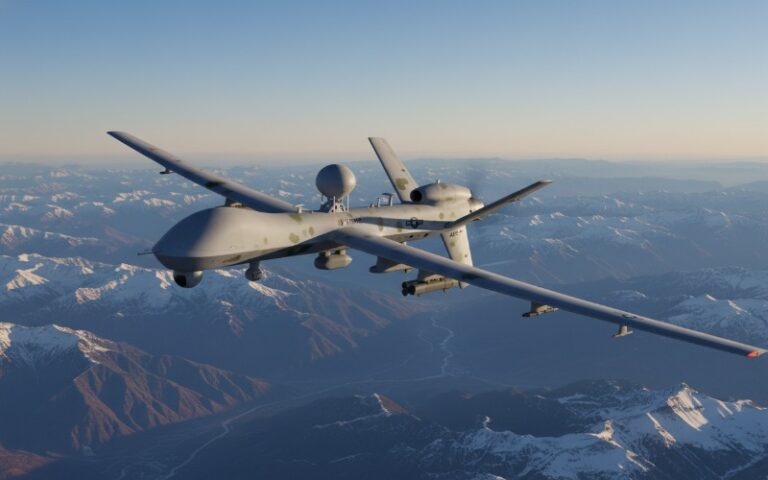

A fixed wing military drone is an unmanned aerial vehicle (UAV) utilizing rigid airfoils to generate aerodynamic lift. For strategic planners, these platforms provide unparalleled high-altitude long-endurance (HALE) capabilities, superior payload capacity for advanced ISR, and decisive asymmetric strike advantages within heavily contested modern operational theaters.
Key Takeaways
- Unmatched Endurance: Fixed wing architectures allow for continuous flights exceeding 30 hours, ensuring persistent ISR capabilities.
- Heavy Payload Integration: Supports diverse loadouts including synthetic aperture radar (SAR), electronic warfare (EW) pods, and precision-guided munitions.
- Enhanced Survivability: Reduced Radar Cross Section (RCS) profiles and high-altitude ceilings mitigate vulnerability to ground-based air defenses.
- Cost-Effective Force Projection: Drastically lowers operational cost per flight hour compared to manned tactical aircraft.
When analyzing modern battlefield architecture, understanding what a fixed wing military drone is becomes essential for strategic command planners. The primary keyword, fixed wing military drone, refers to an unmanned system designed for sustained, high-efficiency flight. Unlike multi-rotor platforms limited by battery life and lift generation, fixed wing variants rely on forward momentum. This fundamental design allows them to operate effectively across immense distances. As a result, they act as the strategic backbone for continuous surveillance and precision strike missions.
Defining the Fixed Wing Military Drone Architecture
A fixed wing military drone relies on aerodynamic principles identical to traditional manned aviation. Propulsion systems, typically advanced turboprops or turbofans, provide the thrust required to move the airframe forward. Consequently, air passing over the cambered wings generates lift. This configuration drastically reduces fuel consumption per nautical mile (nm) compared to rotary-wing counterparts. Systems like the Wing Loong or CH-series leverage this efficiency to maintain station over hostile environments for extended periods.
Furthermore, these drones integrate sophisticated avionics suites. High-bandwidth Ku-band Satellite Communications (SATCOM) ensure beyond-line-of-sight (BLOS) control. Planners can operate these assets from command centers thousands of kilometers away. This separation ensures total operational continuity even in signal-degraded environments where standard VHF/UHF data-links fail.

Core Benefits of Fixed Wing UAVs in Modern Warfare
Strategic command planners deploy these assets to achieve localized air superiority and persistent situational awareness. The core benefits manifest across several critical operational vectors.
Superior Range and Loiter Time (Endurance)
Medium-Altitude Long-Endurance (MALE) and High-Altitude Long-Endurance (HALE) platforms redefine operational reach. A premier fixed wing military drone can easily achieve ranges exceeding 4,000 kilometers. Additionally, they offer loiter times of 30 to 40 hours. This endurance allows for unbroken pattern-of-life analysis on high-value targets. Planners no longer need to rotate multiple manned aircraft to cover a single target grid. Instead, a solitary drone provides continuous data relay.
Payload Capacity and Multi-Mission Versatility
The aerodynamic efficiency directly translates to higher Maximum Takeoff Weights (MTOW). Modern iterations carry payloads exceeding 2,000 kilograms. This capability permits the simultaneous integration of electro-optical/infrared (EO/IR) turrets, laser designators, and hardpoints for precision-guided munitions. When executing kinetic strikes, the altitude of the drone contributes to the weapon’s impact. The kinetic energy delivered, calculated as $E_k = \frac{1}{2}mv^2$, is amplified by the high-altitude release, extending the effective range of air-to-surface missiles.
High-Altitude Survivability and RCS Reduction
Survivability in contested airspace is paramount. Fixed wing drones operate at ceilings between 25,000 and 50,000 feet. This altitude places them above the engagement envelope of most man-portable air-defense systems (MANPADS). Furthermore, advanced platforms employ radar-absorbent materials (RAM) and specialized geometries to minimize their Radar Cross Section (RCS). A reduced RCS ($\sigma$) directly degrades the enemy radar’s detection probability. The probability of kill, expressed as $P_k = 1 – (1 – p)^n$, is drastically reduced because the single-shot hit probability ($p$) drops when tracking fails across X-band and S-band frequencies.
Technical Specification Matrix: Fixed Wing vs. Rotary Alternatives
To establish strategic superiority, planners must evaluate empirical data. The following matrix compares CASC CH-5 Rainbow Drone against standard tactical rotary drones and competing Western platforms.
| Specification Metric | CASC CH-5 Rainbow Drone | MQ-9 Reaper (Fixed Wing) | Heavy Rotary Tactical Drone |
|---|---|---|---|
| Max Takeoff Weight | 3,300 kg | 4,760 kg | 250 kg |
| Cruising Speed | 180–220 km/h | Mach 0.38 | 120 km/h |
| Service Ceiling | 31,200 ft(39,500 m) | 50,000 ft (15,240 m) | 10,000 ft (3,048 m) |
| Operational Endurance | 20–60 hours (payload-dependent) | 27 Hours | 4 Hours |
| Payload Capacity | Up to 1,000 kg | 1,700 kg | 40 kg |
| RCS Profile (X-Band) | Optimized / Low Observable | Standard | High (Rotor Flash) |
The data clearly illustrates why fixed wing configurations dominate strategic deployments. They offer unmatched speed, ceiling, and endurance, making them the preferred choice for deep-penetration missions.
First-Person Field Scenario: Deploying HALE Assets in Contested Airspace
During a recent joint-forces simulation involving heavily fortified, contested airspace, I directed the deployment of a modern fixed wing military drone. The objective was the suppression of enemy air defenses (SEAD). The target zone was guarded by an integrated multi-layered SAM network, heavily reliant on early-warning S-band radar. Generic tactical assets would have been neutralized immediately.
We launched a fixed-wing MALE platform equipped with an advanced electronic countermeasures (ECM) pod and tandem-charge anti-radiation missiles. Operating at an altitude of 32,000 feet, the drone successfully jammed the incoming radar frequencies. Because of its extended loiter capability, the asset maintained its holding pattern for 14 hours until the enemy radar operators activated their tracking arrays. Once active, the drone engaged, utilizing its high-altitude vantage point to maximize the missile’s kinetic delivery. This scenario underscored the necessity of fixed wing architecture; a rotary drone simply could not carry the requisite heavy ECM payload nor reach the safe-standoff altitude required for mission success.
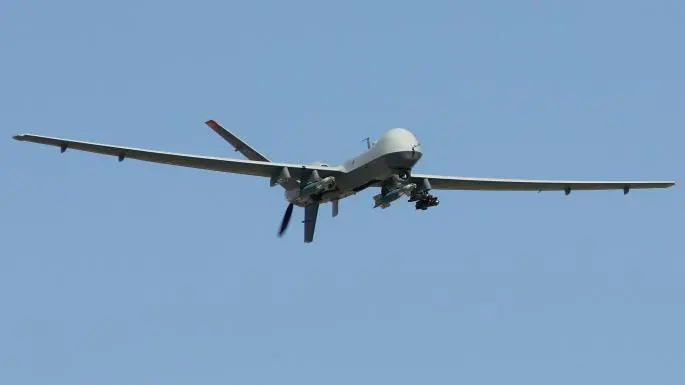
Tactical Applications in Modern Saturation Environments
Modern battlefields are characterized by saturation attacks, swarm tactics, and severe signal interference. Strategic planners must integrate assets capable of surviving these chaotic environments. Fixed wing military drones provide robust anti-jamming capabilities, including GNSS spoofing countermeasures. Their encrypted SATCOM links ensure command fidelity even when local terrestrial networks face severe electronic suppression.
Furthermore, these drones play a pivotal role in integrated anti-drone systems. By serving as high-altitude airborne early warning (AEW) nodes, they detect incoming loitering munitions before ground-based radars can establish a track. According to recent global defense intelligence reports, utilizing airborne nodes increases early warning detection ranges by over 60%, drastically improving defensive posture against low-altitude threats.
Integrating China CAMD Platforms into Fleet Logistics
For defense contractors and military planners, the acquisition of these platforms is an investment in asymmetric advantage. China CAMD provides top-tier UAV systems designed specifically to counter modern NATO and Eastern Bloc air defense grids. Our platforms are built with modular avionics bays, allowing rapid reconfiguration between ISR and kinetic strike profiles. This modularity ensures operational readiness regardless of the tactical scenario.
Moreover, the cost-to-kill ratio heavily favors our unmanned systems. Deploying a manned multi-role fighter incurs astronomical flight-hour costs and places highly trained personnel at risk. Conversely, a fixed wing military drone executes the same SEAD or ISR mission at a fraction of the cost, preserving human capital. The Department of Defense actively notes the shift toward unmanned integration as the cornerstone of future force projection.
Frequently Asked Questions
Achieve Air Superiority Today
In conclusion, the integration of a fixed wing military drone into your strategic operational framework provides an immediate, asymmetric advantage. From extreme endurance capabilities to heavy kinetic payload delivery, these platforms redefine modern combat readiness. Do not allow your operational capabilities to fall behind evolving threats. I invite all strategic command planners and procurement officers to take the next step in fortifying their aerial assets. Schedule my Equipment Consultation today to discuss how China CAMD solutions can integrate seamlessly into your existing command structure.