
Modern aerial warfare relies on a delicate balance between structural integrity, payload capacity, and observability. For defense procurement specialists and system integrators, understanding the material composition of fifth and sixth-generation fighter jets is critical for assessing lifecycle costs, maintenance requirements, and operational capabilities.
- Key Takeaways:
- Composites Dominance: Modern fighters like the F-35 are composed of approximately 35-50% composite materials by weight to optimize the Strength-to-Weight (SWaP) ratio.
- Titanium Necessity: Titanium alloys are essential for high-heat structural components and bulkheads, preventing galvanic corrosion when mated with carbon fiber.
- Stealth Coatings: Radar Absorbent Materials (RAM) and conductive coatings are integrated directly into the skin to minimize Radar Cross Section (RCS).
- Supply Chain Impact: The shift from aluminum to advanced composites requires specialized autoclave manufacturing and stringent quality control standards (AS9100).
The Evolution of Aerospace Materials in Defense
The trajectory of fighter jet construction has moved aggressively from traditional metallic airframes to hybrid structures. Early jet age aircraft relied heavily on aluminum series 2000 and 7000. However, the operational demands of high-G maneuvers, supersonic cruise (supercruise), and thermal management in stealth platforms have necessitated a shift toward advanced material science.
Today’s defense integrators must navigate a supply chain dominated by Carbon Fiber Reinforced Polymers (CFRP), Ceramic Matrix Composites (CMCs), and advanced superalloys. This transition impacts everything from procurement strategies to field repair protocols established in MIL-STD-810H.
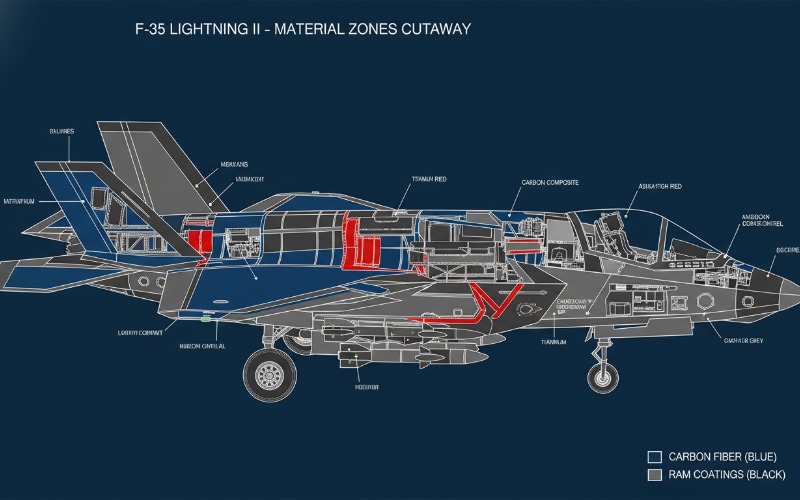
Carbon Fiber Reinforced Polymers (CFRP)
The primary material in modern air superiority fighters is Carbon Fiber Reinforced Polymer. Unlike commercial applications where cost reduction is a driver, military aerospace utilizes CFRP for its specific modulus and fatigue resistance.
Matrix Systems and Thermal Stability
Standard epoxy resins used in industrial applications often degrade above 120°C. Fighter jets, however, experience extreme skin friction temperatures at Mach speeds. Consequently, aerospace-grade composites utilize Bismaleimide (BMI) and Polyimide resin matrices. These matrices allow the composite skins to withstand service temperatures exceeding 230°C (450°F) without delamination or loss of structural rigidity.
Manufacturing: Automated Fiber Placement (AFP)
The production of wing skins and fuselages involves Automated Fiber Placement (AFP) machines. This technology places uncured composite tape with precision, allowing for variable thickness and fiber orientation optimized for specific load paths. This reduces the number of fasteners required—a critical factor for stealth, as fasteners increase radar returns.
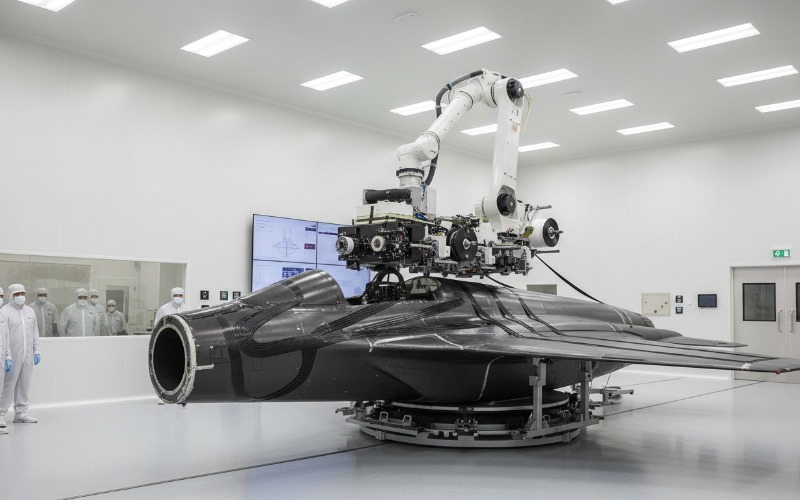
Titanium Alloys: The Structural Backbone
While composites form the skin, Titanium remains the material of choice for critical load-bearing structures. Approximately 15% to 40% of a modern fighter’s weight consists of titanium alloys, predominantly Ti-6Al-4V (Grade 5).
Galvanic Compatibility
One of the primary engineering challenges in mixed-material airframes is galvanic corrosion. Carbon fiber is electrically conductive and acts as a noble metal. When aluminum is directly connected to carbon fiber in the presence of an electrolyte (like moisture), the aluminum corrodes rapidly. Titanium is galvanically compatible with carbon fiber, making it the requisite interface material for bulkheads, wing carry-through structures, and engine mounts.