
Key Takeaways on Tactical Aircraft Endurance
- Distinction of Terms: Operational planning must distinguish between Ferry Range (max one-way distance), Combat Radius (distance to target and return), and Loiter Time (station-keeping duration).
- Fuel Fraction Criticality: The ratio of internal fuel weight to gross takeoff weight remains the primary determinant of unrefueled endurance, with the F-35A and Su-35 holding significant advantages in internal capacity.
- Aerial Refueling Multiplier: In-flight refueling (IFR) effectively removes mechanical range limits, shifting the endurance bottleneck to pilot physiological limits and oil consumption.
- Propulsion Evolution: Emerging Adaptive Cycle Engines (ACE) promise to extend combat radius by 25-30% through variable bypass ratios optimized for different flight regimes.
In the domain of defense procurement and strategic mission planning, the question of “how long can fighter jets fly” is not answered by a single metric. It is a complex calculation involving thrust-specific fuel consumption (TSFC), drag coefficients, internal fuel fractions, and mission profiles. For defense integrators and military stakeholders, understanding the technical constraints of aerial endurance is critical for evaluating platform viability, particularly in theaters defined by the “tyranny of distance,” such as the Indo-Pacific.
This analysis dissects the operational parameters defining fighter jet endurance, contrasting legacy platforms with fifth-generation capabilities and outlining the mechanical and physiological limits that define modern air power projection.
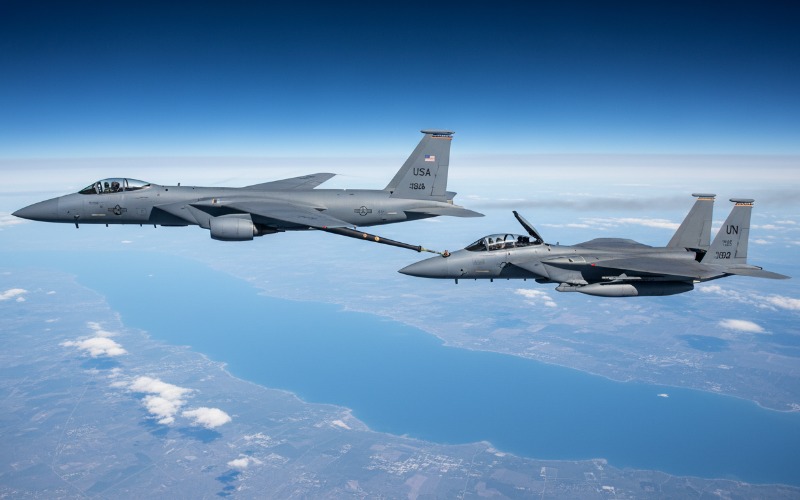
Defining Operational Endurance Metrics
When analyzing technical specifications for Requests for Information (RFI) or Requests for Proposals (RFP), procurement officers must navigate three distinct endurance categories. A misunderstanding of these variables can lead to critical gaps in strategic force posture.
Ferry Range Versus Combat Radius
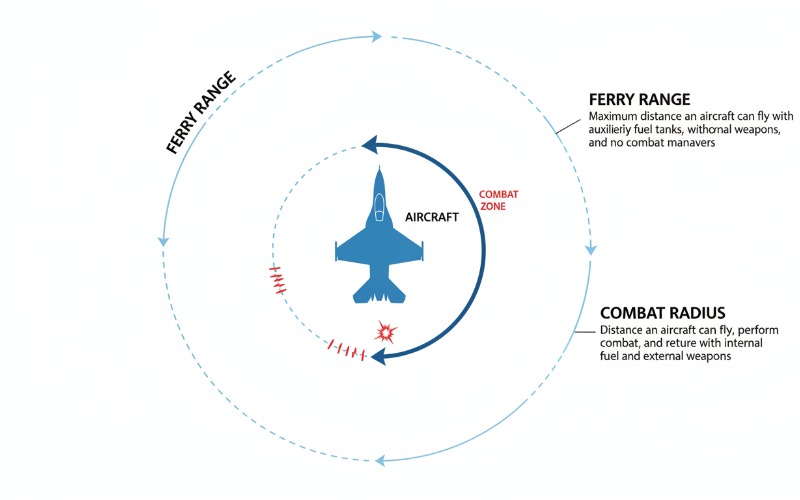
Ferry Range refers to the maximum distance an aircraft can fly with maximum fuel (often including external drop tanks) and minimum payload, typically in a one-way transit. This figure is useful for deployment logistics but irrelevant for tactical engagement scenarios.
Combat Radius is the critical metric for warfighters. It defines the distance an aircraft can travel from its base, execute a combat mission (which consumes fuel at a higher rate due to maneuvering and afterburner use), and return to base with a safety reserve. A standard Fourth-Generation fighter like the F-16C has a combat radius of approximately 340 nautical miles (nm) on internal fuel, whereas the F-35A extends this to roughly 669 nm, altering the strategic reach without tanker support.
Factors Influencing Unrefueled Flight Duration
The unrefueled endurance of a tactical aircraft is governed by the Breguet Range Equation, which balances aerodynamics, propulsion efficiency, and structural weight.
Internal Fuel Fraction and Conformal Tanks
Modern stealth requirements penalize the use of external drop tanks, which significantly increase Radar Cross Section (RCS). Consequently, Fifth-Generation aircraft rely heavily on high internal fuel fractions.
- Legacy Solutions: Platforms like the F-15E Strike Eagle utilize Conformal Fuel Tanks (CFTs) that hug the fuselage to reduce drag compared to underwing tanks. This allows for extended loiter times without sacrificing as much hardpoint capacity for munitions.
- Fifth-Generation Design: The F-35 carries roughly 18,500 lbs of internal fuel. In contrast, an F-16 carries only about 7,000 lbs internally. This massive internal capacity allows the F-35 to maintain stealth while achieving flight times comparable to legacy fighters equipped with external tanks.
Specific Fuel Consumption (SFC) and Supercruise
Engine efficiency is measured in pounds of fuel per hour per pound of thrust. The use of afterburners (wet thrust) increases fuel consumption by 300% to 400% compared to military power (dry thrust). This drastic consumption limits supersonic flight to mere minutes in most aircraft.
Supercruise capability—sustained supersonic flight without afterburners—found in the F-22 Raptor and Eurofighter Typhoon, allows these platforms to cover vast distances quickly without the prohibitive fuel penalty of afterburners, effectively compressing the time-to-target while preserving endurance.
Comparative Technical Analysis of Major Platforms
The following table compares the operational range and endurance characteristics of leading global fighter platforms. Note that “Combat Radius” is highly dependent on mission profile (Hi-Lo-Hi vs. Lo-Lo-Lo) and ordnance loadout.
| Aircraft Platform | Internal Fuel Capacity | Max Ferry Range (w/ tanks) | Combat Radius (Internal Fuel) | Engine Config |
|---|---|---|---|---|
| Lockheed Martin F-35A | 18,250 lbs | 1,200 nm (Internal only) | ~669 nm | Single P&W F135 |
| Boeing F-15EX Eagle II | 13,550 lbs (+ CFTs) | 2,400+ nm | ~800 nm | Twin GE F110-GE-129 |
| Dassault Rafale C | 10,300 lbs | 2,000 nm | ~550 nm | Twin Snecma M88 |
| Lockheed Martin F-22 | 18,000 lbs | 1,600 nm | ~460 nm (Supercruise profiles) | Twin P&W F119 |
| Eurofighter Typhoon | 11,000 lbs | 2,000 nm | ~600 nm | Twin Eurojet EJ200 |
Aerial Refueling The Endurance Multiplier
The theoretical limit of a fighter jet’s flight time is purely mechanical; however, the operational limit is defined by Aerial Refueling (AR). With AR support, endurance is no longer a function of fuel tank size but rather of lubrication systems and crew physiology.
Mechanics of Infinite Range
Modern fighter engines, such as the Pratt & Whitney F135 or the General Electric F110, consume oil at a very slow rate. Theoretically, if fuel is constantly replenished via tankers (KC-46 Pegasus or Airbus A330 MRTT), a fighter could fly for 12 to 15 hours continuously before oil levels become critical or mechanical inspections are required.
Strategic Implications
In operations such as Operation Odyssey Dawn (Libya) or long-range strikes in the Middle East, fighter aircraft have conducted missions exceeding 10 hours. These sorties require multiple refueling brackets. For defense integrators, this highlights the necessity of ensuring probe-and-drogue or flying boom interoperability between acquired fighters and existing tanker fleets.
Physiological Limitations of the Human System
While the hardware can fly indefinitely with refueling, the “human in the loop” is the limiting factor. Pilot endurance is governed by fatigue, hydration, and oxygen generation.
The 12-Hour Hard Limit
Generally, U.S. Air Force and NATO regulations consider 10 to 12 hours to be the maximum single-seat sortie duration before performance degradation becomes dangerous. Factors include:
- Cockpit Ergonomics: Ejection seats are designed for safety, not comfort. prolonged immobility leads to deep vein thrombosis risk and extreme fatigue.
- OBOGS Systems: On-Board Oxygen Generation Systems enable unlimited oxygen supply, replacing older liquid oxygen (LOX) bottles. However, system reliability and the risk of hypoxia or hypocapnia during ultra-long duration flights remain active areas of research in aeromedical safety.