
In the landscape of modern aerial warfare, the distinction between air superiority fighters and multirole combat aircraft remains a critical consideration for defense procurement agencies and military strategists. While the convergence of avionics and stealth technology in fifth and sixth-generation platforms has blurred traditional lines, the operational requirements for establishing air dominance versus conducting flexible strike missions retain distinct engineering and logistical profiles.
Key Takeaways
- Mission Profile Distinctness: Air superiority platforms prioritize kinematics, altitude, and radar reach for air-to-air dominance, while multirole platforms focus on sensor fusion and payload flexibility for ground and sea engagement.
- Cost Efficiency: Multirole fighters generally offer a lower Cost Per Flight Hour (CPFH) and simplified logistics chains compared to specialized air superiority airframes.
- Strategic Mix: Most modern air forces adopt a “High-Low” capability mix, utilizing specialized assets like the F-22 for Day One entry and multirole assets like the F-35 or F-16 for sustained operations.
- Avionics Integration: Modern procurement focuses heavily on SWaP-C (Size, Weight, Power, and Cost) optimization to enable electronic warfare capabilities across both platform types.
Defining the Air Superiority Doctrine
An air superiority fighter is designed with a singular primary objective: to seize control of the airspace, denying the enemy the ability to fly and protecting friendly assets from aerial attack. These platforms are engineered for high-performance kinematics, including high thrust-to-weight ratios, superior climb rates, and extreme maneuverability.
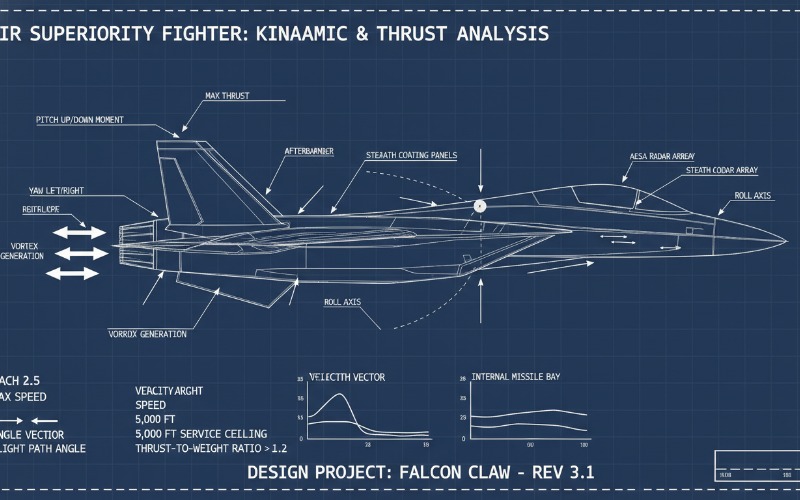
Kinematics and Aerodynamics
The engineering philosophy behind dedicated air superiority platforms, such as the F-15C Eagle or the F-22 Raptor, emphasizes energy maneuverability. Key technical characteristics typically include:
- Supercruise: The ability to sustain supersonic flight without the use of afterburners, reducing infrared signature and conserving fuel.
- Thrust Vectoring: Nozzles that deflect exhaust to allow for extreme angles of attack (AoA) during Within Visual Range (WVR) engagements.
- Service Ceiling: Operations often exceed 50,000 to 60,000 feet, allowing the aircraft to impart greater kinetic energy to Beyond Visual Range (BVR) missiles.
Sensor Capabilities
These aircraft are equipped with powerful Active Electronically Scanned Array (AESA) radars with large apertures capable of detecting low-RCS (Radar Cross Section) targets at extreme ranges. The avionics suite is optimized for track-while-scan capabilities and electronic counter-countermeasures (ECCM) to maintain lock in heavy jamming environments.
Analyzing Multirole Fighter Flexibility
The multirole fighter emerged from the economic necessity to reduce fleet diversity and the operational requirement for swing-role capabilities. Platforms like the F-16 Fighting Falcon, Dassault Rafale, and the F-35 Lightning II are designed to switch operational focus between air-to-air combat, air-to-ground interdiction, and intelligence, surveillance, and reconnaissance (ISR) within the same sortie.
Payload and Integration
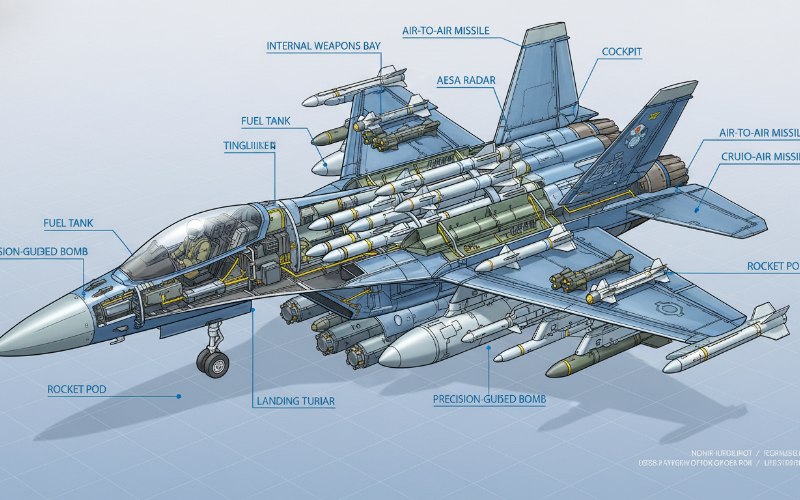
Multirole aircraft prioritize payload diversity over pure kinematic dominance. Procurement specifications for these aircraft heavily weigh:
- Hardpoint Versatility: The ability to carry a mix of AIM-120 AMRAAMs for air defense alongside JDAMs (Joint Direct Attack Munitions) or anti-radiation missiles for suppression of enemy air defenses (SEAD).
- Targeting Pods: Integration of Electro-Optical Targeting Systems (EOTS) for precision ground strikes, often built directly into the fuselage in 5th-generation platforms to preserve stealth.
Economic Lifecycle Advantages
For B2B integrators and government procurement, the multirole fighter offers a streamlined supply chain. Commonality in parts across a large fleet reduces the Maintenance Man Hours per Flight Hour (MMH/FH). The widespread adoption of the F-35, for instance, allows allied nations to share logistics hubs, simulator training facilities, and software upgrade pathways, significantly lowering total cost of ownership (TCO).
Technical Comparison of Operational Metrics
The following table provides a technical comparison between a standard 5th-generation Air Superiority platform and a Multirole platform. Note that specific classified data is approximated based on public export figures.
| Metric | Air Superiority (e.g., F-22 Class) | Multirole (e.g., F-35 Class) |
|---|---|---|
| Primary Mission | Air Dominance / Anti-Access | Strike / CAS / ISR / Air Defense |
| Thrust-to-Weight Ratio | > 1.08 (at combat weight) | ~ 0.87 – 1.0 (varies by fuel load) |
| Radar Aperture Class | Large AESA (Max Detection Range) | Medium AESA (LPI / LPD Focus) |
| Supercruise | Yes (Mach 1.5+) | Limited / Dash capability |
| Payload Configuration | Internal Air-to-Air optimized | Internal/External Mixed Loadout |
| Logistics Footprint | High (Specialized Coatings/Parts) | Moderate (Global Supply Chain) |
| Network Function | Data Consumer / Hunter | Data Node / Sensor Fusion Hub |
Strategic Procurement and The High-Low Mix
Defense procurement rarely favors an exclusive choice between air superiority and multirole platforms. Instead, advanced militaries utilize a “High-Low” capability mix strategy. This approach balances capability with capacity.
The Tip of the Spear
The “High” component comprises air superiority fighters. These assets are procured in smaller numbers due to their extreme cost. Their role is to penetrate Anti-Access/Area Denial (A2/AD) bubbles on “Day One” of a conflict, neutralizing enemy fighters and high-value airborne assets (HVAA) like AWACS. For a defense contractor, this segment involves high-margin, low-volume contracts focusing on cutting-edge material science (stealth coatings) and proprietary engine technology.
The Backbone of the Fleet
The “Low” component (which is a misnomer in the 5th-gen era, effectively meaning “Mass”) consists of multirole fighters. Once air superiority is established, these aircraft conduct the bulk of sorties, including Close Air Support (CAS) for ground troops and interdiction of supply lines. Procurement here focuses on volume, interoperability, and upgrade modularity. Integrators should note that multirole contracts often prioritize open systems architecture (OSA) to allow rapid software updates for new weapons integration.
SWaP-C and Avionics Modernization
Whether procuring for air superiority or multirole, the current battlefield requires intense focus on SWaP-C (Size, Weight, Power, and Cost). Modern jets are effectively flying data centers.
- Thermal Management: High-power radars and EW suites generate immense heat. Air superiority fighters, flying at higher speeds and altitudes, require different thermal dissipation strategies compared to multirole fighters operating at medium altitudes.
- Power Generation: The shift toward directed energy weapons (lasers) in future blocks requires upgraded generators. Multirole fighters often face stricter volume constraints for these upgrades compared to larger air superiority airframes.
The Future: Sixth-Generation Convergence
Looking toward the Next Generation Air Dominance (NGAD) and the Global Combat Air Programme (GCAP), the strict dichotomy between air superiority and multirole is evolving. Future platforms are being designed as “families of systems.”
In this paradigm, a manned fighter (likely optimized for air superiority and command) will control a swarm of Collaborative Combat Aircraft (CCAs). These unmanned “loyal wingmen” will act as the multirole component—carrying munitions, acting as sensor decoys, or conducting electronic warfare. For industry integrators, this shifts the procurement focus from single airframes to AI-driven network integration and autonomous teaming software.
Frequently Asked Questions
No, the F-35 is primarily a multirole strike fighter. While it possesses advanced stealth and sensors that allow it to engage in air-to-air combat effectively (often spotting enemies before being seen), it lacks the kinematic performance (speed, altitude, sustained turn rate) of a dedicated air superiority fighter like the F-22.
4.5-generation multirole fighters (like the F-15EX or Rafale) offer significantly lower operating costs and higher weapon payload capacities than 5th-generation stealth aircraft. For missions in permissive airspace where enemy air defenses are degraded, a non-stealth “bomb truck” is more cost-effective.
Sensor fusion is the great equalizer. It allows multirole fighters to compete in air-to-air engagements by synthesizing data from radar, infrared, and data links to provide situational awareness superior to legacy air superiority platforms. However, against a peer adversary with equivalent sensor fusion and better kinematics, the specialized air superiority fighter holds the advantage.
Multirole fighters are generally easier to export. Dedicated air superiority technology (especially regarding stealth and engine thermodynamics) is often heavily restricted (e.g., the US ban on F-22 exports). Multirole platforms like the F-16 possess well-established export configurations.