
Key Takeaways: Propulsion Acoustics and Operational Trade-offs
- Bypass Ratio Dictates Decibels: Commercial airliners utilize high-bypass turbofans (ratios >10:1) to envelop the noisy core exhaust with slower bypass air, whereas fighter jets use low-bypass engines (<1:1) for maximizing specific thrust, resulting in exposed high-velocity shear layers.
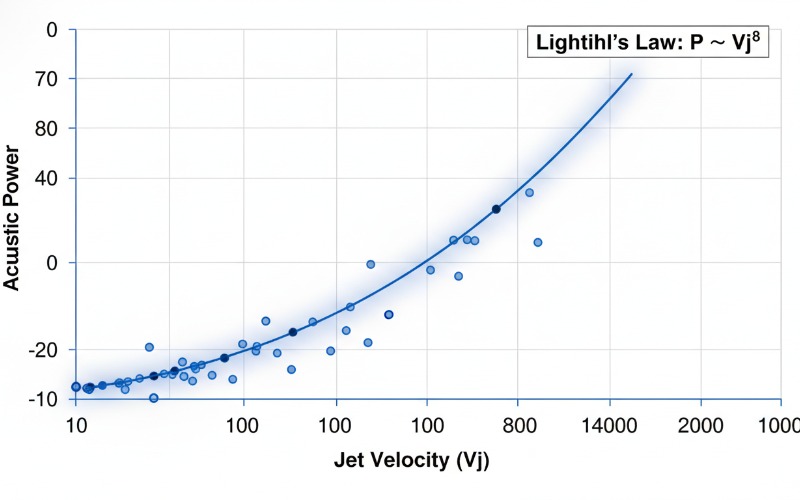
- Lighthill’s Eighth Power Law: Aeroacoustic theory states that sound power generated by a jet is proportional to the eighth power of the jet velocity ($V^8$). Fighter exhaust velocities are significantly higher than airliners, leading to exponential increases in noise generation.
- Afterburner Contribution: The use of reheat (afterburners) injects fuel directly into the exhaust stream, creating shock-cell noise and increasing exhaust velocity, often pushing acoustic levels above 150 dB during takeoff.
- Mission Profile Priorities: Military specifications prioritize SWaP-C (Size, Weight, Power, and Cost) and supersonic capability over noise abatement, necessitating engine geometries that are inherently louder than civilian counterparts.
In the domain of aerospace engineering and defense procurement, the acoustic signature of an aircraft is not merely a byproduct of operation but a direct consequence of its propulsion architecture and mission requirements. While commercial aviation has spent decades optimizing for noise reduction to meet stringent ICAO Chapter 14 standards, military aviation remains governed by the physics of raw performance. For defense contractors and systems integrators, understanding the aeroacoustic divergence between a commercial airliner and a tactical fighter jet requires a deep dive into fluid dynamics, thermodynamic cycles, and the governing laws of jet noise generation.
The Physics of Shear: Lighthill’s Geometric Law
To understand why a tactical fighter (e.g., F-35 or F/A-18) generates a significantly higher acoustic load than a wide-body airliner (e.g., Boeing 777), one must consult Lighthill’s Acoustic Analogy. Sir James Lighthill established that the acoustic power ($P$) radiated by a turbulent jet is proportional to the density of the air ($\\rho$), the speed of sound ($c$), the nozzle exit area ($A$), and significantly, the jet exit velocity ($V$) raised to the eighth power.
The Governing Equation:
$P \\propto \\frac{\\rho A V^8}{c^5}$
This mathematical relationship reveals the critical sensitivity of noise to exhaust velocity. A relatively small increase in jet exit velocity results in a massive increase in acoustic energy. Fighter jets obtain the thrust required for supersonic flight and high-G maneuvers by accelerating a smaller mass of air to extremely high velocities. In contrast, commercial airliners derive thrust by accelerating a large mass of air to lower velocities.
Bypass Ratios and Turbofan Architecture
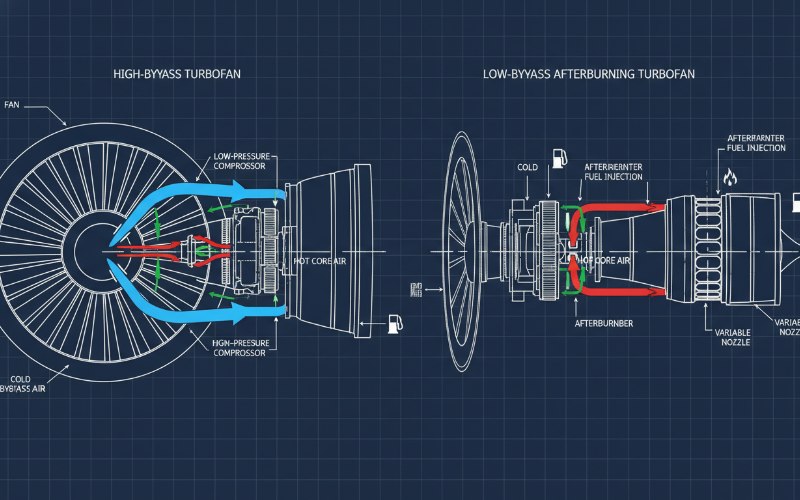
The primary architectural differentiator influencing the $V$ variable in Lighthill’s equation is the engine’s Bypass Ratio (BPR). This ratio measures the mass of air that bypasses the engine core (combustion chamber) relative to the mass of air that passes through the core.
High-Bypass Turbofans (Commercial Aviation)
Modern airliners utilize high-bypass turbofan engines, with ratios often exceeding 10:1 (e.g., the GE9X). In these systems, the vast majority of thrust is generated by the massive front fan rather than the core exhaust. This design creates a “sheathing” effect. The slow-moving, cold bypass air surrounds the fast-moving, hot core exhaust. This buffer layer reduces the shear velocity gradient between the jet exhaust and the ambient air. Since noise is generated by the turbulent mixing of these air streams, reducing the shear gradient drastically lowers the acoustic signature.
Low-Bypass Turbofans (Military Aviation)
Tactical fighters require engines with small frontal cross-sections to minimize drag for supersonic flight and to reduce radar cross-section (RCS). Consequently, they utilize low-bypass turbofans (ratios typically between 0.3:1 and 0.8:1). In these engines, most of the air passes through the core and is expelled at extremely high velocities. Without a significant blanket of cold bypass air to cushion the transition, the high-velocity core exhaust shears violently against the stationary ambient air. This intense turbulent mixing creates the high-frequency “tearing” sound characteristic of military jets.
The Afterburner Factor: Wet Thrust Acoustics
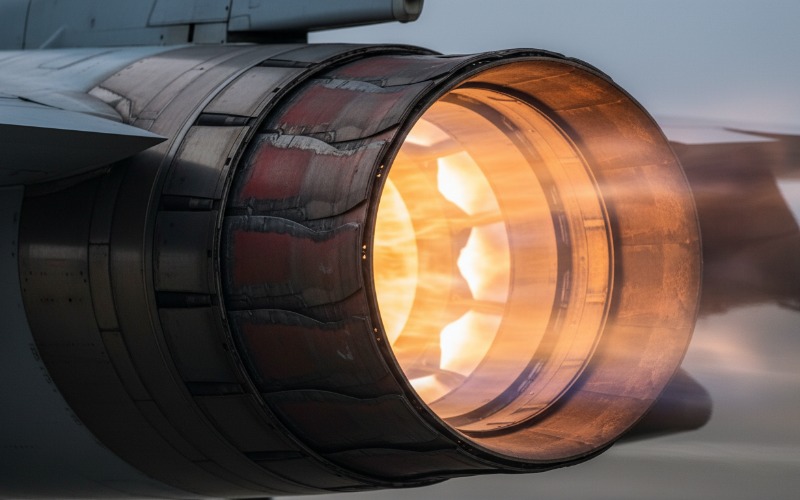
A distinctive feature of combat aircraft propulsion is the augmentor, commonly known as the afterburner. Commercial airliners do not possess this capability. The afterburner is a component located downstream of the turbine section that injects raw fuel directly into the exhaust stream, igniting it to consume the remaining oxygen.
When a pilot engages “wet thrust,” the exhaust temperature and velocity spike dramatically to provide the thrust necessary for carrier launches or supersonic interception. The acoustic implications are severe:
- Velocity Spike: As per Lighthill’s Law, the increase in exit velocity during afterburner operation causes an exponential rise in noise.
- Shock-Cell Noise: The exhaust plume of an afterburning engine is typically supersonic relative to the ambient air. This creates a complex structure of expansion fans and compression waves known as “shock diamonds.” The interaction of turbulent eddies with these shock waves generates “broadband shock associated noise” and “screech tones,” contributing to the physically palpable rumble felt on the ground.
- Thermal Expansion: The extreme temperature rise causes rapid volumetric expansion of the gas, adding a thermodynamic noise component to the aerodynamic noise.
Variable Nozzle Geometries and Mixer Technology
Commercial engines often employ chevrons or serrated edges on the nacelle and exhaust nozzle (visible on the Boeing 787). These physical features promote forced mixing of the core and bypass air streams, breaking up large turbulent eddies into smaller, higher-frequency ones that dissipate energy more quickly and are less audible over long distances.
Fighter jets, conversely, utilize variable-area exhaust nozzles. These iris-like mechanical structures must expand and contract to manage backpressure during afterburner operation. While critical for engine performance and stall prevention, these complex mechanical nozzles generally lack the intricate acoustic liners and serrated mixers found on civilian engines. Adding such noise-reduction features would add weight and complexity, and potentially compromise the nozzle’s ability to withstand the thermal loads of reheat operation, violating the strict SWaP (Size, Weight, and Power) constraints of combat aircraft.
Defense Procurement and MIL-STD Compliance
For procurement specialists and defense consultants, understanding the regulatory environment is as important as the physics. While civilian aircraft are certified under FAA Part 36 or EASA acoustic standards, military aircraft are subject to different criteria.
MIL-STD-1474E (Department of Defense Design Criteria Standard: Noise Limits) outlines the requirements for acoustic noise limits in military systems. However, tactical aircraft often operate under waivers or specific operational allowances because the physics of achieving Mach 1.6+ in a compact airframe creates unavoidable acoustic penalties. The priority in defense procurement is lethality, survivability, and maneuverability. If reducing the decibel level by 3dB results in a 5% loss in thrust or range, the trade-off is operationally unacceptable.
Comparative Technical Analysis: Airliner vs. Fighter
| Metric | Commercial Airliner (e.g., B737/A320) | Tactical Fighter (e.g., F-16/F-35) | Acoustic Impact |
|---|---|---|---|
| Engine Type | High-Bypass Turbofan | Low-Bypass Turbofan | Low-bypass creates higher shear velocity. |
| Bypass Ratio | 10:1 to 12:1 | 0.3:1 to 0.8:1 | Lower ratio exposes high-velocity core exhaust. |
| Exit Velocity ($V_j$) | Subsonic / Low | Supersonic (in core/AB) | Noise scales with $V^8$. |
| Afterburner | None | Variable Reheat | Reheat creates shock-cell noise. |
| Nozzle Geometry | Fixed, Chevrons, Acoustic Liners | Variable Area (Iris) | Variable nozzles prioritize pressure management over mixing. |
| Peak Noise (Takeoff) | ~90 – 100 dB | 140 – 150+ dB | Logarithmic scale; +10dB is 10x intensity. |
Future Horizons: Adaptive Cycle Engines
The future of military propulsion may bridge the gap between efficiency and power, with incidental benefits for acoustics. The Adaptive Cycle Engine (ACE), currently under development by major defense primes for the Next Generation Air Dominance (NGAD) programs, enables an engine to alter its bypass ratio in flight.
During cruise, an ACE can operate in high-bypass mode for fuel efficiency and reduced thermal/acoustic signature. During combat maneuvers, it can switch to low-bypass mode for maximum thrust. While the primary goal is range extension and thermal management, the ability to operate in a higher bypass mode during takeoff and landing approaches could theoretically reduce the noise pollution impacting communities near airbases.
Conclusion
The acoustic disparity between fighter jets and airliners is not a failure of design but a triumph of specialized engineering. It represents the divergence of two distinct optimization curves: one bending toward economic efficiency and environmental compliance, the other toward raw kinetic performance and survival. For the defense industry, the roar of a low-bypass engine is the sound of specific thrust being converted into air superiority.
Frequently Asked Questions
The “crackling” texture of high-performance jet noise is attributed to the formation of weak shocks within the turbulent eddies of the shear layer. This phenomenon, known as “mach wave radiation,” occurs when turbulent structures travel supersonically relative to the ambient air, creating a jagged, non-linear acoustic waveform.
MIL-STD-810H (Method 515.8) addresses Acoustic Noise testing. It is used to ensure that equipment carried on or near the aircraft (such as external munitions, avionics pods, or ground support equipment) can withstand the intense sound pressure levels (SPL) generated by the jet engine without structural failure or component degradation.
Ground-based “hush houses” or suppressors are used during maintenance testing to dampen noise. However, flight-capable silencers are impractical due to the immense weight, drag, and thrust loss they would impose, rendering the fighter combat-ineffective.