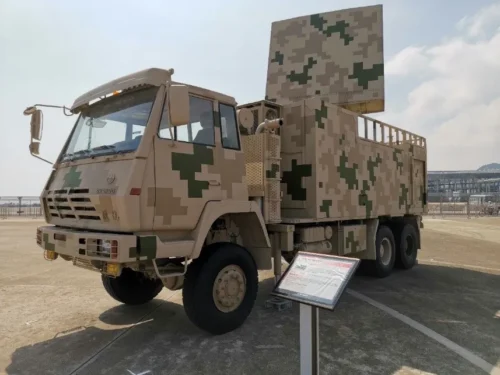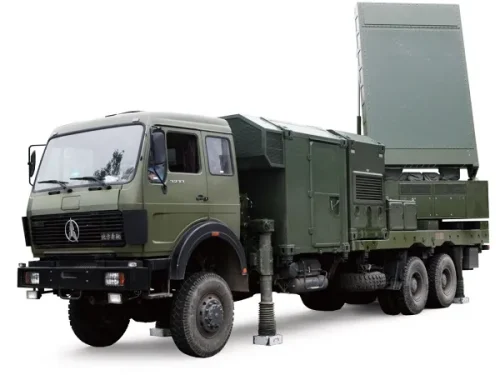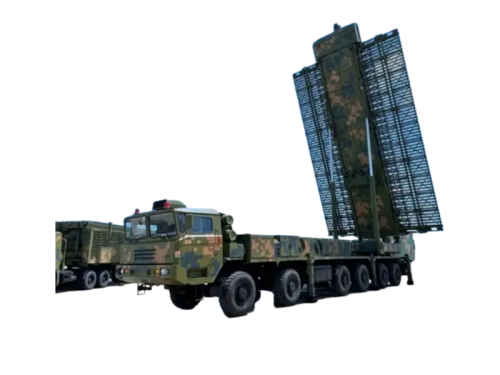

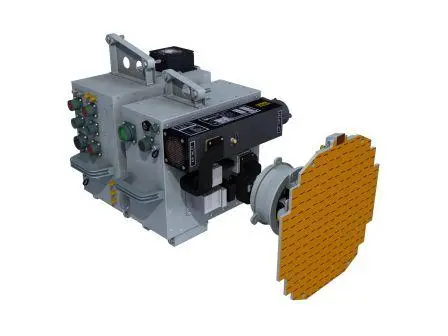
SY-80A fire control radar is improved on the basis of foreign trade SY-80 fire control radar. It can search and track air targets under all-weather and all altitude conditions, accurately range ground targets, provide necessary information for avionics equipment, and cooperate to control weapon launch and delivery.
SY-80 fire control radar is an X-band, medium pulse repetition rate Doppler fire control radar. Pulse Doppler radar can search and track air targets under all-weather and all altitude conditions, especially solving the problem that it is difficult for monopulse radar to look down to search air targets in the past. The radar also has the ability to accurately range ground targets and cooperate to control the launch and delivery of airborne weapons. It has frequency agility, various anti-interference capabilities and automatic detection function.
Technical parameters for SY-80 fire control radar:
Total weight: ≤ 60kg
Volume: < 0.04m3
Service height: 0 ~ 18000m
Search and tracking range: ± 30 °
Detection distance: 30km
Single target tracking distance: 26km
Tracking angle accuracy: 6mrad
MTBF:100Hrs
Key Features and Capabilities
-
X-Band Operation:
-
Operating in the X-band (8-12 GHz) is the defining characteristic of a fire control radar. This high frequency allows for:
-
Extremely High Accuracy: Provides a very narrow beamwidth for precise angular measurement, essential for guiding a missile directly to a target.
-
High Resolution: Can distinguish between closely spaced targets and generate detailed track data.
-
Effective in All Weather: Good performance in adverse weather conditions, though it can be attenuated by very heavy rain.
-
-
-
Phased-Array Technology:
-
The SY-80A employs an active or passive electronically scanned array (AESA/PESA). This allows it to:
-
Electronically Steer its beam at extremely high speeds without mechanical movement.
-
Track Multiple Targets simultaneously while continuing to search for new ones.
-
Perform “Track-via-Scan” or dedicated tracking for the highest priority threats.
-
-
-
Integrated Electro-Optical (EO) System:
-
The radar is typically paired with a thermal imager and a TV camera.
-
This provides a passive tracking option, allowing the system to engage targets without emitting any radar signals (stealthy operation) and to visually identify targets. It also serves as a critical backup if the radar is jammed.
-
-
High Mobility and Automation:
-
The radar is integrated directly onto the same tracked or wheeled vehicle as the missile launcher (e.g., on the HQ-17A vehicle). This makes the entire system self-contained and highly mobile.
-
The process from target detection to missile guidance is highly automated, enabling rapid engagement times to counter fast-moving, low-altitude threats.
-
-
Electronic Counter-Countermeasures (ECCM):
-
As a high-value target itself, it is equipped with features like frequency agility, low sidelobes, and advanced signal processing to resist enemy jamming and anti-radiation missiles (ARMs).
-
Technical Specifications (Estimated)
| Feature | Specification |
|---|---|
| System Name | SY-80A |
| Developer | China Electronics Technology Group Corporation (CETC) |
| Role | Fire Control Radar (for SHORAD systems like HQ-17A) |
| Frequency Band | X-band |
| Range | Tracking Range: ~20-30 km (aligned with HQ-17A missile range) |
| Targets | Can track multiple targets simultaneously (est. 2-4 for engagement) |
| Guidance | Provides command guidance for missiles (sends course corrections via datalink) |
| Platform | Integrated on the HQ-17A/FK-2000 launch vehicle |
Strategic Role and Purpose
The SY-80A is the core sensor that enables a SHORAD system to be effective:
-
Point Defense: Its primary role is to protect high-value assets (military bases, command centers, mobile columns) from low-altitude air threats at short range.
-
Engagement of Saturation Attacks: It is designed to handle multiple simultaneous threats, such as swarms of cruise missiles, precision-guided munitions, drones (UAVs), and low-flying attack aircraft and helicopters.
-
Mobile Protection: Because it is mounted on an armored vehicle, it can provide continuous air defense coverage for maneuvering mechanized and armored units.
-
The “Shooter”: In the “sensor-to-shooter” chain, the SY-80A is the final link for the HQ-17A system. It takes target data from broader surveillance radars (like the YLC-12) and then provides the precise, real-time guidance needed to destroy the target.
Comparison to Other Systems
-
vs. Surveillance Radars (e.g., YLC-12):
-
YLC-12 (C-band): A surveillance/acquisition radar. It searches a wide volume of airspace, detects targets, and provides initial tracks. It has longer range but lower accuracy.
-
SY-80A (X-band): A fire control radar. It takes cues from radars like the YLC-12, acquires the specific target, and provides the extreme precision needed for missile guidance. It has shorter range but极高 (extremely high) accuracy.
-
-
vs. Russian Systems:
-
The SY-80A’s role is directly analogous to the 1RS2-1E radar on the Russian Tor-M2 system. Both are X-band FCRs integrated on a tracked vehicle for point defense.
-
-
vs. Western Systems:
-
It is comparable to the fire control radars used on systems like the French Crotale or the tracking radar on the American AN/MPQ-64 Sentinel (though the Sentinel is more of a surveillance radar for forward areas).
-
Conclusion
The SY-80A is not a standalone radar; it is the essential, integrated “brain” and “eyes” of the HQ-17A air defense system. Its X-band frequency and phased-array technology provide the lethal accuracy required to engage modern, low-altitude, high-speed threats. By combining powerful radar with electro-optical tracking, it ensures a high probability of kill while maintaining resilience against electronic warfare. It represents a key component in China’s layered, integrated air defense network, providing the critical last line of defense for mobile forces and fixed installations.