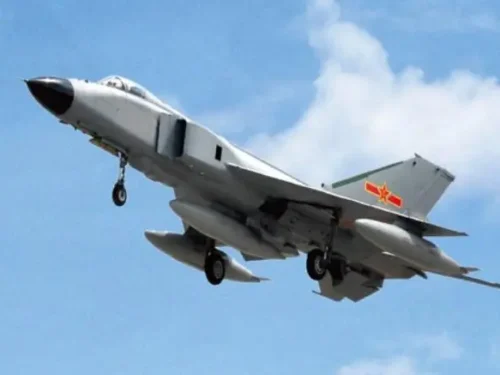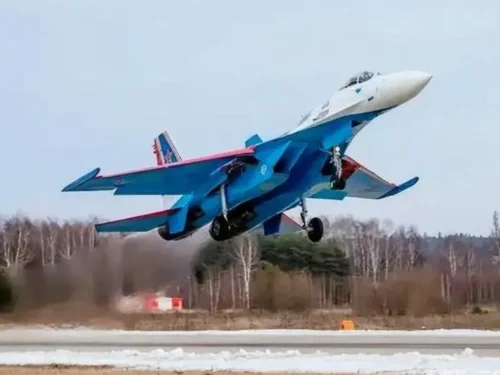


The J-7 (Chinese code name: J-7, English: Chengdu J-7/F-7 fighter aircraft, NATO code name: Fishbed, translation: fish nest) fighter jet is a type developed by China’s Shenyang Aircraft Factory in the 1960s Single-seat single-engine supersonic jet fighter. The J-7 is a copy of the Soviet MiG-21Ф-13. The aircraft was later transferred to Chengdu Aircraft Manufacturing Plant and Guizhou Aircraft Manufacturing Plant for subsequent improvement, modification and mass production.
The J-7 is the first double-sonic jet fighter developed by China. It is widely equipped with the Chinese Air Force and Naval Air Force. It is mainly used for homeland air defense and to seize front-line air supremacy on the battlefield. It can also perform ground attack missions. It is a typical second-generation fighter. . The technical features of the J-7 are its high-altitude and high-speed characteristics, its lightness, small size and flexibility, low cost, high efficiency, and simple operation and maintenance. The J-7 fighter has been exported to many countries in the world in batches. China is promoting the J-7 fighter, so there are many second-hand J-7s.
Based on the basic model of J-7, J-7 has derived many improved models, including type I, type II, type III, type A, type B, type E, type M, type MG, type PG, type P, type MP , FS type, MF type, etc.
Representative Specifications (indicative)
| Parameter | Value / Range | Notes |
|---|---|---|
| Crew | 1 | Single-seat variant |
| Length | ~14.7 m | Depending on production batch |
| Wingspan | ~7.15 m | Delta-wing design |
| Height | ~4.1 m | Standard configuration |
| Maximum Takeoff Weight | ~5,800 kg | Depends on loadout |
| Engine | 1 × Tumansky/RD-9B turbojet | Refurbished or overhauled |
| Maximum Speed | ~Mach 2.0 | At high altitude |
| Service Ceiling | ~17,500 m | Operational altitude limit |
| Combat Radius | ~400–500 km | Without external fuel tanks |
| Ferry Range | ~1,200 km | With drop tanks |
| Armament | Internal 30 mm cannon; up to 2–4 air-to-air missiles | Optional rocket pods for training |
| Avionics | Basic radar, communication, and navigation systems | Suitable for training and operational missions |
| Landing Gear | Tricycle retractable | Standard MiG-21 style |
Key Features
-
Supersonic Performance: Capable of Mach 2 speeds, enabling high-speed interception and air combat.
-
Single-Engine Design: Turbojet engine with high thrust-to-weight ratio for agility and rapid climb.
-
Armament Capability: Equipped to carry air-to-air missiles, unguided rockets, and internal gun systems (specific armament depends on user configuration).
-
Avionics: Basic radar, communication systems, and navigation aids suitable for air combat and training.
-
Maintenance & Refurbishment: Second-hand units undergo inspection, servicing, and replacement of worn components to ensure operational readiness.
-
Compact & Lightweight: Simplifies logistics, transport, and maintenance compared to larger fighter platforms.
-
Training & Operational Use: Suitable for pilot conversion training, tactical exercises, and limited operational deployment.