

The QW18 portable air defense missile belongs to the third generation of man-portable air defense systems. Incorporating numerous advanced technologies, this missile possesses exceptionally strong anti-jamming capabilities. The QW18’s seeker design truly breaks new ground by integrating a dual-band sensor array directly beneath the fairing. This array utilizes two atmospheric windows—3-5 micrometers and 8-12 micrometers—to simultaneously detect both thermal signatures from aircraft engine exhaust plumes and aerodynamic heating effects on the airframe.
The primary countermeasure employed by aircraft under attack involves deploying flares to evade infrared-guided missiles. The QW-18 missile exploits the narrow spectral signature and intense thermal signature of these flares. By refining the seeker design within technical constraints, it effectively neutralizes existing countermeasures. It has achieved anti-jamming capabilities comparable to fourth-generation missiles.
QW-18 Missile Characteristics
The most significant feature of the QW-18 air defense missile is its dual-band passive infrared seeker. This system detects heat sources from both the target’s exhaust plume and its skin, enabling firm lock-on. Consequently, the QW-18 exhibits exceptional anti-jamming capabilities. Its sensitivity and precision currently rank highest among domestic missiles of its type and are internationally leading.
The Qianwei-18 missile measures 1.526 meters in length, with the weapon system weighing 18 kilograms. The minimum firing height has been reduced to 15 meters.
-
Imaging Infrared (IIR) Seeker:
-
This is the most significant upgrade. Unlike the cooled seeker in the QW-2, the QW-18 uses an Imaging Infrared (IIR) seeker with a Focal Plane Array (FPA).
-
Advantages:
-
Superior Counter-Countermeasures (CCM): It creates a detailed image of the target, making it highly resistant to flares (decoys) by distinguishing between the shape of an aircraft and a simple heat source.
-
All-Aspect Engagement: Can engage targets from the front, side, and rear, not just from behind the engine exhaust.
-
Improved Accuracy: Better target discrimination and tracking.
-
-
-
Fire-and-Forget Operation:
-
Once locked, the missile guides itself to the target, allowing the operator to take cover immediately.
-
-
“Soft Launch” Capability:
-
The missile is ejected from the tube by a small charge before the main motor ignites at a safe distance. This reduces backblast, enabling launches from confined spaces (e.g., buildings, urban areas).
-
-
Advanced Warhead and Fuzing:
-
Features a laser proximity fuze and impact fuze. The proximity fuze ensures the warhead detonates near the target for maximum effect, even with a near-miss.
-
-
Digital Processing:
-
Incorporates advanced digital signal processing for improved guidance and resistance to electronic countermeasures (ECM).
-
Technical Specifications (Estimated)
| Feature | Specification |
|---|---|
| Designation | QW-18 (前卫-18) |
| Developer | China Precision Machinery Import-Export Corp. (CPMIEC) |
| Role | Man-Portable Air-Defense System (MANPADS) |
| Missile Length | ~1.5 m (in tube) |
| System Weight | Complete system: ~18 kg |
| Guidance | Imaging Infrared (IIR) / Fire-and-Forget |
| Warhead | Directed fragmentation with laser proximity fuze |
| Engagement Range | ~500 m to ~6 km |
| Engagement Altitude | ~10 m to ~3.5 km |
| Target Speed | Up to ~400 m/s (Mach 1.2) |
Strategic Role and Purpose
The QW-18 is designed for modern air defense scenarios:
-
Point Defense: Protects infantry, bases, and critical assets from low-altitude threats.
-
Counter-UAS: Highly effective against drones and UAVs due to its precise IIR seeker.
-
Denial of Airspace: Forces enemy aircraft to fly higher, reducing their effectiveness.
-
Special Operations: Ideal for special forces due to its portability and soft-launch capability.
Comparison to Other Systems
-
vs. QW-2: The QW-18’s IIR seeker offers better resistance to countermeasures and all-aspect engagement compared to the QW-2’s cooled seeker.
-
vs. U.S. FIM-92 Stinger: The QW-18 is comparable to the latest Stinger variants (e.g., Stinger-Block II) with IIR seekers.
-
vs. Russian 9K333 Verba: The Verba has a multi-band seeker, but the QW-18’s IIR provides similar advanced capabilities.
Conclusion
The QW-18 is a top-tier MANPADS, reflecting China’s advancement in portable air defense technology. Its imaging infrared seeker and proximity fuze make it a formidable threat to low-altitude aircraft and drones, ensuring its relevance in modern asymmetric and conventional warfare.
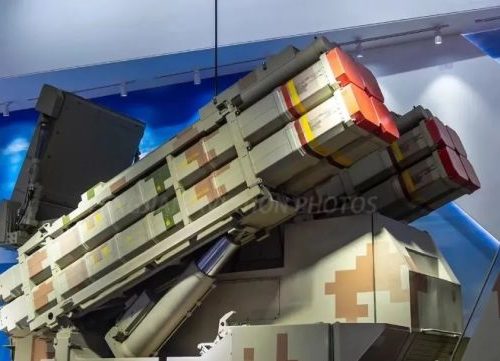

-500x375.webp "HQ-9BE Long-range Surface-to-air Missile (FD-2000 )")