
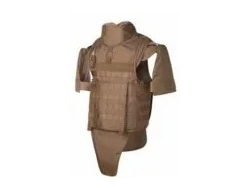
The Military Bulletproof Vest is the cornerstone of personal protection for armed forces worldwide, designed to deflect or absorb ballistic threats, fragmentation, and stab attacks while enabling mobility, mission endurance, and equipment integration. Unlike civilian vests, military body armor is part of a modular, scalable system that balances protection, weight, and tactical functionality.
Modern military vests have evolved from simple soft armor carriers (e.g., PASGT Vest) into integrated combat platforms — such as the U.S. Army’s IOTV (Improved Outer Tactical Vest) and the Crye Precision AVS (AirFrame Battle Harness) — that combine ballistic protection, load-bearing capability, and modular MOLLE webbing for mission-specific gear.
These systems utilize multi-layered protection:
- Soft Armor Panels (NIJ Level II/IIIA): Stop handgun rounds and fragmentation.
- Hard Armor Plates (Level III/IV): Defeat high-velocity rifle rounds (e.g., 7.62×39mm, 5.56×45mm, .30-06 AP).
- Side Plate Protection: Critical for urban and CQB environments.
- Optional Add-ons: Trauma pads, groin protectors, neck/shoulder guards, and blast mitigation padding.
Used by infantry, special operations, vehicle crews, and dismounted patrols, today’s military vests are engineered for extreme durability, rapid donning/doffing, and compatibility with body armor plates, helmets, and communication systems.
While no vest can guarantee survival against all threats, modern designs have reduced combat fatalities from torso wounds by over 70% since the early 2000s.
Key Features
- Modular Scalable Protection (MSV Concept):
- Operators can adjust protection level based on mission threat (e.g., soft armor only for low-risk, full plates for direct action).
- Ballistic Protection Standards:
- Soft Armor: NIJ Level IIIA — stops 9mm FMJ, .44 Magnum
- Hard Plates:
- Level III: Stops 7.62×51mm NATO M80 Ball
- Level IV: Stops .30-06 M2 AP (armor-piercing)
- Materials: UHMWPE (Dyneema®, Spectra®), ceramic-composite, or steel
- Weight Range:
- Soft-only carrier: 5–8 lbs (2.3–3.6 kg)
- Fully loaded (plates, magazines, gear): 30–50+ lbs (13.6–22.7+ kg)
- Ergonomic Design:
- Adjustable cummerbund, shoulder straps, and back panel
- Laser-cut or PALS MOLLE webbing for modular pouch attachment
- Sewn-in or removable trauma pads to reduce blunt force injury
- Ventilation & Comfort:
- Mesh-lined backing, breathable fabrics, and airflow channels
- Some models feature cooling pads or moisture-wicking materials
- Rapid Donning Systems:
- Quick-release pull cords (e.g., IOTV Gen IV)
- Shoulder release buckles for emergency removal
- Compatibility:
- Works with plate carriers, tactical helmets, NVGs, radios, and hydration systems
- Designed to be worn over combat uniforms (e.g., ACU, OCP, MultiCam®)
- Threat Coverage:
- Front, back, and side plate pockets (SAPI/ESAPI size)
- Optional collar, groin, lower back, and deltoid protectors
- Durability:
- Resistant to UV, abrasion, water, and mildew
- Service life: 5–7 years (armor plates: 5 years or single-use for steel)
Technical Specifications (IOTV Gen IV & AVS Comparison)
| Parameter | IOTV Gen IV (U.S. Army) | Crye Precision AVS Gen 3 |
|---|---|---|
| Type | Integrated Outer Tactical Vest | Modular Battle Harness + Plate Carrier |
| Primary User | U.S. Army Conventional Forces | SOF, SWAT, Specialized Units |
| Protection Level | NIJ Level IIIA (soft) + Level IV (hard) | NIJ Level IIIA + Level III/IV (user-choice) |
| Soft Armor | 10×12” front/back; side inserts | 10×12” front/back; optional side kits |
| Hard Plates | SAPI/ESAPI (10×12” front/back/sides) | SAPI/CCIR (custom cut for AVS) |
| Weight (Empty) | ~8.5 lbs (3.85 kg) | ~4.2 lbs (1.9 kg) |
| MOLLE System | Traditional PALS webbing | Laser-cut GHOOK™ webbing – lighter, quieter, more flexible |
| Retention System | Cummerbund + shoulder straps | H-harness + cummerbund – superior weight distribution |
| Quick-Release | Yes – dual pull cords | Optional QSS (Quick Snap System) |
| Ventilation | Mesh back panel | Open architecture design – high airflow |
| Modularity | High (standard MOLLE) | Extreme – G-MOD compatibility, tool-less adjustments |
| Color Options | OCP, MultiCam®, ACU | MultiCam®, Black, Ranger Green, Arid, etc. |
| Manufacturer | Various (Point Blank, Survitec, etc.) | Crye Precision |
| Fielded By | U.S. Army, NATO allies | U.S. SOCOM, UKSF, Australian SASR, FBI HRT, LAPD SWAT |
Operational Roles
- Infantry Combat: Standard issue for dismounted patrols in high-threat zones (e.g., Afghanistan, Ukraine).
- Special Operations: Used in direct action, hostage rescue, and reconnaissance missions.
- Vehicle Crews: Lightweight variants for tankers and drivers.
- Urban Warfare (MOUT): Full side protection critical for ambush and CQB scenarios.
- Law Enforcement: SWAT, HRT, and tactical response units use SOF-style carriers.
- Security Details: VIP protection, embassy guards, and private military contractors.
- Training & Simulation: Non-ballistic training carriers for muscle memory development.
Evolution & Combat Impact
- Historical Milestones:
- PASGT Vest (1983): First Kevlar® soft armor system.
- Interceptor Body Armor (IBA, 2000): Introduced SAPI plates.
- IOTV (2007–2020): Improved comfort, coverage, and modularity.
- Soldier Plate Carrier System (SPCS): Lighter variant for maneuver units.
- Modular Scalable Vest (MSV, 2020+): Next-gen replacement for IOTV with enhanced ergonomics.
- Survivability Data:
- Over 2,000 documented saves by U.S. body armor in Iraq and Afghanistan (2003–2021).
- Level IV plates stopped .50 BMG in rare over-penetration scenarios.
- Future Trends:
- Lighter materials (nanocomposites, graphene research)
- Active protection systems (experimental)
- Integrated health monitoring (biometrics, impact sensors)
- Exoskeleton integration for weight distribution