
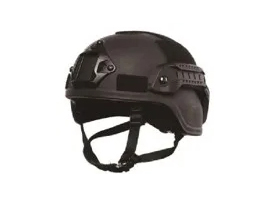
The Modular Integrated Communications Helmet (MICH), introduced in 2001, marked a revolutionary shift in U.S. military head protection by replacing the iconic but bulky PASGT “Fritz” helmet with a lighter, lower-profile, and communication-ready design. Developed for the U.S. Army Special Operations Command (SOCOM) and later adopted across conventional forces, the MICH was engineered to meet the evolving needs of special operations, urban warfare, and networked combat.
Unlike its predecessor, the MICH prioritizes ergonomics, modularity, and situational awareness, featuring a cut-down shell that improves hearing, reduces weight, and enhances compatibility with night vision devices (NVDs), headsets, and tactical accessories.
Available in multiple variants — MICH TC-2000, MICH 2001, and MICH 2002 — the helmet uses Kevlar® or hybrid aramid composites to deliver NIJ Level IIIA ballistic protection against handgun rounds and fragmentation, while reducing weight by up to 20% compared to the PASGT.
The MICH’s integrated four-point retention system with padded chinstrap and foam liner provides superior shock absorption and comfort during prolonged wear, making it ideal for special forces, SWAT teams, and rapid-response units operating in complex environments.
Though largely superseded by the Advanced Combat Helmet (ACH) and Enhanced Combat Helmet (ECH) in frontline U.S. service, the MICH remains in widespread use among allied militaries, law enforcement agencies, and security contractors worldwide due to its proven performance and cost-effectiveness.
Key Features
- Low-Profile Design: Reduced front and side brim improves field of view, hearing, and compatibility with optics/NVDs.
- Weight Reduction: 3.0–3.5 lbs (1.36–1.59 kg) — significantly lighter than PASGT (3.6+ lbs).
- Ballistic Protection:
- NIJ Level IIIA
- Stops 9mm FMJ (124 gr @ 398 m/s)
- Stops .45 ACP FMJ (230 gr @ 293 m/s)
- Fragment protection up to 6-grain fragment @ 2,000 ft/s
- Material: 17–19 layers of Kevlar® 129 or hybrid aramid composite shell.
- Suspension & Fit System:
- Four-point retention system with adjustable nape pad
- Dual-density closed-cell foam padding for impact absorption
- Quick-release Velcro® chinstrap with anti-slip backing
- Integrated Communication Support:
- Built-in radio headset mounting points
- Compatible with David Clark, Sensimetrics, and Peltor ComTac series headsets
- Optional ARC rails (added post-production) for accessory mounting
- Helmet Mounts:
- Standard PVS-7/PVS-14 night vision mount (dovetail rail)
- Can be retrofitted with Picatinny or Wilcox rails
- Ventilation: Two small ventilation holes on each side (non-ballistic).
- Camouflage Options:
- Black, Olive Drab, Coyote Brown, MultiCam®, Urban Gray
- Hook-and-loop (Velcro®) cover field for name tapes and insignia
- Durability: Resistant to UV, moisture, and mildew; service life of 5–7 years under operational conditions.
- Non-Magnetic: Suitable for EOD and explosive environments.
Technical Specifications
| Parameter | Specification |
|---|---|
| Designation | MICH TC-2000 / MICH 2001 / MICH 2002 |
| Type | Tactical Combat Helmet |
| Material | Kevlar® 129 or hybrid aramid composite |
| Shell Thickness | ~9–11 mm |
| Weight (Size Medium) | 1.45 kg (3.2 lbs) |
| Available Sizes | Small, Medium, Large, Extra Large |
| Head Circumference Range | 51–66 cm |
| Ballistic Standard | MIL-STD-662F (V50 > 680 m/s for 17-grain fragment) |
| NIJ Rating | Level IIIA (0101.04) |
| Threat Protection | 9mm FMJ, .45 ACP, shell fragments (6-grain) |
| Retention System | 4-point nylon webbing with foam pads and nape strap |
| Chinstrap | Quick-release Velcro® or snap closure |
| Mounting Options | NVD dovetail rail; optional ARC/Picatinny rails |
| Communication Ready | Yes – integrated headset routing and mounts |
| Operating Temperature | -40°C to +71°C (-40°F to +160°F) |
| Service Life | 5–7 years (subject to inspection) |
| Manufacturer | Gentex Corporation, Team Wendy, Revision Military |
| Fielded By | U.S. SOCOM, Rangers, Delta Force, 75th Ranger Regiment, NATO allies, global LE units |
| Successor | ACH, ECH, LH-Helmet (Lightweight Helmet) |
Operational Roles
- Special Operations: Primary helmet for U.S. Army Special Forces, Rangers, and Delta Force during early OEF/OIF.
- Law Enforcement: Widely used by SWAT, Hostage Rescue Teams (HRT), and tactical response units.
- Urban Combat: Optimized for CQB/CQC with improved hearing and reduced snag risk.
- Vehicle Crews: Low profile allows easier entry/exit from armored vehicles.
- Aviation Personnel: Worn by door gunners and crew chiefs on helicopters.
- Security Contractors: Popular choice for PMCs in Iraq, Afghanistan, and Africa.
- Training & Reserve Units: Still issued in many allied nations due to reliability and availability.
Legacy & Evolution
- Combat Proven: Used extensively in Operation Enduring Freedom (Afghanistan) and Operation Iraqi Freedom.
- Design Influence: Direct predecessor to the ACH and Team Wendy EXFIL, setting the standard for modern modular helmets.
- Upgrade Path: Many MICH helmets retrofitted with:
- ARC Rails (Wilcox or similar) for lights, cameras, lasers
- Improved Padding Systems (e.g., Team Wendy Halo)
- IR-compliant Covers and name tapes
- Still in Service: Used by reserve units, foreign militaries (e.g., Philippines, Colombia, Ukraine), and tactical police.
- Collectible Value: Original SOCOM-issued MICH helmets are highly valued by collectors.