
Key Features and Capabilities
-
Precision Strike:
-
The M20A is designed for high accuracy against fixed targets. It uses a combination of Inertial Navigation System (INS) and GPS/BeiDou (BDS) satellite guidance, achieving a reported Circular Error Probable (CEP) of less than 30 meters. This allows it to effectively engage point targets like command bunkers, hangars, and infrastructure.
-
-
Quasi-Ballistic Trajectory:
-
The missile does not follow a simple parabolic arc. It is capable of in-flight maneuvers and flies on a depressed trajectory. This makes its flight path less predictable and more difficult to intercept by enemy missile defense systems compared to traditional ballistic missiles.
-
-
Range and Payload:
-
The M20A has a maximum range of approximately 280 kilometers. This is deliberately designed to stay just under the 300km threshold of the Missile Technology Control Regime (MTCR), making it eligible for export.
-
It can carry a unified warhead estimated at nearly 500 kg, capable of causing significant damage to hardened targets.
-
-
Canisterized Launch:
-
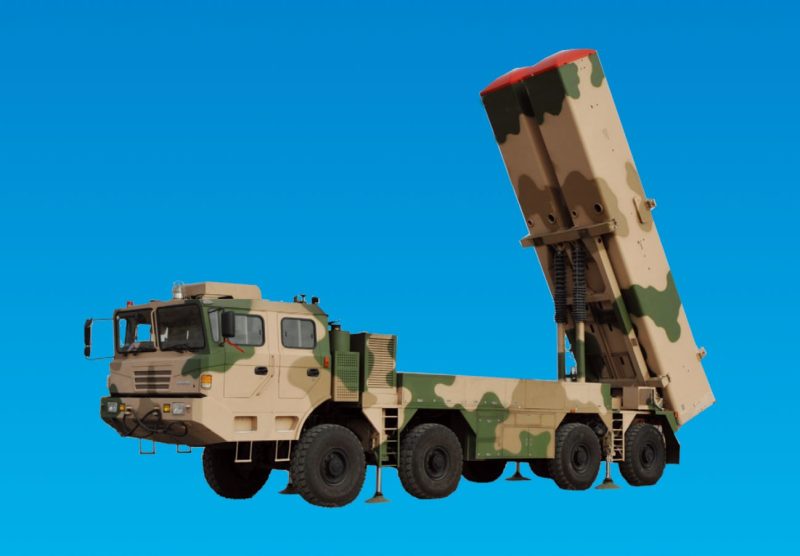
The missile is stored, transported, and launched from a sealed canister. This simplifies logistics, reduces maintenance, and ensures high reliability. The canister is mounted on a Transport-Erector-Launcher (TEL) vehicle.
-
-
High Mobility and Survivability:
-
The system is integrated onto an 8×8 high-mobility truck, which functions as the TEL. This provides the system with the ability to move quickly, hide, and launch from unprepared positions, adhering to a “shoot-and-scoot” tactic to avoid counter-battery fire.
-
-
Modularity:
-
The M20A shares a common chassis and core technology with its sibling, the anti-ship M20B. This modularity simplifies training, maintenance, and logistics for operators.
-
Technical Specifications (Estimated)
| Feature | Specification |
|---|---|
| System Name | M20A / BP-12A |
| Developer | China Aerospace Science and Technology Corporation (CASC) |
| Role | Short-Range Ballistic Missile (SRBM) / Land Attack |
| Missiles per Launcher | 2 |
| Range | ~280 km |
| Guidance | INS + GPS/BeiDou (BDS) Satellite Guidance |
| Accuracy (CEP) | < 30 meters |
| Warhead | Unified Blast-Fragmentation, Penetration, or Submunitions (est. ~480 kg) |
| Trajectory | Quasi-Ballistic |
| Launch Vehicle | 8×8 Transport-Erector-Launcher (TEL) |
Strategic Role and Purpose
The M20A is designed to provide theater commanders with a responsive and powerful precision-strike capability:
-
Deep Strike: Its primary role is to destroy critical fixed targets deep behind enemy lines: command and control centers, airfields, communication nodes, logistics hubs, and troop concentrations.
-
Counter-Value Targeting: It can be used for strategic effect by targeting key economic or infrastructure targets to degrade an enemy’s war-fighting capability.
-
Suppression of Enemy Air Defenses (SEAD): It is an ideal weapon for striking fixed SAM sites and radar installations at the outset of a conflict.
-
Force Multiplication: A single M20A battery can threaten a vast area, forcing an adversary to disperse forces and invest heavily in air and missile defense.
Comparison to Other Systems
-
vs. M20B (Anti-Ship Variant):
-
M20A: Designed for fixed land targets. Uses INS/GPS/BeiDou guidance.
-
M20B: Designed for moving naval targets. Adds a terminal seeker (radar/IIR) and data-link for mid-course updates. They are two specialized variants of the same base missile system.
-
-
vs. Russian Iskander-M:
-
The Iskander is a renowned SRBM system. The M20A is a direct conceptual competitor. The Iskander has a similar range (~500km for export versions is often cited, though likely less) and is also maneuverable. The M20A represents China’s effort to field a system with comparable capabilities.
-
-
vs. ATACMS:
-
The U.S. Army Tactical Missile System (ATACMS) has a similar range (300km) and role. The M20A’s canisterized twin-launcher and quasi-ballistic flight profile are modern features that the older ATACMS design lacks. The M20A is China’s answer to this capability gap.
-
-
vs. Rocket Artillery (A300, WS-3A):
-
While the A300 and WS-3A have similar ranges, they are guided rockets. The M20A is a ballistic missile. The key differences are:
-
Flight Time: The M20A’s ballistic trajectory is much faster, giving targets less warning time.
-
Kinetic Energy: The missile’s high-speed dive delivers immense kinetic energy alongside its warhead, enhancing its effectiveness against hardened targets.
-
Defense Penetration: Its speed and maneuverability make it a more challenging target for missile defenses.
-
-
Conclusion
The M20A is a modern, highly capable, and export-oriented short-range ballistic missile system. It provides a critical link between long-range rocket artillery and more strategic medium-range ballistic missiles. Its precision, range, and mobility make it a formidable tool for shaping the battlefield and holding an adversary’s key assets at risk, representing a significant component of modern PLA ground-based firepower.