
Key Characteristics and Capabilities:
-
System Concept: The LQ-008 follows the standard ASROC concept:
-
A rocket motor propels a payload—in this case, a lightweight anti-submarine torpedo—through the air on a ballistic trajectory.
-
The rocket burns out, and the payload continues to the predicted location of the enemy submarine.
-
Upon splashdown, the torpedo is released, enters the water, activates its own sonar seeker, and begins a search pattern to locate, home in on, and destroy the target submarine.
-
-
Payload: The system delivers a lightweight torpedo as its warhead. While the specific model is not always confirmed, it is highly likely to be the ET-52 or a similar derivative, which is the Chinese version of the American Mk 46 Mod 2 torpedo. This torpedo is designed to be effective against deep-diving nuclear-powered submarines (SSNs) and quieter conventional submarines (SSKs).
-
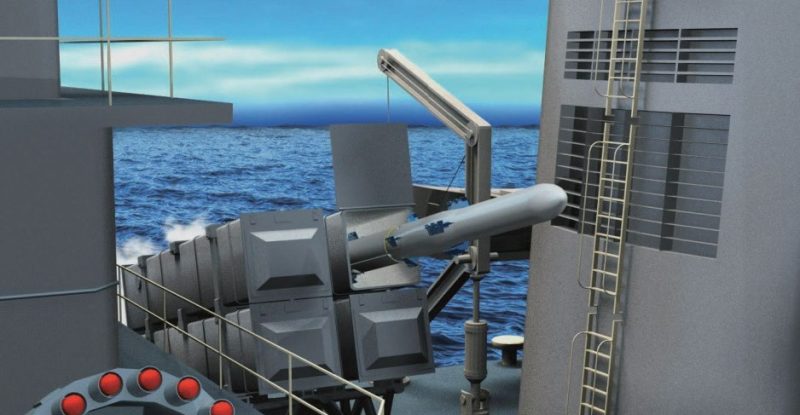
Launch Platform: The LQ-008 is typically launched from a multi-tube rotary launcher.
-
It is a standard fitment on many modern Chinese warships, including the Type 054A (Jiangkai-II) frigate and the Type 052D (Luyang-III) destroyer.
-
The launcher is often integrated with the ship’s bow-mounted sonar (hull-mounted sonar) and towed array sonar system, which provide the target data for the launch.
-
-
Range: The rocket-assisted delivery extends the engagement range significantly compared to simply launching a torpedo over the side.
-
While exact figures are classified, its effective range is estimated to be between 10 to 20 kilometers (6 to 12 miles).
-
This allows the launching ship to engage a detected submarine without having to close within the range of the submarine’s own weapons (which can be 30-50km for modern torpedoes).
-
Comparison with Similar Weapons:
The LQ-008 is China’s direct equivalent to Western and Russian systems that fulfill the same role.
| Feature | Chinese LQ-008 | US RUM-139 VL-ASROC | Russian 90R1 Vodopad-NK | Ship-Launched Torpedo (e.g., Yu-7) |
|---|---|---|---|---|
| Launch Method | Dedicated Rotary Launcher | Vertical Launch System (VLS) | Vertical Launch System (VLS) | Torpedo Tube |
| Payload | Lightweight Torpedo (e.g., ET-52) | Mk 54 Lightweight Torpedo | APR-3E Lightweight Torpedo | Lightweight or Heavy Torpedo |
| Range | Medium (~10-20 km) | Long (~22 km) | Medium (~15 km) | Short (Directly off the ship’s side) |
| Key Advantage | Extends torpedo range quickly | Fits in standard VLS, faster reaction | Fits in standard VLS | No minimum range |
-
vs. the US VL-ASROC: The US system is more modern and flexible, as it is launched from a standard Mk 41 Vertical Launch System (VLS) cell, freeing up deck space. The LQ-008 uses a dedicated launcher, which is simpler but less flexible.
-
vs. a simple torpedo launch: The key advantage is range and reaction time. A ship can only launch a torpedo from its tubes a short distance away. The LQ-008 allows it to engage a submarine detected many kilometers away almost instantly, without the time it would take for the ship to get closer or for a helicopter to be dispatched.
Strategic Significance:
The LQ-008 is a critical system because it:
-
Provides Essential Layer of Defense: It forms a key middle layer in a modern warship’s multi-layered anti-submarine warfare (ASW) suite:
-
Long-Range: ASW helicopters (e.g., Z-9C, K-28).
-
Medium-Range: Rocket-assisted torpedoes like the LQ-008.
-
Close-Range: Ship-launched torpedoes (e.g., from triple-tube launchers) and depth charges.
-
-
Counters Regional Threats: It is particularly effective against the threat posed by modern conventional diesel-electric submarines operated by regional navies, which are very quiet and difficult to detect until they are relatively close.
-
Enhances Fleet Survivability: By allowing a ship to engage a submarine from a distance, it drastically increases the survival chances of the ship and its crew, preventing the submarine from getting into an optimal firing position.
In summary, the LQ-008 is a rocket-assisted torpedo delivery system that provides Chinese surface warships with a rapid-reaction, medium-range capability to engage hostile submarines. It is a workhorse system that forms a vital and standard part of the ASW arsenal for the People’s Liberation Army Navy (PLAN), significantly enhancing the fleet’s defensive capabilities against underwater threats.