
Basic information
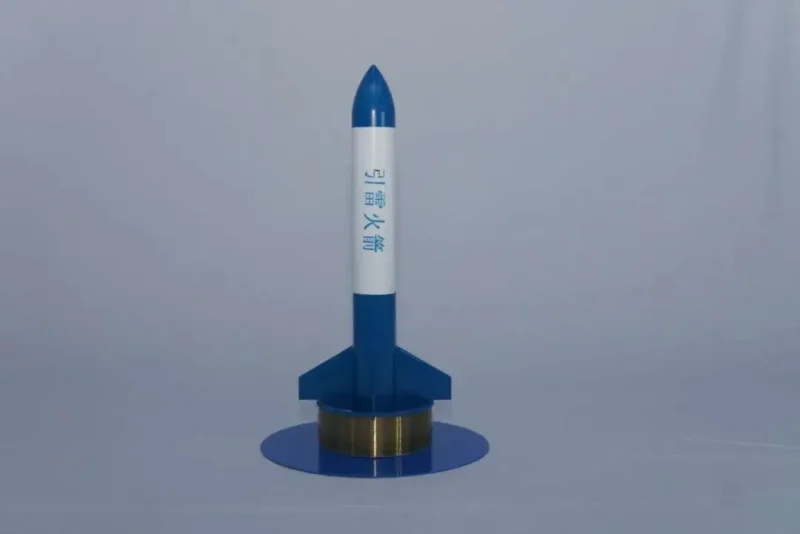
The lightning rocket operation system is light in weight, safe to use and reliable in operation. Under specific meteorological conditions, lightning in a certain range of thunderstorm weather can be led to the designated device,which can be widely used in scientific research on lightning and reduce the impact of lightning disasters in China’sareas of electronics, petroleum, chemical, agriculture and forestry fields.
Product parameters
Length:492mm
Diameter:φ56mm
Rocket shot height:700m (theoretical parachute opening height)
lgnition current:3A(duration >25ms)
Rocket exitlaunch velocity: ≤20m/s
lanition delay time:≤30m/s
Wreckage landing speed:≤5m/s
Application areas
The lightning rocket, developed in cooperation with the Institute of Atmospheric Physics of the Chinese Academy of Sciences, consists of an arrowrocket body (including the head cone and engine), a recovery device (parachute and parachute compartment), a tail fin, a wire shaft and a metal wire. It has already been used in several test sites in China.
Product advantages
Unique wire winding process, easy to releaseput the wire
Using wireless remote control transmitter controller, reliable and stable ignition performance.
Good waterproof, fireproof and lightning-proof performance.
🔬 Purpose and Applications
- Scientific Research:
Lightning rockets are primarily used by atmospheric physicists and meteorologists to study the physics of lightning. By triggering lightning strikes at will, researchers can precisely measure parameters such as:- Peak current
- Electromagnetic fields
- Return stroke characteristics
- Ground current distribution
- Lightning Protection Testing:
Used to evaluate the performance of lightning protection systems (e.g., surge arresters, grounding networks, aircraft components) under real lightning conditions. - Critical Infrastructure Protection:
In high-risk areas (e.g., rocket launch pads, power stations, fuel depots), lightning rockets may be deployed during thunderstorms to safely trigger lightning discharges before natural, unpredictable strikes occur—diverting energy to designated safe paths.
🚀 How It Works
- Rocket Launch:
A small, ground-launched rocket is fired upward into a thundercloud that has developed a strong electric field but has not yet discharged naturally. - Trailing Wire:
The rocket trails a thin, conductive wire (usually copper or Kevlar-coated copper, ~0.1–0.2 mm diameter) connected to the ground. This wire creates a low-resistance path between the cloud and earth. - Triggering Discharge:
As the rocket ascends (typically to 200–500 meters), the wire enhances the local electric field, initiating an upward leader that connects with the downward stepped leader from the cloud—triggering a full lightning discharge along the established path. - Controlled Strike:
The lightning current follows the wire to a grounded launch facility equipped with measurement instruments, allowing safe data collection.
⚡ Once the connection is made, the wire vaporizes due to extreme heat, but the ionized channel sustains the lightning arc.
🛠️ Technical Features
Feature |
Specification |
|---|---|
| Rocket Type | Solid-propellant, single-stage |
| Weight | 0.5 – 2 kg |
| Length | ~60 – 80 cm |
| Wire Length | 200 – 1000 m |
| Wire Material | Copper, steel, or composite conductive fiber |
| Launch System | Automated or manual launcher with shielding |
| Operational Altitude | Up to 500–800 m AGL |
| Weather Conditions | Active thunderstorm with strong vertical electric field (>10 kV/m) |
🌍 Global Use and Research Sites
- China:
The Chinese Academy of Meteorological Sciences conducts regular triggered lightning experiments in Guangzhou and other southern provinces. - USA:
International Center for Lightning Research and Testing (ICLRT) at Camp Blanding, Florida. - France:
Saint-Privat d’Allier test site operated by ONERA and CNRS. - Japan:
Coastal facilities in Niigata and Hokuriku regions frequently perform rocket-triggered lightning tests.
✅ Advantages
- Enables repeatable, instrumented lightning studies.
- Improves lightning protection standards for aviation, power grids, and electronics.
- Reduces risk of uncontrolled natural strikes in sensitive areas.
❌ Limitations
- Requires specific thunderstorm conditions.
- Limited range and altitude.
- High cost per launch (mainly due to instrumentation and safety measures).
📝 Conclusion
The lightning rocket (引雷火箭) is not a weapon, but a vital scientific tool in atmospheric research. By artificially triggering lightning, it allows scientists and engineers to observe, measure, and mitigate one of nature’s most powerful phenomena. Its use continues to advance our understanding of lightning physics and improve the resilience of modern infrastructure against electrical storms.