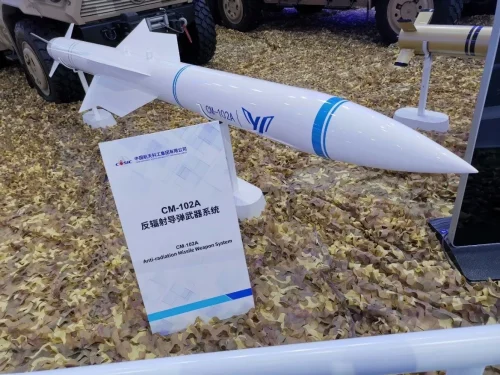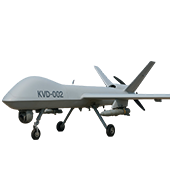


The LD-10 Anti-Radiation Missile (ARM) is a precision-guided missile designed to detect, track, and destroy enemy radar installations and electronic emitters. Engineered for high-speed engagement and accuracy, the LD-10 enhances suppression of enemy air defenses (SEAD) capabilities for modern combat aircraft and UAV platforms. Its advanced guidance system and aerodynamic design ensure effective neutralization of hostile radar threats.
Representative Specifications (indicative)
| Parameter | Value / Range | Notes |
|---|---|---|
| Missile Type | Air-to-Surface Anti-Radiation | Designed to target radar emitters |
| Guidance System | Passive radar seeker | Homes in on active radar signals |
| Length | ~3.2 m | Approximate |
| Diameter | ~0.25 m | Standard missile body |
| Launch Weight | ~250–280 kg | Depending on configuration |
| Warhead | ~60–80 kg | High-explosive, blast-fragmentation |
| Maximum Range | ~70–120 km | Depending on launch altitude and speed |
| Speed | Mach 1.5–2.0 | High-speed engagement |
| Operational Altitude | Sea level to ~12,000 m | Compatible with multiple aircraft flight profiles |
| Environmental Tolerance | -40°C to +50°C | All-weather operational capability |
Key Features and Capabilities
Passive Radar Homing Seeker:
The LD-10 is equipped with a broadband passive seeker capable of detecting, identifying, and homing in on enemy radar emissions across a wide frequency spectrum (typically S-band to Ku-band), including:
- SAM guidance radars (e.g., Patriot, S-300, HQ-9)
- Early warning and acquisition radars
- Fire control and tracking systems
High-Speed, Kinetic Engagement:
Based on the supersonic KH-31 airframe, the LD-10 retains the original’s ramjet propulsion system, enabling speeds of Mach 2–3. This allows rapid engagement of enemy radar sites with minimal reaction time.
- Advantages:
- High kinetic energy increases warhead effectiveness.
- Reduces the window for enemy radar shutdown or relocation.
Advanced ECCM (Electronic Counter-Countermeasures):
Features enhanced ECCM capabilities, including:
- Target memory mode: Continues tracking even if the radar shuts down after launch.
- Directional accuracy and signal sorting to distinguish between multiple emitters.
- Resistance to false signal deception and jamming.
Mid-Course Guidance & Data Link (Likely):
While primarily a fire-and-forget weapon, the LD-10 likely supports inertial navigation (INS) with GPS/Beidou mid-course updates, enabling pre-programmed targeting and improved accuracy when engaging relocatable or intermittent emitters.
Fire-and-Forget Operation:
Once launched, the missile autonomously guides to the radiation source, allowing the launching aircraft to disengage immediately, enhancing survivability.
Extended Engagement Range:
Estimated range of up to 100–120 km, enabling aircraft to strike enemy air defense networks from outside the lethal envelope of most short-to-medium range SAMs.
Technical Specifications (Estimated)
| Feature | Specification |
|---|---|
| Designation | LD-10 |
| Developer | China Aerospace Science and Industry Corp (CASIC) |
| Role | Air-Launched Anti-Radiation Missile (ARM) for SEAD/DEAD |
| Missile Length | ~4.7 m |
| Diameter | 0.36 m |
| Launch Weight | ~600 kg |
| Propulsion | Solid-fuel booster + liquid-fueled ramjet |
| Speed | Mach 2 – 3 |
| Range | 100 – 120 km (estimated) |
| Guidance | INS + Passive Radar Homing (Broadband Seeker) |
| Warhead | 94 – 110 kg blast-fragmentation |
| Target Acquisition | Frequency range: S-band to Ku-band |
| CEP | <10 m (with active emitter) |
| Launch Platforms | J-16, JH-7A, J-10C, future UCAVs |
Strategic Role and Purpose
The LD-10 is a critical component of China’s modern electronic warfare and precision strike doctrine:
- SEAD/DEAD Missions: Enables PLAAF strike packages to neutralize enemy air defense radars before main attacks.
- Battlefield Dominance: Disrupts enemy command, control, and situational awareness.
- Platform Synergy: Integrated with advanced EW aircraft (e.g., Y-8GX7) and targeting pods for emitter detection and cueing.
- Export Potential: Offers foreign customers a cost-effective, high-performance SEAD solution without reliance on Russian systems.
Comparison to Other Systems
| System | LD-10 Advantage |
|---|---|
| Russian KH-31P | LD-10 features improved seeker sensitivity, better ECCM, and integration with Chinese avionics and targeting systems. Performance otherwise similar. |
| U.S. AGM-88G AARGM-ER | AARGM-ER has longer range, multi-mode seeker (ARH + IIR), and networked data link. LD-10 is less advanced but more affordable and already in service. |
| European MBDA ARMIGER | Still in development; LD-10 is operational and combat-proven in training scenarios. |
| Indian Rudram-1 | Rudram-1 has similar range and purpose but lower speed (Mach 2); LD-10 offers superior kinematic performance due to ramjet propulsion. |
Conclusion
The LD-10 represents a significant advancement in China’s indigenous SEAD capability, combining the proven speed and airframe of the KH-31 with modern Chinese electronics and targeting systems. As a high-speed, long-range anti-radiation missile, it enables Chinese fighter-bombers to effectively suppress and destroy enemy air defense networks, ensuring air superiority in contested environments. While not as advanced as the latest U.S. AARGM-ER, the LD-10 provides a highly capable, cost-effective solution for both domestic use and export, solidifying China’s position in the global precision-guided munitions market.