
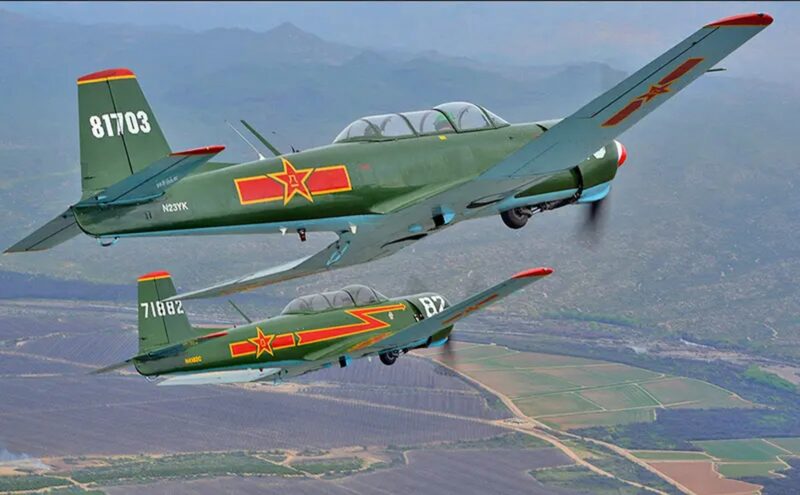
Chujiao-6 (code name: HAIG CJ-6, factory code name: PT6, English: Nanchang CJ-6, Chinese name: Young Eagle) is a primary propeller trainer aircraft developed by China in the late 1950s. The aircraft has long served in the Chinese Air Force and local aviation schools, and is the main model of the Chinese Air Force’s primary trainer aircraft.
The aircraft is a two-seater, low-wing, three-point landing gear design. The power plant is a 285-horsepower piston-6A (HS-6A) star-shaped air-cooled 9-cylinder engine, equipped with a two-bladed automatic pitch-variable propeller. The fuselage, wings and empennage stabilizer of JJ-6 are of all-metal structure, and only the aileron and rudder surface are of metal skeleton cloth structure. This type is equipped with a full set of flight instruments, radio communication and navigation equipment.
CJ-6 fighter production is estimated to have exceeded 2,500.
Representative Specifications (indicative)
| Parameter | Value / Range | Notes |
|---|---|---|
| Crew | 2 | Pilot and instructor (tandem configuration) |
| Length | ~8.8 m | Airframe length |
| Wingspan | ~10.72 m | Low-wing monoplane design |
| Height | ~2.93 m | Standard landing gear height |
| Maximum Takeoff Weight | ~1,200 kg | Fully loaded |
| Engine | 1 × Piston radial engine (or equivalent) | ~285–300 hp |
| Maximum Speed | ~215 km/h | Level flight |
| Cruise Speed | ~180 km/h | Economical training speed |
| Service Ceiling | ~5,500–6,000 m | Operational altitude limit |
| Range | ~700 km | Endurance for training missions |
| Landing Gear | Fixed tailwheel | Robust for training airstrips |
| Fuel Capacity | ~200 L | Sufficient for typical training sorties |
| Avionics | Basic flight instruments and radio | Suitable for instruction and navigation |
Key Features
-
Trainer Aircraft: Designed for primary and intermediate pilot training.
-
Durable Airframe: Reliable construction with low maintenance requirements.
-
Aerobatic Capability: Capable of performing basic aerobatic maneuvers for pilot skill development.
-
Simple Avionics: Basic navigation, communication, and instrumentation suitable for training missions.
-
Cost-Effective Operation: Low fuel consumption and operational costs.
-
Two-Seat Tandem Configuration: Pilot and instructor arrangement for effective flight instruction.
-
Versatile Deployment: Can operate from short or unprepared airstrips.