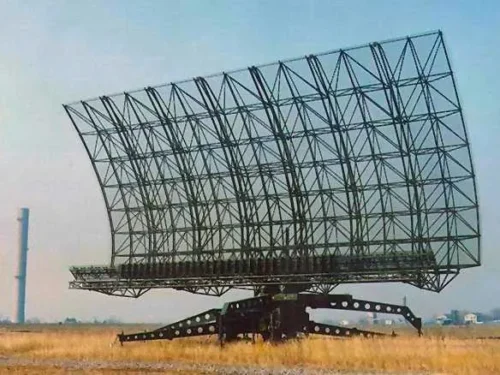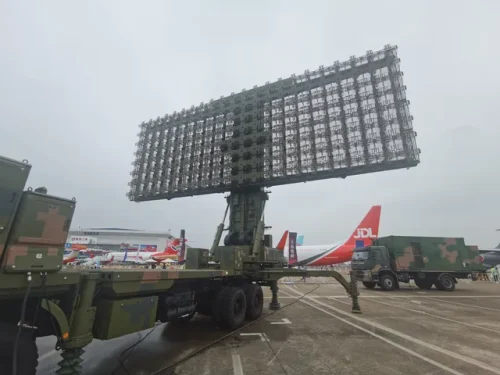


SLC-2E long-range multifunctional weapon positioning rada r(RA-3 arty locating radar) can not only be used for ground weapon positioning, but also can detect air targets. The SLC-2E radar is suitable for combat in a variety of battlefield environments, such as all-weather operations in deserts, mountains, and plains. Its high reliability, excellent performance, high maneuverability, ease of operation, and battlefield survivability can meet the needs of modern operations.
The SLC-2 Radar is a Chinese active electronically scanned array counter-battery radar designed to locate hostile artillery, rocket and ground-to-ground missile launchers immediately after firing, and to support friendly artillery by guiding counter-battery fire. SLC-2 radar can also be applied in adjusting firing of friendly weapons or rockets. With slight modification to software parameters the radar can also be used to detect and track low flying targets such as light aircraft, helicopters and UAVs. SLC-2 radar systems have sometimes been mounted on a Dongfeng EQ2102 3.5 ton truck.
Myanmar Army currently operating as many as 27 SLC-2 radar for artillery force.Bangladesh Bought two in 2012. Pakistan also operates significant number of SLC-2 Radar.
China has exported more than 100 sets of SLC-2 radar.
Specifications
S – band
Detection range: (for 80% detection probability against 81-mm mortar rounds sized target)
For artillery—35 km
For rockets—50 km
Accuracy: 0.35% of range (for range more than 10 km)
35 m (for range less than 10 km)
Peak power: 45 kW
Noise: 3 dB
Clutter improvement factor: 55 dB
Other features:
Active phased array antenna with electronic scanning both in azimuth and elevation
Sophisticated computer-controlled digital signal processing
Comprehensive online or offline BITE
Automatic/manual height correction with digital/video map
Various effective ECCM
Tracking while scanning

Myanmar artillery test SLC-2 radar photos

The SLC-2 radar equipped by the Bangladesh Army

SLC-2 radar equipped in Pakistan
Key Features and Capabilities
-
Passive Phased-Array Radar (PESA):
-
The SLC-2E uses a single central transmitter and a passive array of antenna elements to electronically steer its beam. This is a step more advanced than older mechanical radars but less complex than a full Active Electronically Scanned Array (AESA). It provides rapid beam steering and multi-target tracking capability without physically moving a large dish.
-
-
Weapon Locating Principle:
-
The radar detects incoming enemy shells or rockets in flight.
-
It then tracks their trajectory backwards using sophisticated software algorithms.
-
Within seconds, it calculates the point of origin (where the weapon was fired from) and the impact point (where the projectile will land).
-
This data is instantly relayed to friendly artillery units, enabling them to conduct lethal counter-battery fire to destroy the enemy launchers.
-
-
High Mobility and Rapid Deployment:
-
The entire system is mounted on a single 6×6 high-mobility truck, which provides the platform, power, and cabin for the crew.
-
It can deploy and begin operations within minutes, and just as quickly pack up and move (“shoot-and-scoot”) to avoid being targeted itself by enemy counter-radar missiles.
-
-
Multi-Target Engagement:
-
The system is capable of simultaneously tracking multiple incoming rounds from different weapons, allowing it to handle barrages and attacks from battery-sized units.
-
-
All-Weather, 24/7 Operation:
-
It provides a critical capability that is unaffected by darkness or most weather conditions, giving its users a major advantage over forces reliant on visual or acoustic locating methods.
-
Technical Specifications (Estimated)
| Feature | Specification |
|---|---|
| System Name | SLC-2E (Chinese Designation); RA-3 (NATO Reporting Name) |
| Developer | China Electronics Technology Group Corporation (CETC) |
| Role | Weapon Locating Radar / Counter-Battery Radar |
| Range | Mortars: ~25-30 km Artillery Shells: ~35-40 km Rockets: ~45-50 km (e.g., for MLRS like Grad) |
| Location Accuracy | ~35 meters CEP for launch point (estimated) |
| Number of Targets | Can track multiple projectiles simultaneously |
| Deployment Time | < 5 minutes (estimated) |
| Platform | Integrated on a 6×6 high-mobility truck |
Strategic Role and Purpose
The SLC-2E is a force multiplier that fundamentally changes the artillery duel:
-
Counter-Battery Fire: Its primary purpose is to enable friendly artillery to quickly and accurately suppress or destroy enemy artillery, mortar, and rocket positions.
-
Force Protection: By providing early warning of incoming fire and predicting impact points, it can warn troops to take cover, saving lives.
-
Artillery Dominance: Winning the “counter-battery fight” is key to winning the broader artillery battle. A force equipped with a system like the SLC-2E can shoot first and with devastating effect, forcing the enemy to constantly relocate or be destroyed.
-
Integration with MLRS: The targeting data provided by the SLC-2E can be directly fed to modern Multiple Launch Rocket Systems (MLRS) like the PHL-03 or A100, allowing them to engage enemy artillery positions with precision and overwhelming firepower.
Comparison to Other Systems
-
vs. U.S. AN/TPQ-53 (Q-53):
-
The American AN/TPQ-53 is a top-tier AESA counter-battery radar. The SLC-2E is a capable Chinese counterpart in the same category. The Q-53 has an AESA, which is more advanced than the SLC-2E’s PESA, offering potentially greater reliability and jamming resistance.
-
-
vs. Russian / Soviet Zoopark-1/2:
-
The Russian Zoopark-1 is a similar truck-mounted counter-battery radar. The SLC-2E is a more modern system with better software and likely greater accuracy and range.
-
-
vs. Earlier SLC-2 variants:
-
The SLC-2E is an export-oriented evolution of the original SLC-2 system used by the PLA. It features improved performance, mobility, and reliability.
-
Conclusion
The SLC-2E (RA-3) is not a weapon itself, but a critical “brain” for modern artillery forces. It turns artillery from an area suppression tool into a precision dueling weapon. Its ability to rapidly find and fix enemy artillery positions makes it one of the most feared and valuable assets on the battlefield. Its presence ensures that any enemy firing a mortar, howitzer, or rocket exposes itself to immediate and destructive counter-fire, granting its users a decisive advantage in the crucial counter-battery fight.