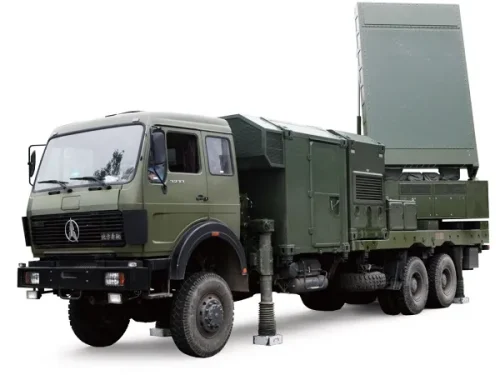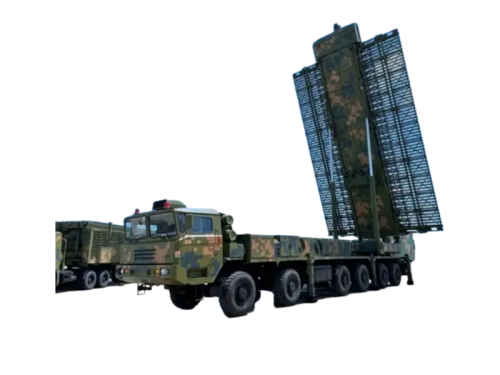

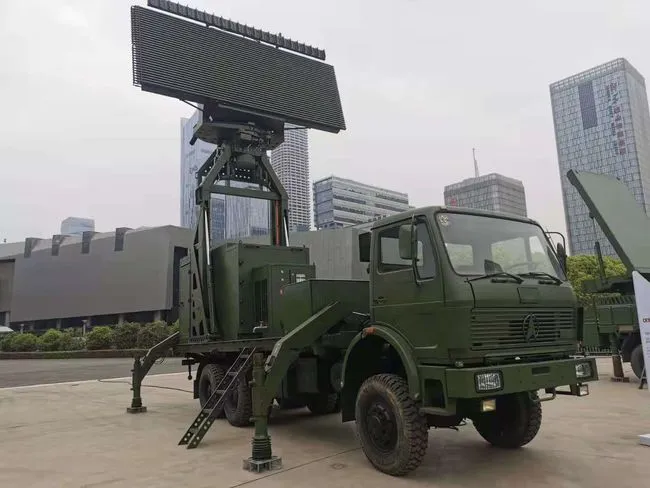
The reported system features are excellent low-altitude performance with high measurement accuracy, strong ECCM capability.
CETC YLC-18 radar is mainly used to detect all kinds of air targets, especially low altitude and ultra-low altitude targets such as helicopters, UAVs and cruise missiles. It can be used as low altitude blinding radar of land air defense network and target search radar of air defense weapon system.
CETC YLC-18 radar Specifications:
Coverage: (Pd = 80%, RCS = 2m2)
Range: ≥ 250km
Height: ≥ 12,000m
Elevation: 0º ~ 35º
Azimuth: 0º ~ 360º
Its detection range suggest instantaneous PRF of 600pps thus operational PRF of approx 400 is suspected.
Measurement accuracy: (rms)
Azimuth: ≤ 0.3º
Range: ≤ 100m
Height: ≤ 600m (within 200km)
Assembly/disassembly: 20mins/4 persons
MTBCF: ≥ 1,000 hrs
MTTR: ≤ 30 mins
In view of its 3D capability and potential to control aircraft and surface-to-air weapons, its likely frequency cover is shown, which is within the ITU regulated bands.


Key Features and Capabilities
-
S-Band Operation with Pulse Doppler:
-
Operating in the S-band (2-4 GHz) offers a excellent compromise between detection range, resolution, and resistance to weather attenuation.
-
It employs Pulse Doppler technology, which is essential for its mission. This allows it to:
-
Filter out ground clutter: By measuring the Doppler shift of moving targets, it can distinguish between stationary ground objects and moving aircraft, even when flying at very low altitudes.
-
Provide velocity data: It can measure the speed of a target, which is crucial for threat identification and weapon assignment.
-
-
-
3D Coverage:
-
The “3D” designation means it provides range, azimuth (direction), and altitude data for every target it tracks. This comprehensive picture is vital for command and control and for effectively vectoring interceptors or cueing air defense systems.
-
-
High Mobility and Rapid Deployment:
-
This is a core feature. The entire system is integrated onto a single high-mobility 4×4 truck. The antenna folds down for travel and can be deployed hydraulically in minutes.
-
This allows for a “shoot-and-scoot” tactic, where the radar can operate for a short period, pack up, and move before an enemy can locate and target it with anti-radiation missiles.
-
-
Electronic Counter-Countermeasures (ECCM):
-
The radar is equipped with modern ECCM features, such as frequency agility, adaptive processing, and low sidelobe levels, to maintain operation in intense electronic warfare (EW) environments where jamming is present.
-
-
Optimized for Low RCS Targets:
-
Its design and S-band frequency give it a better chance of detecting targets with a low radar cross-section (RCS), such as stealthy cruise missiles and drones, compared to higher frequency fire control radars.
-
Technical Specifications (Estimated)
| Feature | Specification |
|---|---|
| System Name | YLC-18 |
| Developer | China Electronics Technology Group Corporation (CETC) |
| Role | Mobile Low-Altitude Surveillance & Target Acquisition |
| Frequency Band | S-band |
| Range | Aircraft-sized target: ~150-200 km (est.) Low RCS targets (e.g., cruise missiles): ~50-80 km (est.) |
| Altitude Coverage | Very Low-to-Medium Altitude (Specialized for under 3,000-5,000m) |
| Mobility | Integrated on a single 4×4 high-mobility truck |
| Data | Provides Range, Azimuth, and Altitude (3D) |
| Technology | Pulse Doppler for clutter rejection |
Strategic Role and Purpose
The YLC-18 is designed to be a agile, survivable sensor that plugs a critical gap in air defense:
-
Low-Altitude Gap Filler: Large, long-range surveillance radars have a gap in their coverage close to the ground due to the curvature of the earth (radar horizon). The YLC-18 is deployed to specifically cover this blind spot, detecting pop-up threats that other radars might miss.
-
Forward Area Air Defense: Its high mobility makes it ideal for providing air defense surveillance for maneuvering army units. It can keep up with mobile forces and set up quickly to protect them from air attack.
-
Cruise Missile Defense: Its pulse Doppler capability and S-band frequency make it exceptionally well-suited for detecting and tracking small, fast, and low-flying cruise missiles.
-
Network Integration: It acts as a key node in an Integrated Air Defense System (IADS). It feeds its track data to command centers, which can then cue short-range air defense systems (like the HQ-17A) or fighter jets to engage the threats it detects.
Comparison to Other Systems
-
vs. YLC-12 (C-band): The YLC-12 is also a mobile medium-range radar but operates in C-band. The YLC-18’s S-band gives it better performance in adverse weather and potentially better detection characteristics against certain low-observable targets. They are complementary layers.
-
vs. JY-27A (VHF Band): The JY-27A is a long-range, counter-stealth early warning radar. The YLC-18 is a medium-range radar focused on the low-altitude fight and providing accurate, clutter-free tracks for engagement.
-
vs. Western Systems (e.g., GIRAFFE): The YLC-18 is conceptually similar to mobile S-band radars like the Saab GIRAFFE AMB (now part of the GIRAFFE family). Both are highly mobile, pulse Doppler radars designed to provide accurate low-level coverage for army formations and point defense.
Conclusion
The YLC-18 is a specialized and vital tool for modern air defense. It doesn’t have the extreme range of large warning radars or the pinpoint accuracy of an X-band fire control radar. Instead, it excels in the demanding and crucial mission of finding low-flying threats that are designed to avoid detection. Its combination of S-band pulse Doppler technology, 3D coverage, and exceptional mobility makes it a resilient and effective sentinel against some of the most dangerous modern aerial threats, ensuring that air defense networks have no weak spots at low altitude.