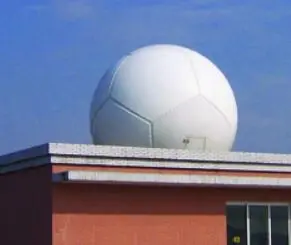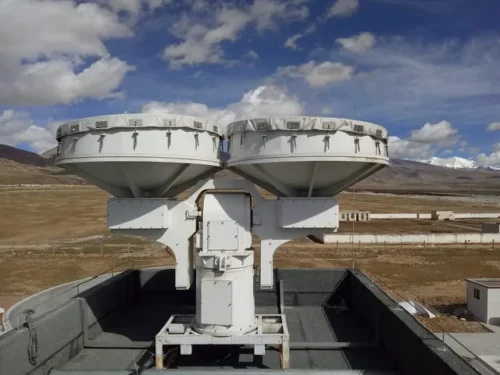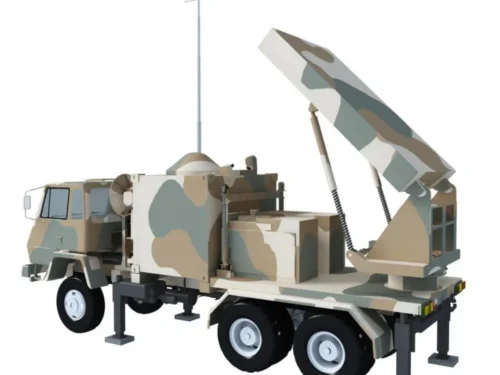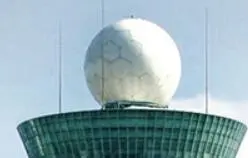


The GR-18CS C-band weather radar adopts an all-solid-state pulse Doppler system, which can not only improve the precision of precipitation measurement, eliminate clutter, but also have the ability to identify the phase state of water objects, and can obtain more information about the shape and phase state of precipitation particles It can measure the phase state and other characteristics of particles, and has real-time detection and alarm capabilities for small and medium-scale storms, hail, strong wind shear, cyclones, tornadoes, gale and other disastrous weather.
The radar is not only suitable for meteorological departments at all levels, but also has a wide range of applications in aviation, water conservancy and other fields.
The GR-18CS C-band weather radar adopts an all-solid-state pulse Doppler system, which can not only improve the precision of precipitation measurement, eliminate clutter, but also have the ability to identify the phase state of water objects, and can obtain more information about the shape and phase state of precipitation particles It can measure the phase state and other characteristics of particles, and has real-time detection and alarm capabilities for small and medium-scale storms, hail, strong wind shear, cyclones, tornadoes, gale and other disastrous weather.
The radar is not only suitable for meteorological departments at all levels, but also has a wide range of applications in aviation, water conservancy and other fields.
Main Feature
Fully coherent pulsed Doppler dual linear polarization regime;
High-gain, low-sidelobe dual-polarized antenna;
All-solid-state transmitter using third-generation semiconductor technology;
Low noise and large dynamic digital receiver;
High-speed digital signal processing and data processing technology;
Continuous operation around the clock;
With a full life cycle, low operation and maintenance costs;
Perfect automatic calibration and BIT function, unattended.
Main Specifications
Working frequency: 5300~5700MHz (dot frequency work)
Detection range: intensity monitoring distance ≥ 400km;
Intensity, velocity, polarization measurement distance ≥ 200km;
Output parameter measurement range: intensity: -15dBZ ~ +70dBZ;
Speed: -64m/s ~ +64m/s;
Spectral width: 0m/s ~ 16m/s.
Antenna scanning range: azimuth: 0°~360°;
Pitch: -1°~+92°.
Horizontal and vertical branch transmitter peak power (single channel): ≥3kW.
Antenna aperture: 4.5m/8.5m.
Output products: intensity (Z), velocity (V), spectral width (W), dual polarization parameters.
Power supply voltage: three-phase 380V±10%, 50Hz±5%.
Machine power consumption: ≤15kW.
Representative Specifications (indicative)
| Parameter | Value / Range | Notes |
|---|---|---|
| Frequency Band | C-Band (4–8 GHz) | High-resolution, medium-range weather radar |
| Polarization | Dual-linear | Horizontal & vertical measurement |
| Doppler Capability | Yes | Measures radial wind speed and storm motion |
| Maximum Range | ~200–250 km | Depending on antenna and atmospheric conditions |
| Antenna Type | Parabolic reflector or phased array | Rotating or fixed scanning options |
| Beamwidth | ~1° | High spatial resolution |
| Pulse Repetition Frequency | 250–1,200 Hz | Adjustable for range and resolution |
| Scan Modes | PPI, RHI, volumetric | Programmable scanning patterns |
| Data Output | Real-time digital | Compatible with meteorological software and networks |
| Power Supply | AC 220/380 V; optional mobile generator | Site dependent |
| Environmental Rating | -30°C to +50°C; waterproof and wind-resistant | Suitable for harsh environments |
| Mobility | Fixed, tower-mounted, or vehicle-mounted | Modular deployment options |
Key Features
-
C-Band Frequency: Provides optimal balance between range and resolution for meteorological applications.
-
Dual-Linear Polarization: Enables accurate identification of precipitation types (rain, snow, hail) and improves quantitative precipitation estimation.
-
All-Solid-State Design: Enhances reliability, reduces maintenance, and ensures continuous operation.
-
Doppler Capability: Measures radial wind velocity for real-time storm tracking and severe weather analysis.
-
High-Resolution Scanning: Detects fine meteorological structures, small-scale weather events, and hydrometeor types.
-
Flexible Deployment: Suitable for fixed installation, tower-mounted, or mobile platforms.
-
Advanced Signal Processing: Includes clutter suppression, echo classification, and volumetric scanning for comprehensive analysis.
-
User-Friendly Interface: Integrated software for visualization, reporting, and data management.
-
Remote Operation: Optional networked monitoring for centralized weather data integration.