
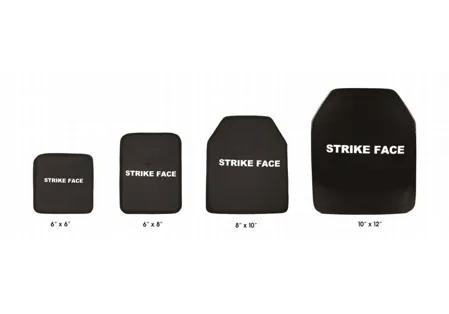
The Bulletproof Plate, also known as a ballistic plate or hard armor panel, is the critical component in modern body armor systems that stops high-velocity rifle rounds and armor-piercing (AP) threats — capabilities beyond the reach of soft body armor alone.
Used in military, law enforcement, tactical security, and civilian preparedness scenarios, these rigid plates are inserted into plate carriers, tactical vests, or backpacks to protect vital organs from lethal gunfire. Unlike soft armor (which deforms and catches bullets), hard plates shatter, deform, or decelerate incoming projectiles through advanced material science.
Modern bulletproof plates are engineered to meet strict international standards — primarily the NIJ 0101.06 (National Institute of Justice) — and come in standardized sizes such as:
- SAPI Cut (U.S. Military): 10″ x 12″ trapezoidal shape
- Shooter’s Cut: Beveled edges for better weapon handling
- Swimmer’s Cut: Rounded shoulders for enhanced mobility
- CCIR / IECEP: NATO standard (250 x 300 mm)
Made from ceramic composites, ultra-high-molecular-weight polyethylene (UHMWPE), or steel, each material offers unique trade-offs between weight, protection, multi-hit performance, and cost.
With the rise of rifle threats in active shooter events and asymmetric warfare, bulletproof plates have become essential for SWAT teams, executive protection agents, preppers, journalists in conflict zones, and frontline soldiers.
A single Level IV ceramic plate can stop a .30-06 M2 AP round — equivalent to defeating a WWII-era anti-tank rifle — making it one of the most life-saving inventions in modern personal protection.
Key Features
- Protection Levels (NIJ 0101.06):
- Level III: Stops 7.62×51mm NATO M80 Ball (147 gr @ 2,780 ft/s)
- Level IV: Stops .30-06 M2 AP (166 gr @ 2,850 ft/s) — the highest NIJ level
- Common Threats Defeated:
- 5.56×45mm M193 & M855 (AR-15)
- 7.62×39mm (AK-47)
- 7.62×51mm (.308 Winchester)
- .30-06 Springfield AP
- 7.62×54mmR (Dragunov)
- Materials:
- Ceramic Composite:
- Alumina (Al₂O₃), Silicon Carbide (SiC), or Boron Carbide (B₄C)
- Lightweight; shatters on impact to disperse energy
- Typically backed by UHMWPE or fiberglass
- Single-hit or limited multi-hit depending on design
- UHMWPE (Dyneema®, Spectra®):
- Ultra-light polymer fibers
- Flexible yet extremely strong
- Excellent blunt trauma reduction
- Vulnerable to heat (>180°F/80°C) and sharp objects
- Often multi-hit capable
- Steel:
- Hardened AR500 or AR550 steel
- Affordable and durable
- Heavy (~8–10 lbs per plate)
- Requires rubber coating to prevent ricochet spall
- Can be multi-hit, but may degrade after impacts
- Ceramic Composite:
- Weight Range:
- Ceramic: 4.0–5.5 lbs (1.8–2.5 kg) per 10″x12″ plate
- UHMWPE: 3.0–4.0 lbs (1.4–1.8 kg)
- Steel: 7.5–10.0 lbs (3.4–4.5 kg)
- Dimensions & Cuts:
- Standard: 10″ x 12″ (254 x 305 mm)
- Sizes: Small (8″x10″), Medium (9″x12″), Large (10″x12″), XL (11″x14″)
- Cuts: SAPI, Shooter’s, Swimmer’s, Rectangle
- Backface Signature (BFS):
- Maximum allowable deformation behind the plate: ≤44 mm
- Lower BFS = less blunt trauma = higher survivability
- Service Life:
- 5 years (or until impacted)
- Ceramic/UHMWPE: Inspect for cracks, moisture, or delamination
- Steel: Check for dents, rust, or coating damage
- Environmental Resistance:
- Must withstand humidity, temperature extremes, and UV exposure
- UHMWPE sensitive to prolonged heat (e.g., left in car)
- Certification:
- Must be NIJ 0101.06 certified and listed on the NIJ Compliant Product List (CPL)
- Independent lab tested (e.g., HP White Lab, Texas A&M)
Technical Specifications (Comparison of Top Plate Types)
| Parameter | Ceramic Composite | UHMWPE (Polyethylene) | Hardened Steel (AR500/550) |
|---|---|---|---|
| NIJ Level | III or IV | III or IV | III (AR500), IV (AR550) |
| Weight (10″x12″) | 4.2–5.5 lbs (1.9–2.5 kg) | 3.0–4.0 lbs (1.4–1.8 kg) | 7.5–10.0 lbs (3.4–4.5 kg) |
| Multi-Hit Capability | Limited (depends on design) | Good | Good (but spall risk) |
| Blunt Trauma (BFS) | Low to Moderate | Lowest | High (requires trauma pad) |
| Heat Sensitivity | Moderate | High (>80°C damages) | Low |
| Moisture Resistance | Good (if sealed) | Excellent | Poor (rust if uncoated) |
| Durability | Fragile (impact/crack risk) | Flexible, resilient | Very durable |
| Cost (per plate) | 250–400 | 300–500 | 100–200 |
| Lifespan | 5 years | 5 years | 5+ years (with maintenance) |
| Spall Risk | Low (with backer) | None | High (must use spall cover) |
| Best For | Military, LE, balanced weight/protection | Weight-sensitive users, long missions | Budget buyers, training, vehicle crews |
Operational Roles
- Military Combat: Frontline troops in Afghanistan, Ukraine, Gaza.
- Law Enforcement SWAT: Active shooter response, high-risk warrants.
- Tactical Security: Executive protection, VIP details, private military contractors.
- Civilian Preparedness: Home defense, bug-out bags, prepper kits.
- Vehicle Crews: Drivers and gunners in conflict zones.
- Journalists & Aid Workers: Protection in war-torn regions.
- School Safety: Ballistic panels for teachers and administrators.
- Range Training: Steel plates used as targets (non-certified).
Evolution & Innovation
- Historical Milestones:
- 1980s: First ceramic plates developed for U.S. military.
- 2000s: SAPI (Small Arms Protective Insert) fielded in Iraq/Afghanistan.
- 2010s: ESAPI (Enhanced SAPI) defeats .30-06 AP (Level IV).
- 2020s: Rise of lightweight UHMWPE and hybrid ceramic-poly designs.
- Survivability Impact:
- Over 90% effectiveness in stopping rifle threats when properly worn.
- Documented saves in Uvalde, Parkland, Las Vegas shooting.
- Future Trends:
- Graphene-reinforced composites – lighter and stronger.
- Self-healing materials – experimental polymers that reseal after impact.
- Active Armor – electromagnetic or reactive systems (in R&D).
- AI-optimized shapes – 3D-printed lattice structures for energy dispersion.
- Integrated sensors – impact detection, GPS, health monitoring.