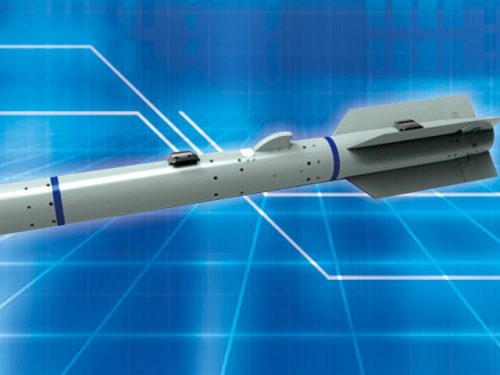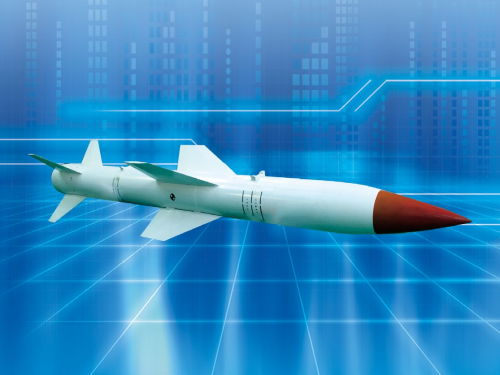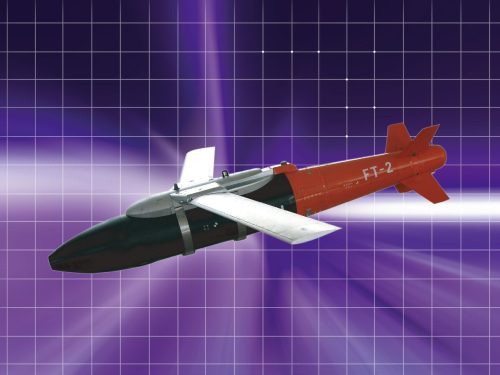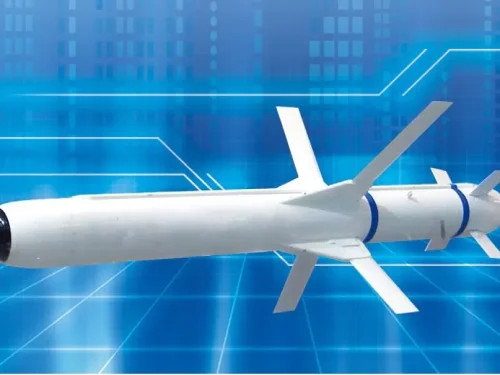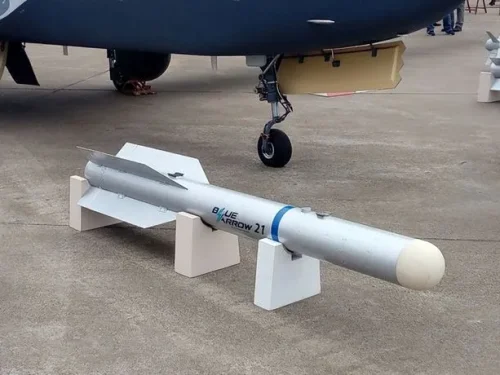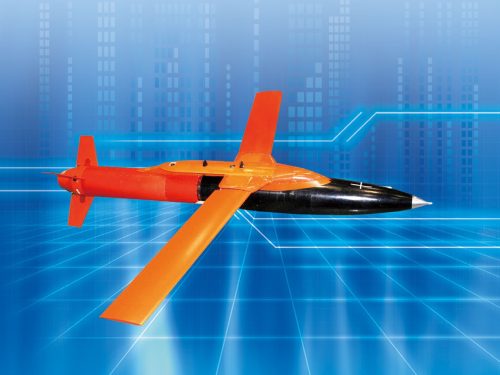


The AR-1 (Blue Arrow-1) is a laser-guided, anti-armor missile developed by China Aerospace Science and Industry Corporation (CASIC). It was one of the first missiles specifically designed in China to be integrated on Unmanned Combat Aerial Vehicles (UCAVs).
Key Characteristics and Capabilities:
-
Guidance System: It uses Semi-Active Laser Homing (SALH). This means it requires a laser designator to “paint” or illuminate the target for the entire duration of the missile’s flight until impact. The laser can be provided by the UCAV itself, another aircraft, or ground forces.
-
Implication: This is not a “fire-and-forget” weapon. The platform must maintain a line-of-sight to the target, which can put it at risk in contested environments.
-
-
Warhead: It features a tandem-charge High-Explosive Anti-Tank (HEAT) warhead. This is designed specifically to defeat armored vehicles by first detonating any explosive reactive armor (ERA) and then penetrating the main armor beneath.
-
Range: It has an effective range of approximately 8 to 10 kilometers (5 to 6 miles). This provides a useful stand-off distance for the UCAV, keeping it away from light air defenses and small arms fire.
-
Launch Platform: Its primary platform is the CAIG Wing Loong I (Pterodactyl I) UCAV. The missile’s size and weight (around 45 kg / 100 lb) were designed to be carried by medium-altitude, long-endurance (MALE) drones. A Wing Loong I can typically carry two AR-1 missiles per mission.
Comparison with its Successor (AR-2) and Similar Weapons:
The AR-1 is a first-generation system that was quickly improved upon. The key differences between it and the AR-2 are in guidance and versatility.
| Feature | Chinese AR-1 | Chinese AR-2 | US AGM-114K Hellfire II |
|---|---|---|---|
| Guidance | Semi-Active Laser (SALH) | Laser, IIR, or GPS/INS | Semi-Active Laser (SALH) |
| Warhead | Tandem HEAT (Anti-Armor) | 20 kg Blast/Fragmentation (Multi-Purpose) | Tandem HEAT (Anti-Armor) |
| Primary Role | Anti-Tank, Anti-Armor | Multi-Purpose (Soft targets, light armor, structures) | Anti-Tank, Anti-Armor |
| Fire-and-Forget | No | Yes (with IIR seeker) | No |
-
vs. the AR-2: The AR-1 is more specialized. Its tandem HEAT warhead makes it excellent for destroying tanks and armored personnel carriers but less optimal for attacking buildings, bunkers, or groups of personnel. The AR-2’s multi-purpose warhead and more advanced seeker options (especially the fire-and-forget IIR) make it a far more versatile and modern weapon.
-
vs. the Hellfire: The AR-1 is China’s direct analogue to the original laser-guided AGM-114 Hellfire. They are very similar in size, weight, role, and guidance technology. The AR-1 was developed to ensure Chinese UCAVs had a weapon equivalent to what Western drones were using.
Strategic Significance and Current Role:
The AR-1 was significant because it:
-
Pioneered Chinese UCAV Armament: It was a critical enabling technology that turned Chinese surveillance drones into armed, hunter-killer platforms.
-
Proved a Concept: Its development and successful integration on the Wing Loong I proved there was a domestic demand and export market for armed Chinese drones.
-
Built a Foundation: The lessons learned from the AR-1 were directly applied to the development of the more capable and versatile AR-2.
Current Status: While still in service, the AR-1 is now considered a first-generation system. It has been largely superseded by the AR-2 for most missions due to the AR-2’s superior flexibility. The AR-1 remains a potent anti-armor option, but the multi-role AR-2 is the preferred and more widely advertised missile for current-generation Chinese UCAVs like the Wing Loong II.
In summary, the AR-1 is a foundational, laser-guided, anti-tank missile that provided China’s emerging UCAV fleet with its initial precision strike capability. It is a capable weapon in its specific anti-armor role but has been overshadowed by its more advanced and versatile successor.