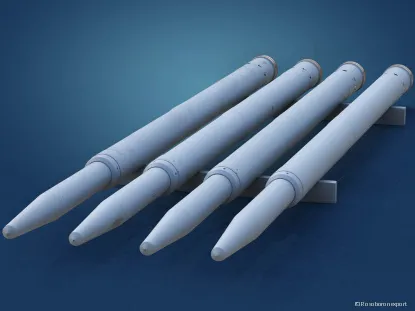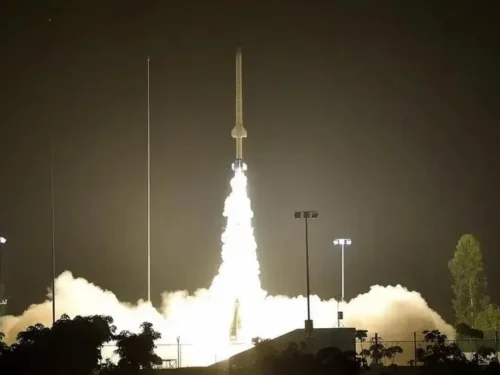

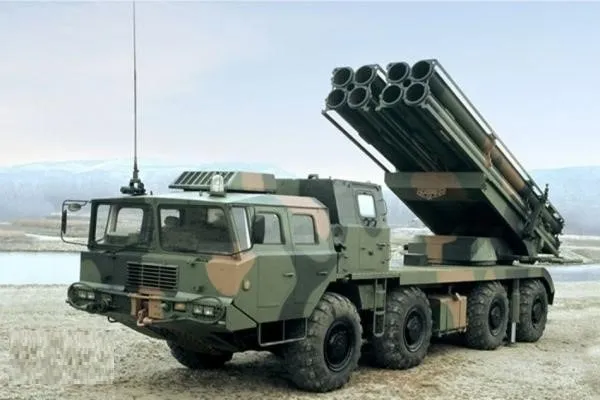
The A300 rocket is one of the latest Chinese artillery rocket systems. Recently a large number of new artillery rocket systems of various calibers were developed in China. Actually the A300 is an export name. It is a further development of the A200. The new system has increased range of fire. It is being proposed for export customers.
The A300 rocket is designed to attack important area targets well behind the enemy lines. Such heavy artillery rocket systems are extremely effective against large area targets, such as concentration of troops or armored vehicles, artillery and air defense batteries, airfields, command posts, ammunition depots, support facilities and other important military targets. Due to its range and powerful warhead the A300 might be one of the deadliest artillery rocket systems in the world.
The A300 rocket has a maximum range to 290 km, opposed to 200 km of the earlier A200. The A300 has a larger engine than its predecessor. Currently this Chinese artillery rocket system has the longest range in the world.
The A300 rocket carries a 150 kg warhead. It is believed that several types of warheads are available.
Rocket of the A300 rocket has inertial and GPS guidance. CEP is about 30 to 45 meters. So these rockets are very accurate even at maximum range. It has been reported that these rockets maneuver in flight in order to overcome air defenses.
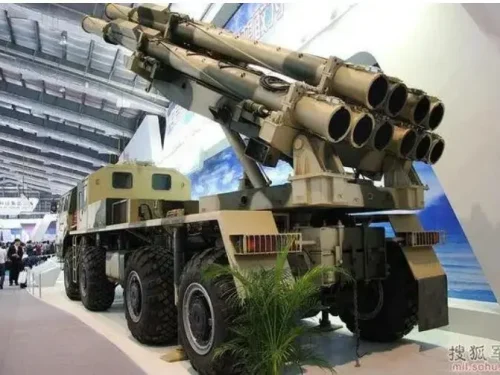
Launcher is capable of single or salvo firing. It takes 50 seconds to launch a full salvo of 8 rockets. It is claimed that each rocket can be targeted individually. So the A300 can hit up to 8 different targets simultaneously.
Representative Specifications (indicative for procurement / tender)
Parameter |
A300 (standard) |
A300-ER (extended-range) |
A300-P (precision-capable) |
Notes |
|---|---|---|---|---|
| Rocket diameter | 300 mm | 300 mm | 300 mm | Common caliber across family |
| Rocket length (approx.) | ~3.2 m | ~4.2 m | ~3.2–4.2 m | Length varies with motor/booster |
| Typical warhead types | HE-frag, fragmentation, smoke, illumination, training | Same | Same + guided warheads | Warhead suite per customer requirements |
| Typical warhead weight | 25–80 kg | 30–120 kg | 25–120 kg | Wide range depending on warhead choice |
| Indicative max range | 30–70 km | 60–200 km | 30–200 km (with guidance) | Range depends on motor, booster, and guidance |
| Guidance options | Unguided (standard); optional GPS/INS | Optional GPS/INS / glide kits | GPS/INS + terminal seeker options | Precision kits sold per licensing rules |
| Launch tubes / pods | Modular pods, e.g., 4–8 tubes per pod | Same | Same | Pod and tube count configurable |
| Launcher pods per vehicle | 1–4 (typical) | 1–4 | 1–4 | Chassis- and mission-dependent |
| Rate of fire | Salvo-configurable (per-pod) | Salvo-configurable | Salvo-configurable | Firing profiles provided under contract |
| Reload method | Quick-swap pods / vehicle-assisted loaders | Same | Same | Optional semi-automatic loaders available |
| Typical crew | 3–6 | 3–6 | 3–6 | Includes vehicle crew and reload/maintenance team |
| Electrical interface | Vehicle 24 V DC / optional APU | Same | Same | Standard military power interface |
| Environmental design | Field-grade; ruggedized for transport/storage | Same | Same | Environmental specs per contract |
| Transportability | Tactical truck, trailer, or containerized for strategic lift | Same | Same | Platform dependent |
Key Features and Capabilities
-
-
Ultra-Long Range:
-
This is the A300’s defining characteristic. It boasts a maximum range of approximately 290-300 kilometers. This carefully places it just under the 300km threshold of the Missile Technology Control Regime (MTCR), making it more easily exportable while providing devastating reach.
-
-
Exceptional Precision:
-
The A300 features a highly sophisticated guidance system. It uses a combination of:
-
Inertial Navigation System (INS) for mid-course guidance.
-
Beidou (BDS) / GPS Satellite Guidance for course correction.
-
Optional Terminal Seekers for final targeting. This can include infrared (IR) or radar seekers, enabling it to engage moving targets, such as vehicles or even ships at sea.
-
-
This system achieves a reported Circular Error Probable (CEP) of less than 30 meters, and potentially under 10 meters with terminal guidance.
-
-
Advanced Aerodynamic Design:
-
The rocket features a sleek, streamlined design with a reduced-diameter body and a bulged warhead section, optimizing it for long-distance flight and stability. It is a completely new rocket, not just an upgrade of the A200.
-
-
Launch Platform and Salvo Size:
-
The system is integrated onto an 8×8 high-mobility truck for excellent strategic mobility.
-
The launcher carries 8 rockets in two pods of 4, maintaining the same form factor as the A200 but firing a much more powerful rocket.
-
-
Multi-Role Warheads:
-
The A300 can be equipped with a variety of warheads to suit different missions:
-
Unified Blast-Fragmentation: For soft targets and area effects.
-
Cluster Munitions: For engaging dispersed personnel or light vehicles.
-
Armor-Piercing Submunitions: For defeating armored formations.
-
Thermobaric: For structures and fortified positions.
-
-
-
The terminal guidance option allows it to function as a poor-man’s cruise missile.
The A300 is not merely an artillery rocket system; it is a strategic-level precision strike weapon. It represents the culmination of a decades-long evolution in rocket technology, where increased range and precision have fundamentally transformed a weapon of area saturation into a tool for executing precise, strategic effects deep within an adversary’s territory. Its existence signals a shift in modern warfare where long-range firepower is increasingly accessible and decisive, challenging traditional dominance by air forces and ballistic missiles.