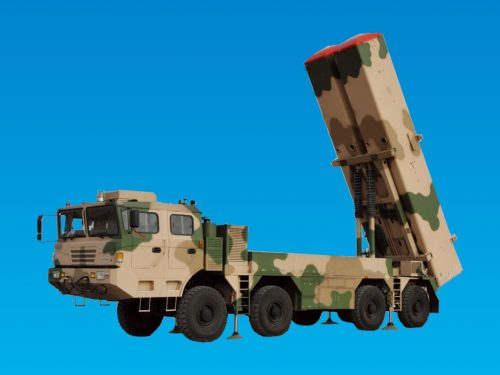

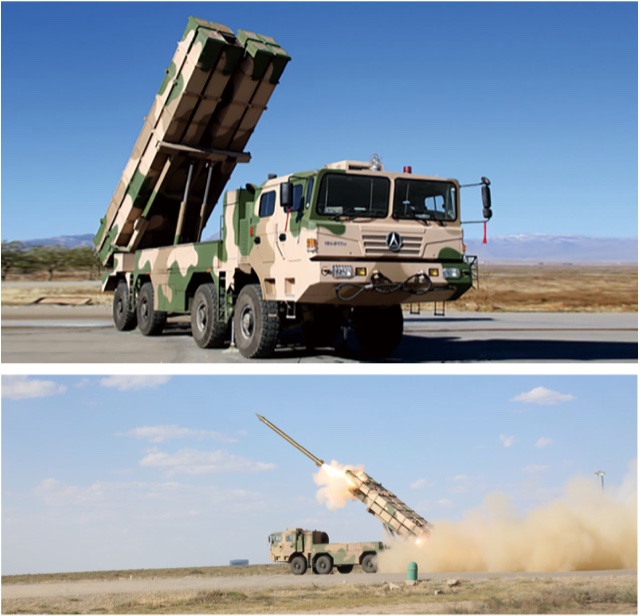
The A100G is a 300mm caliber precision-guided rocket system developed by China Aerospace Science and Technology Corporation (CASC), the main competitor to CASIC (which makes the WS-series). The “G” suffix denotes its guided capability. It is designed as a direct competitor to systems like the Russian Smerch and, more importantly, the American M270 MLRS and M142 HIMARS that fire standard GMLRS rockets.
Key Features and Capabilities
-
Caliber and Compatibility:
-
The A100G uses a 300mm rocket, the same caliber as the Russian 9K58 Smerch system. This allows it to fire older, unguided 300mm rockets from the base A100 system, providing logistical flexibility and a upgrade path for existing users.
-
-
Precision Guidance:
-
The “G” model introduces a guidance package to the rocket, transforming it from an area saturation weapon into a precision strike asset.
-
It uses a combination of Inertial Navigation System (INS) and GPS/BeiDou (BDS) satellite guidance, achieving a reported Circular Error Probable (CEP) of 30-45 meters. This allows it to engage point targets like vehicles, structures, and command posts effectively.
-
-
Range:
-
The guided A100G rocket has an estimated maximum range of approximately 100 kilometers, which is a significant increase over the unguided version and is competitive with the standard GMLRS (70km+).
-
-
Launch Platform and Salvo Size:
-
The system is typically integrated onto an 8×8 high-mobility truck.
-
The launcher carries 10 rockets in two pods of 5, giving it a larger salvo size than the 6-rocket pod of the HIMARS/M270, but on a par with the Smerch.
-
-
Variety of Warheads:
-
Like other modern MLRS, it can be equipped with a variety of warheads, including:
-
High-Explosive Fragmentation (HE-Frag)
-
Cluster Munitions (with anti-personnel or anti-armor submunitions)
-
Thermobaric
-
Precision-guided submunitions or terminally guided seeker kits for even higher accuracy against moving targets (a capability that has been demonstrated in later variants).
-
-
The A100G MLRS, which configured with A120 rocket and A150 rocket, is designed to suppress, neutralize, delay, or destroy various point targets and concentrated groups of targets within a range of 40-150km. The rockets adopt full course inertial/multimode-satellite combined guidance system, and have a certain maneuverability during the flight.
TECHNICAL SPECIFICATIONS
A120 rocket |
A150 rocket |
|
| Range | 45-110 km | 55-145 km |
| Accuracy | CEP ≤ 30 (Unitary warhead) CEP ≤ 45 (Cluster warhead) |
|
| Weight of Warhead | 260 kg | 190 kg |
| Take-off Mass | 810 kg | |
| Length of Rocket | 7,200 mm | |
| Diameter of Rocket | Φ310 mm | |
| Guidance Mode | INS+GNSS(BDS/GPS/GLONASS) | |
| Type of Warhead | Unitary blast Unitary fragmentation Fragmentation cluste |
|
| Maneuverability of Rocket | 2 × 2 km | |
| Function of Canister | Storage,transportation,launching | |
| Launching Readiness Time | ≤ 6min From launching vehicle driving to the launch site |
|
| ≤ 2 min From horizontal ready-to-launch status to launch |
||
| ≤ 0.5 min From oblique ready-to-launch status to launch |
||
| Loading Quantity | 8 per vehicle | |
| Launch Mode | Vehicular oblique hot launch without preset position | |
Typical Applications
-
Area suppression and interdiction
-
Obscuration (smoke) and illumination missions
-
Live-fire training with inert/practice munitions
-
Rapid concentrated indirect fires in mobile operations
Representative Specifications (indicative for procurement / tender)
Parameter |
A100G (base) |
A120 (mid-range) |
A160 (extended) |
Notes |
|---|---|---|---|---|
| Rocket length (approx.) | ~3.0 m | ~3.6 m | ~4.2 m | Length influences propellant and range |
| Warhead types | HE-frag, fragmentation, smoke, illumination, training | Same | Same | Customer-specified loadouts available |
| Typical warhead weight | 20–50 kg | 30–70 kg | 40–90 kg | Dependent on warhead selection |
| Indicative max range | 20–45 km | 30–70 km | 40–100 km | Range varies by motor and guidance |
| Guidance options | Unguided (standard); optional GPS/INS | Optional GPS/INS | GPS/INS + terminal options | Precision kits per customer policy |
| Launcher pods per vehicle | 1–4 | 1–4 | 1–4 | Chassis dependent |
| Typical crew | 3–5 | 3–5 | 3–5 | Includes driver, commander, reload crew |
| Electrical interface | Vehicle 24 V DC / APU option | Same | Same | Standard military interface |
| Reload method | Vehicle-assisted / modular pods | Vehicle-assisted | Vehicle-assisted | Loader equipment affects time |
| Environmental design | Field-grade, MIL-like transport/storage handling | Same | Same | Details per contract |
| Transportability | Tactical truck, trailer, or containerized | Same | Same | Platform dependent |
Configurations & Options
-
Basic Kit: Launcher, mounting frames, manual interfaces, spares
-
Reload Assistance: Semi-automatic loaders, pod adapters
-
Precision Upgrade: GPS/INS modules, mission planning software, insulated warhead options
-
Training Package: Inert rounds, simulation software, instructor training
-
Logistics Support: Spare parts package, test/calibration gear, technical documentation
Strategic Role and Purpose
The A100G is designed as a corps-level fire support asset to provide long-range, precision firepower:
-
Counter-Battery Fire: Destroying or suppressing enemy artillery and rocket systems.
-
Deep Strike: Engaging tactical targets behind the front lines, such as troop concentrations, assembly areas, supply convoys, and command posts.
-
Air Defense Suppression: Attacking air defense systems and radar sites.
-
Interdiction: Disrupting enemy movements and logistics by striking chokepoints, bridges, and routes.
Comparison to Other Systems
-
vs. U.S. M142 HIMARS (GMLRS):
-
HIMARS (GMLRS): 227mm caliber, 6 rockets per launcher, ~70-150km range, exceptional accuracy (<10m CEP). Highly modular launcher.
-
A100G: 300mm caliber, 10 rockets per launcher, ~100km range, good accuracy (30-45m CEP). Larger warhead per rocket but less accurate.
-
Key Difference: The A100G prioritizes larger salvos and larger warheads, while GMLRS prioritizes extreme precision and modularity.
-
-
vs. Russian 9K58 Smerch:
-
The A100G is a modernized, guided evolution of the Smerch concept. It offers similar firepower but with dramatically improved accuracy, making it a more efficient and effective system.
-
-
vs. Chinese WS-3A:
-
WS-3A (CASIC): 400mm caliber, much longer range (200-300km), more akin to a SRBM.
-
A100G (CASC): 300mm caliber, shorter range (~100km), designed for tactical rather than strategic fire support.
-
This highlights the competition and different design philosophies between China’s two major aerospace defense giants.
-
Conclusion
The A100G is a modern, capable precision-guided rocket system that fills the crucial “tacticallong-range fire” niche. It doesn’t aim for the extreme range of the WS-3A or the anti-ship capability of the WS-64. Instead, it provides a reliable, powerful, and accurate solution for defeating tactical targets on the modern battlefield, directly competing with Western systems like HIMARS and upgrading the legacy capabilities of Soviet-era systems like the Smerch. It is a workhorse system intended for export and for use within the PLA to provide heavy fire support at the corps level.